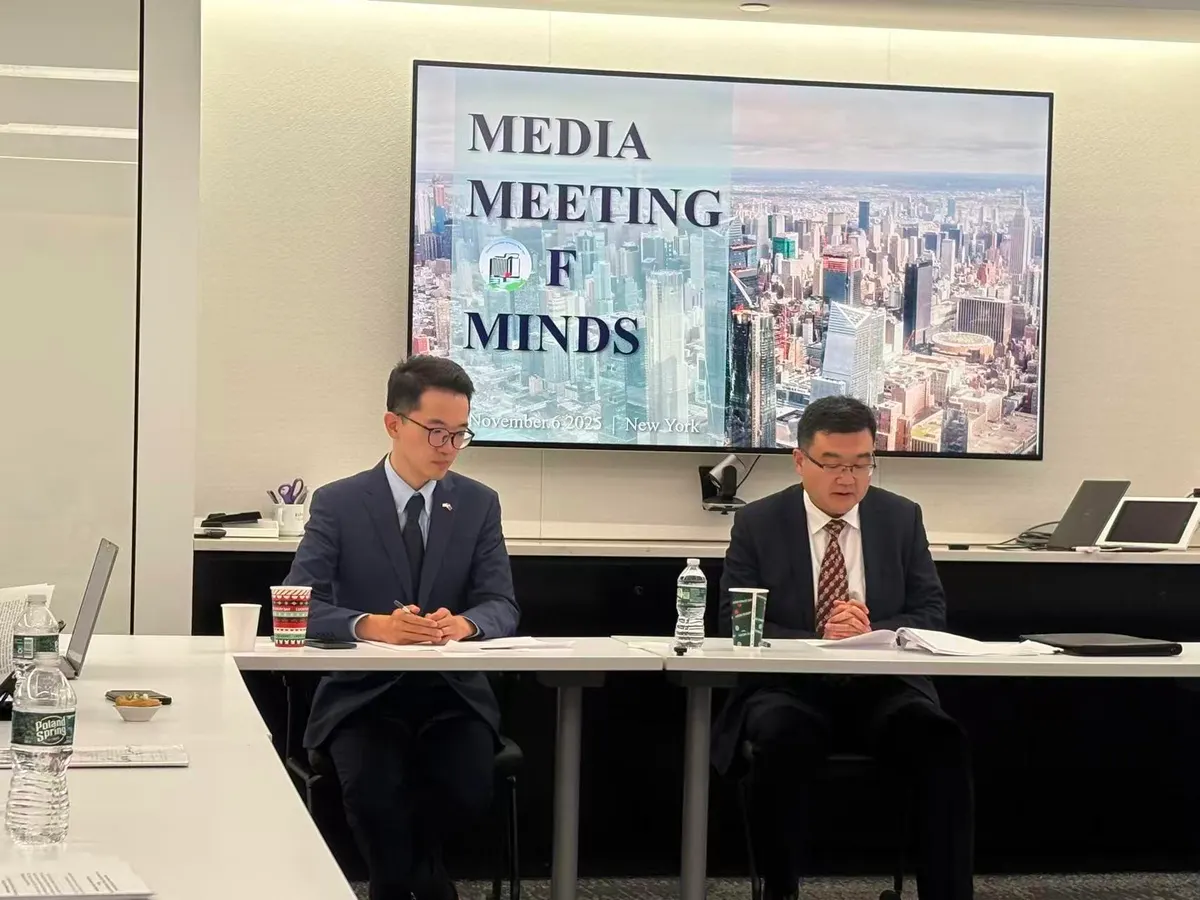
Ma Xiaoxiao, deputy consul general at China’s Consulate General in New York, and consul Zhao Yunzhe, met with reporters in Manhattan last Thursday.
Russell Flannery
China, the world’s No. 2 economy, will aim for increased technological self-reliance during the country’s upcoming five-year plan to be launched next year, a Foreign Ministry official said at a media briefing in New York last Thursday.
“China will focus on the main goals of economic and social development during the 15th Five-Year Plan period, achieving significant results in high-quality development (and) substantially improving the level of technological self-reliance and self-strengthening,” New York Consulate Deputy Consul General Ma Xiaoxiao told a briefing of more than a dozen journalists from U.S. and Chinese media.
The gathering, billed as offering insights into the outlook for China’s development and U.S.-China high-level exchanges, followed up on a key Communist Party meeting in Beijing last month. Ma’s comments were in line with recommendations adopted at that plenum session of party leaders in October.
Ma noted that a substantial percentage of growth in China’s GDP this year will come from its digital economy. The country has ranked first in the world in both the number of high – level international journal papers and international patent applications for five straight years, he said. “The shift from ‘demographic dividend’ to ‘talent dividend’” from China’s large population “provides continuous momentum for innovation-driven development,” Ma noted.
“Innovation momentum continues to strengthen. Scientific and technological innovation leads the transformation and upgrading of the entire industrial chain. Breakthroughs in emerging industries such as artificial intelligence, 5G communication, new energy, and biomedicine are significant,” he said.
Notable Chinese tech leaders from the world of AI and semiconductors debuted on the 2025 Forbes China Rich List unveiled last week. Liang Wenfeng, founder of homegrown AI firm DeepSeek, ranked at No. 34 with a fortune worth $11.5 billion. Zhou Chaonan, founder of data center operator Range Intelligent Computing Technology Group, also debuted at No. 85 with an estimated fortune worth $5.3 billion. The collective net worth of the members of the 2025 Forbes list of China’s 100 Richest rose by $320 billion from last year to $1.35 trillion. Helped in part by tech stocks, China’s benchmark CSI 300 index gained 15% from a year earlier.
Underscoring China’s growing tech clout, AI firm DeepSeek’s founder Liang Wenfeng debuted on the Forbes China Rich List last week with an estimated fortune of $11.5 billion. (Photo by VCG/VCG via Getty Images)
VCG via Getty Images
While calling out room for collaboration in U.S.-China ties, Ma also noted that “frequent global geopolitical conflicts, the rise of unilateralism, and severe challenges such as ‘decoupling and cutting off’ of the industrial chain are imminent.” U.S. President Donald Trump and Chinese President Xi Jinping met in South Korea on the sidelines of an APEC summit on Oct. 30; Trump described the meeting as “amazing” and rated it a “12 out of 10.”
Speaking in New York, one of the world’s top capitalist hubs, the Chinese diplomat lauded China’s socialist system. “The socialist system with Chinese characteristics ensures the smooth implementation of policies from top to bottom and the ability to concentrate resources to accomplish major tasks, demonstrating significant effectiveness in tackling key core technologies, implementing major projects, and responding to risks,” Ma said.
“The combination of an efficient market and an active government form an economic order that is ‘both dynamic and well-regulated,’ ensuring the precision and effectiveness of macro policies,” he said.
