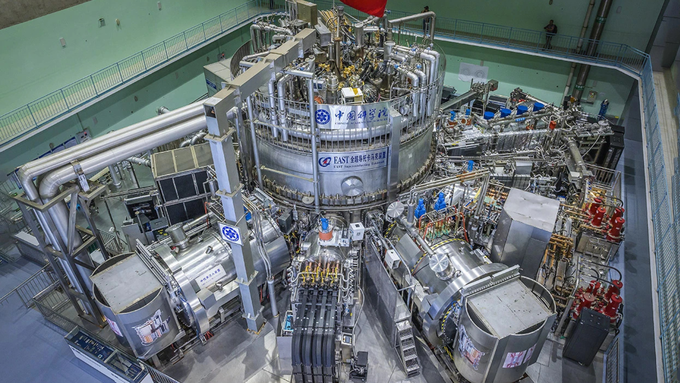
The superconducting magnet for the China Fusion Engineering Test Reactor (CRAFT), which supports the Experimental Advanced Superconducting Tokamak (EAST), known as the “artificial sun,” recently passed development acceptance and full-parameter testing.
The CRAFT project aims to recreate the nuclear fusion process that powers the sun by generating plasma at temperatures exceeding 100 million degrees Celsius inside a doughnut-shaped reactor.
The system has two key components: a toroidal-field coil that creates a powerful magnetic field to keep the superheated plasma away from the reactor walls, and a central solenoid that initiates and controls the plasma current.
The toroidal-field coil is the reactor’s largest and most important superconducting magnet. Measuring 21 meters long, 12 meters wide and 3.3 meters high, it weighs 582 metric tons. It has 1.3 times the volume and three times the energy storage capacity of the corresponding magnet used in the International Thermonuclear Experimental Reactor under construction in southern France, making it the largest superconducting magnet of its kind ever built.
 |
|
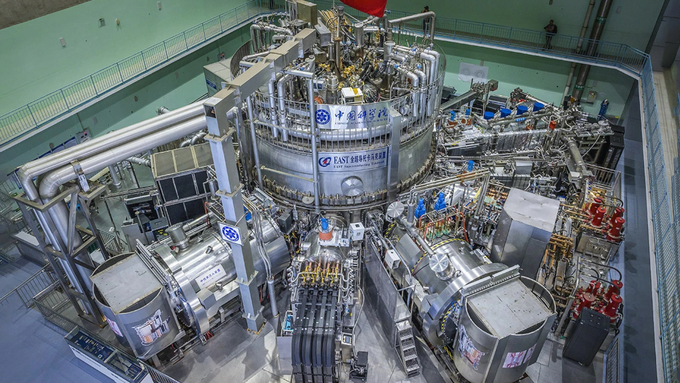
EAST fusion-research tokamak at the Chinese Academy of Science’s Institute of Plasma Physics (ASIPP) in Hefei, China. Photo courtesy of ASIPP |
Institute director Song Yuntao told the South China Morning Post that the coil took six years to develop and has the highest energy storage capacity of any comparable magnet worldwide. He said its specialty steel, insulation materials and superconducting wires were all produced in China.
Researchers also completed testing of the high-temperature superconducting central solenoid, which acts as the reactor’s igniter by initiating plasma currents and continuously adjusting the magnetic field to keep the plasma stable during operation.
Song said the successful development of the two superconducting components strengthens China’s capabilities in fusion reactor engineering and enhances the country’s independent research, manufacturing and engineering capacity for future fusion facilities.
Song Zhongping, a Chinese technology expert with a background in electromagnetic research, told the Global Times that both superconducting magnets are indispensable to controlled nuclear fusion reactors.
He said the significance of developing the equipment domestically extends beyond the project itself because it establishes complete industrial supply chains for both low- and high-temperature superconducting technologies, supporting broader advances across China’s manufacturing sector.