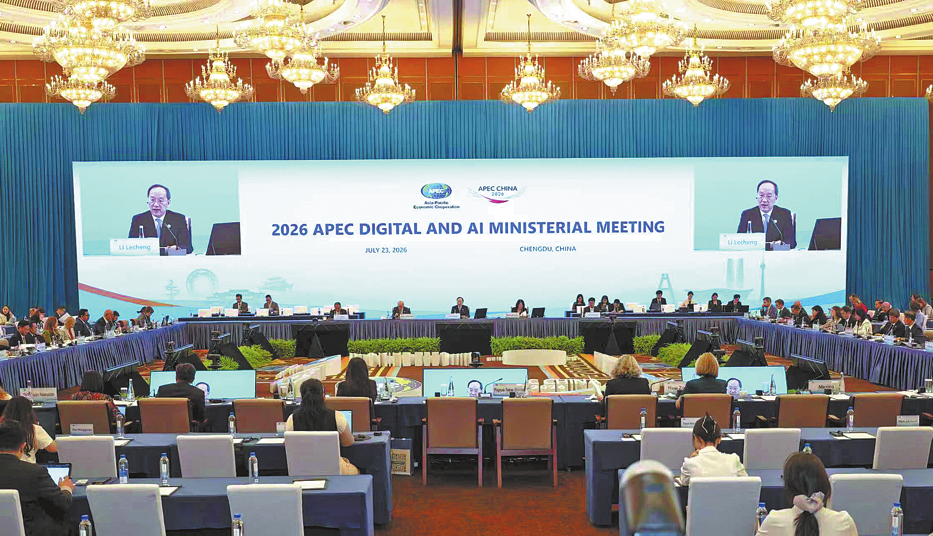
China stands ready to deepen cooperation with other APEC economies in the digital economy and artificial intelligence sectors, and to actively promote joint standards-setting, rulemaking and industrial development, said the country’s top industry regulator on Thursday.
China’s Minister of Industry and Information Technology Li Lecheng also called for greater exchanges and collaboration in talent, knowledge and technology, as well as cooperation in open-source technologies, to build a competitive and open innovation ecosystem.
His remarks came at the 2026 APEC Digital and AI Ministerial Meeting held in Chengdu, Sichuan province, which concluded the same day as the adoption of an important declaration, which serves as a key framework charting the course for regional cooperation in digital and AI development over the coming years.
The meeting brought together ministers and senior officials from Asia-Pacific economies to discuss shared pathways toward harnessing digital intelligence for sustainable and inclusive growth.
The ministerial discussions centered around three themes: strengthening digital and AI empowerment for development, enabling universal and meaningful digital connectivity, and supporting digital inclusion and skills upgrading.
Li said that as part of the outcomes of the meeting, a broad consensus emerged that digital intelligence-driven innovation is a powerful engine for growth, with AI and digital technologies unlocking vast potential for productivity gains across the region.
Moreover, participants deepened their recognition of the need to guard against risks — while AI brings immense opportunities, its inherent and derivative hazards must be seriously addressed through policy dialogue and the sharing of best practices to ensure a safe, reliable and resilient environment.
Meanwhile, the meeting reaffirmed that cooperation is the only path to shared prosperity.
“The history of Asia-Pacific prosperity and development shows that cooperation is the only path to progress, and that non-cooperation poses the greatest risk. Decoupling and disrupting supply chains benefits no one,” Li said, adding that the fact that Asia-Pacific economies gathered in Chengdu reflects a shared commitment to win-win cooperation and a willingness to complement each other’s strengths.
“Through exchanges and mutual learning, we will inspire innovation and pursue common development by enabling each other’s success.”
He added that ministers attending the meeting are also committed to promoting inclusive and universal access by building digital and AI infrastructure, bridging the digital divide and extending the benefits of technology to industry, agriculture, healthcare, education, transport and culture.
Eduardo Pedrosa, executive director of the APEC Secretariat, praised China’s active role in advancing regional connectivity.
Pedrosa said that China has invested heavily in broadband and technology deployment, leapfrogging from 3G to 4G to 5G. “China has put a great deal of emphasis on the application of 5G and connectivity,” he said, citing a sub-fund China created for APEC to explore how AI can be used for sustainability and greener development — including emissions reductions and applications in healthcare and education.
Addressing the significant digital disparities among APEC economies, Pedrosa stressed that the organization’s strength lies in sharing best practices and promoting interoperability rather than imposing a single model.
While solutions like satellite connectivity are increasingly explored to reach rural and remote areas, Pedrosa said a large segment of the population still lacks internet access, making policy learning and tailored approaches essential.
He also highlighted Chengdu’s unique blend of ancient heritage and modern tech dynamism. “Chengdu has been one of the first cities in China to really open up and has now had a focus on technology,” he said, pointing to its critical mass of research institutions, universities and businesses that form a cluster of talent and innovation.
Zhao Wenqiao, deputy head of the Sichuan Provincial Department of Economy and Information Technology, revealed that the province now hosts over 1,900 AI companies, with industry revenue exceeding 190 billion yuan ($28 billion) last year. More than 70 key tech breakthroughs have been achieved, and a range of industrial large models and original smart robotics products are being rolled out at an accelerated pace.

