In 1984, Warren Buffett asked a simple question that is still extremely relevant to traders today:
If the success of great investors is nothing more than luck, why did so many of them come from the same school of thought?
This question lies at the heart of Buffett’s famous essay:
The Superinvestors of Graham-and-Doddsville
But the most important lesson for a modern trader isn’t Buffett himself.
It’s the way he thinks.
🎯 First, Forget One Big Misconception
Many traders believe that success means being able to predict the future.
For example:
“Bitcoin is definitely going to dump tomorrow.”
Or:
“This stock is definitely going to the next resistance.”
But the market isn’t a place for fortune-telling.
Nobody knows the future with certainty.
A professional trader isn’t someone who is always right.
A professional trader is someone who:
makes money when the thesis is right,
and protects capital when the thesis is wrong.
That difference is far more important than finding a magical indicator.
🧠 The Famous Coin-Toss Example
Buffett used a very simple example to illustrate an important argument.
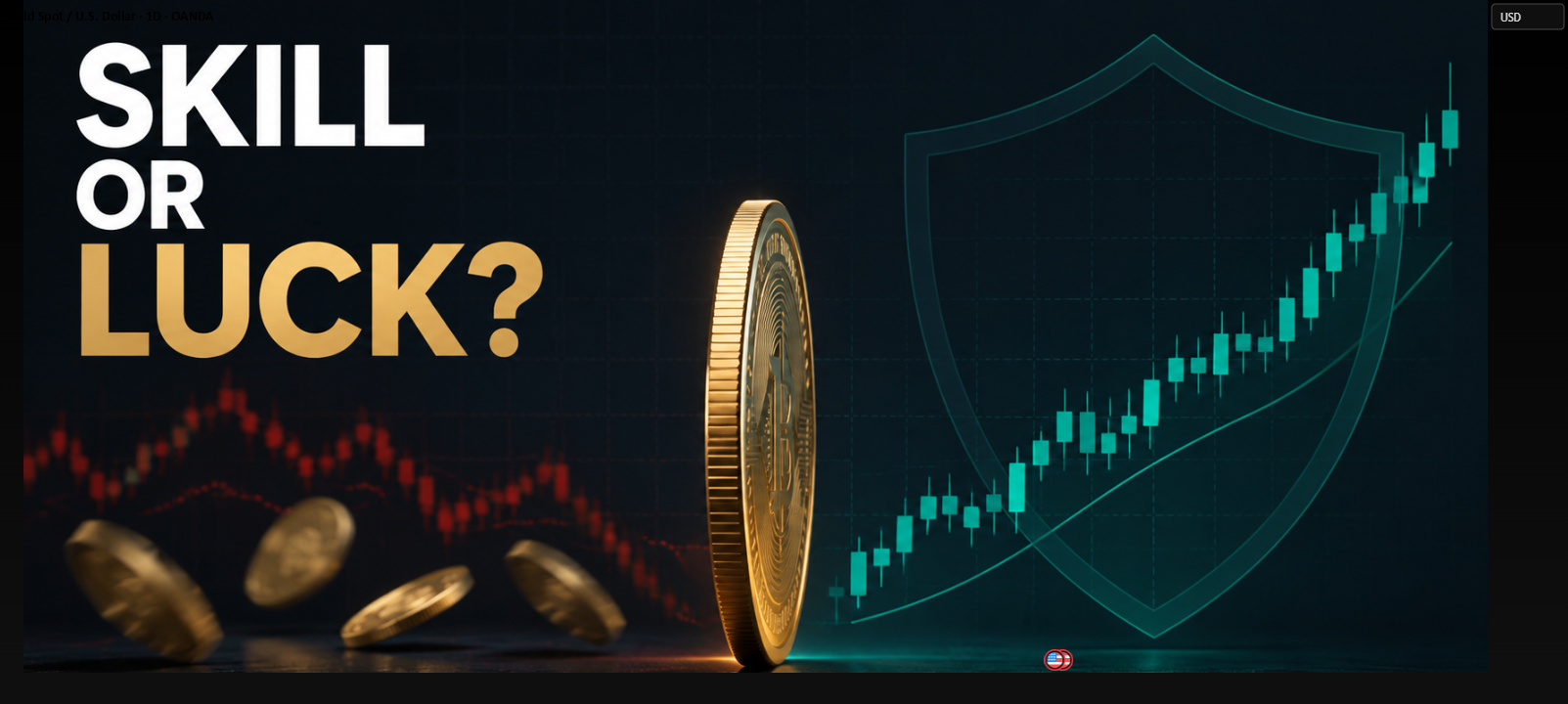
Imagine 1,000 people flipping coins.
Heads = winner.
Tails = loser.
After several rounds, naturally, a small number of people will have won again and again.
Are they geniuses?
Not necessarily.
They may simply have been lucky.
Now ask a more interesting question:
What if many of those consistent winners came from the same school of thought?
That changes the story.
Because now we have to ask:
Is it really reasonable to explain all of their success as pure luck?
💡 What Did Graham & Dodd See Differently?
Benjamin Graham and David Dodd built one of the foundations of modern value investing around a simple but powerful idea:
Price is not the same as value.
The market may tell you:
“This asset is worth $50.”
But the investor should ask:
“What is it actually worth?”
Those two numbers are not always the same.
And when they diverge, an opportunity may exist.
That is why a value investor doesn’t simply look at a chart.
They look behind the chart.
They look at the business.
🔥 So What Does This Have to Do With Trading?
Much more than you might think.
Imagine a stock falls from:
$100 → $50
The inexperienced trader says:
“It dropped 50%. It must be cheap.”
The professional asks:
“What is its intrinsic value?”
Maybe the company was worth $120 and is now worth $80.
In that case, $50 could indeed be attractive.
But maybe the company’s true value has fallen from $120 to $30.
Then:
$50 isn’t cheap at all.
So remember this:
A falling price does NOT automatically mean a buying opportunity.
⚠️ “Cheap” Is Not Enough
This is one of the most dangerous mistakes in the market.
An asset can fall:
50%
and still be expensive.
Why?
Because its previous price is not proof of its true value.
The fact that something traded at $100 yesterday doesn’t mean it is worth $50 today.
So always ask:
“Cheap compared to what?”
🛡️ The Most Important Concept: Margin of Safety
One of the most important ideas from the Graham school is:
Margin of Safety
Imagine your analysis suggests that a company is worth approximately:
$100 per share.
Should you automatically buy it at $100?
Not necessarily.
Because:
Your analysis could be wrong.
Growth could slow.
Margins could decline.
Debt could increase.
The economy could change.
A new competitor could appear.
Or you could simply have made an error in your assumptions.
A professional investor therefore leaves room for being wrong.
If the asset can be purchased significantly below your estimate of intrinsic value, some of your analytical error may be absorbed by that discount.
In simple terms:
“Before thinking about how much you can make, think about how much room you have to be wrong.”
📊 This Is Exactly What Traders Need to Understand
You don’t need to be right all the time.
Imagine your trading system wins:
55% of its trades.
With proper risk management, that can be a very profitable system.
But if you risk so much on every trade that one loss wipes out all your previous gains, even a good strategy can destroy your account.
So the real question isn’t:
“What is my win rate?”
The better question is:
“How much do I lose when I’m wrong?”
🧠 This Is Where Professionals Separate Themselves
Amateur:
“This stock is definitely going up.”
Professional:
“My bullish thesis is this. If X happens, my thesis is invalid.”
Amateur:
“Everyone is buying.”
Professional:
“What is my edge over the market?”
Amateur:
“This stock has fallen a lot.”
Professional:
“Did its value change, or did only its price change?”
Amateur:
“How much can I make?”
Professional:
“How much can I lose if I’m wrong?”
🚨 One Important Rule for TradingView Traders
If you take only one lesson from this post, make it this:
Before entering a trade, define the point where your thesis becomes invalid.
Before you click Buy, know:
What would have to happen for me to admit that I was wrong?
If you don’t know the answer, you may not have a trade.
You may only have hope.
And hope is not a trading strategy.
🔍 A Simple Exercise
Before your next trade, write down these five questions:
1️⃣ Why am I entering?
What exactly creates the opportunity?
2️⃣ What confirms my thesis?
Look for confirmation, not just emotion.
3️⃣ What invalidates my thesis?
This can be more important than your entry.
4️⃣ How much will I lose if I’m wrong?
Have a specific number.
5️⃣ Is this trade actually worth the risk?
Not emotionally.
From a Risk/Reward perspective.
💎 Maybe Buffett’s Biggest Lesson Is This:
You don’t need to know what the market will do tomorrow.
You need to be able to:
identify your edge,
control your risk,
and stay in the game when you’re wrong.
The market gives you opportunities every day to make predictions.
But a professional trader doesn’t say:
“I know what the market is going to do.”
They say:
“I have a thesis, and I know what I’ll do if I’m wrong.”
Those two statements are worlds apart.
🔥 And Here’s the Real Question:
If you opened a trade right now and the market moved violently against you…
Would you know exactly where your thesis failed?
If the answer is YES:
You are making a decision based on a process.
If the answer is NO:
You may not have a trade.
You may only have hope.
🧠 The Final Lesson
The market doesn’t reward the smartest person.
It doesn’t reward the trader with the most indicators on their chart.
And it doesn’t always reward the person with the best prediction.
Over the long run, what matters is:
Decision-making process + Risk Management + Discipline
That’s why the story of the Superinvestors of Graham-and-Doddsville remains relevant decades later.
Because its deepest lesson isn’t simply about value investing.
It is about having a framework for making decisions when the future is uncertain.
“Before trying to beat the market, learn how not to beat yourself.”
📌 If you found this useful, save this post.
In the next post, we can go deeper into:
How can a trader determine whether their strategy actually has an edge — and whether their profits come from skill or simply luck?
👇
What do you think?
Can the market actually be beaten consistently, or does it all eventually come down to luck?