With automation changing the parameters of what baristas can create, SEB Professional Beverage says this presents an opportunity to match the machine to the craft.
When does automation support the barista, and when does the machine become the prerequisite for craftsmanship?
These two fundamental questions are what equipment manufacturer SEB Professional Beverage believes are at the heart of coffee machine automation.
According to the company, operators are increasingly deploying different machine types within a single location – allocating tasks based on speed requirements, staff skill levels, and the intended customer experience.
A café or hotel, for instance, might feature a manual espresso machine for a more personalised experience, while a nearby automatic machine can complement this and step in to efficiently manage a peak service period.
SEB Professional’s pairing of the WMF espresso NEXT and the recently-acquired La San Marco LA 125 machines aims to formalise this divide, with the distinction reflecting “two different professional needs, rather than a hierarchy of quality”.
Giovanni Fucili, Managing Director at La San Marco SEB Professional Beverage, says baristas using WMF espresso NEXT prioritise consistency, speed, and ease of operation. Meanwhile, users of the LA 125 seek control, precision, and the ability to craft espresso manually.
“Both approaches reflect different but equally valid expressions of espresso culture,” he says.
But what makes each machine unique in its own right?
Craftsmanship and heritage
Following La San Marco’s recent international relaunch (Groupe SEB acquired the heritage brand in 2023) it’s now positioned as an “artisanal expression of professional coffee making”.
Fucili says the decision to acquire the brand was driven by a clear ambition: to cover the full spectrum of coffee preparation.
“With La San Marco, SEB Professional adds true craftsmanship and heritage – rooted in authentic espresso – to its existing expertise in automation. This allows SEB Professional to act as a complete enabler for every espresso need,” he says.
And with the LA 125 designed for high volume cafés and premium hospitality venues, SEB Professional says the machine delivers consistent espresso quality – even under peak conditions – while keeping the barista firmly in control.
The group says thermal stability and individually controlled brew groups give baristas confidence and repeatability, and electronic temperature regulation for each brew group – accurate to ±0.1°C – combined with insulated boilers, ensures both extraction precision and energy efficient performance.
Fucili says the LA 125 stands out because it “embodies over 100 years of true portafilter heritage, translated into a modern machine generation”.
“The LA 125 combines iconic Italian craftsmanship with advanced design and technology, offering baristas full control over extraction while ensuring consistency and reliability,” he says.
“It represents a philosophy where craftsmanship remains at the centre of the espresso experience.”
Fucili says La San Marco strengthens SEB Professional’s position in the specialty espresso segment, premium hospitality, and barista-driven environments, and enhances credibility among professionals who value craftsmanship, authenticity, and control in espresso preparation.
Together, SEB Professional says they define two complementary approaches to espresso, covering the full spectrum of professional needs.
In fact, an internationally shared service structure already exists to help support the machines across the DACH region (Germany, Austria, and Switzerland).
Fucili says this was the first area where the joint service approach between WMF and La San Marco was developed, and it now serves as the benchmark and reference model for other regions that are currently being expanded.
“For operators, this means more consistent service standards, faster response times, and access to shared technical expertise, resulting in improved reliability and smoother operations across different markets,” he says.
“This reduces complexity, improves operational efficiency, and ensures a coherent coffee strategy across multiple touchpoints”.

Automation as a creative enabler
Where the LA 125 puts the barista at the centre of the process, SEB Professional positions the WMF espresso NEXT as a machine that expands who can participate in espresso preparation – without lowering the quality benchmark.
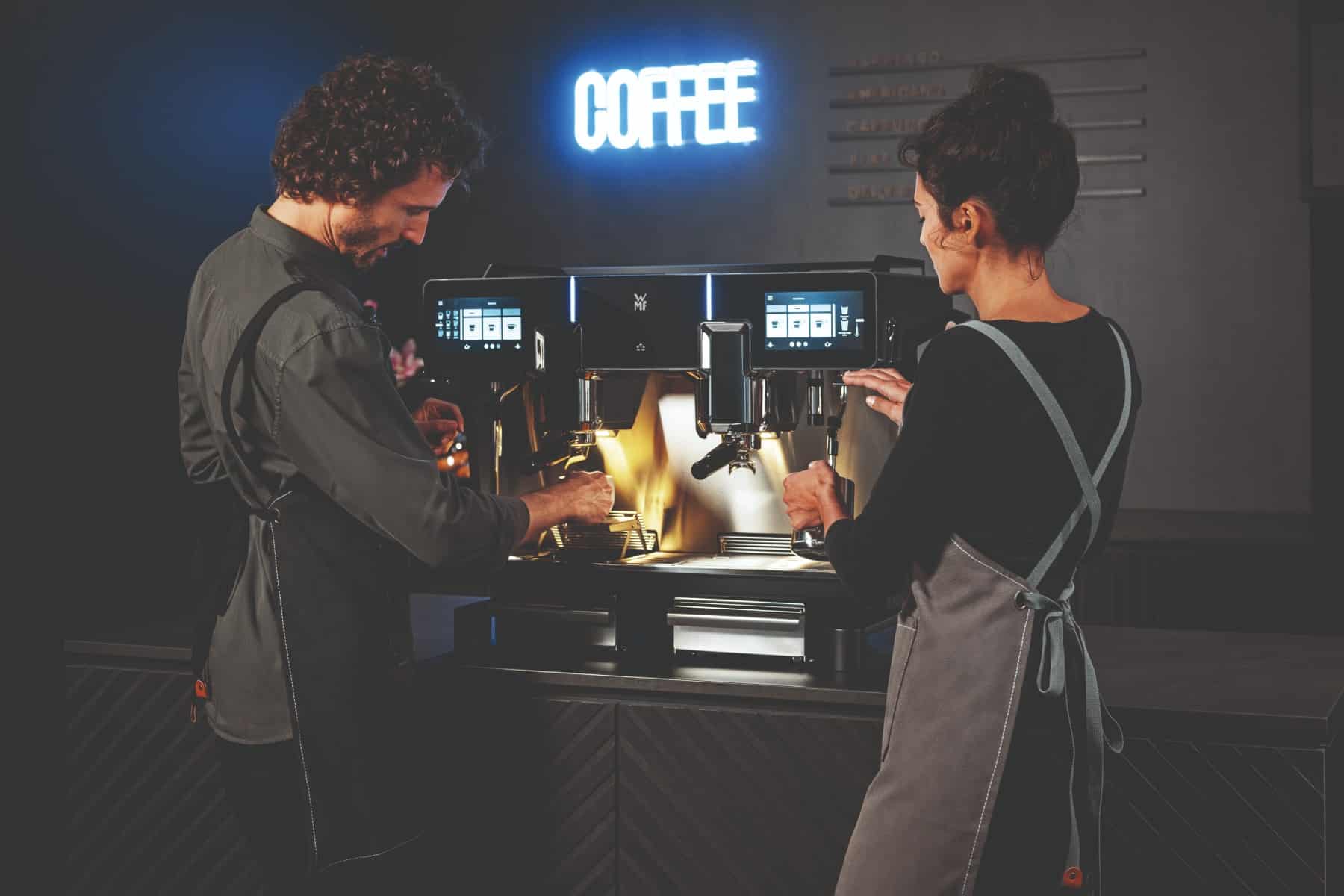
Designed as a fully automatic portafilter-style machine, WMF espresso NEXT bridges the gap between traditional espresso equipment and super-automatic systems. It retains many visual and operational cues of a classic machine while integrating automated grinding, dosing, tamping, and extraction processes.
For operators, this means the ability to produce espresso-based beverages with minimal training while maintaining a consistent sensory profile.
And in environments with high staff turnover or limited barista expertise, this consistency can be critical – particularly in high-volume settings such as quick-service cafés, hotel breakfast operations, and convenience-driven retail, where speed and reliability are essential.
The WMF espresso NEXT has been designed to deliver back-to-back drinks with minimal downtime, supporting peak service periods without compromising output quality. Its integrated systems monitor key parameters in real time, with each shot meeting predefined standards.
SEB Professional says this level of control can also help operators standardise coffee quality across multiple locations, creating a consistent brand experience. Recipes can be pre-programmed and replicated, reducing the margin for human error while preserving the intended flavour profile.
At the same time, the machine still allows for a degree of flexibility. Beverage settings can be adjusted to suit different coffee origins, roast profiles, or menu offerings, enabling operators to maintain a tailored approach even within an automated framework.
A key differentiator of the WMF espresso NEXT is how it applies technology to deliver precision at scale. Automated calibration, pressure control, and extraction timing are designed to work together as part of an integrated system. For multi-site operators, the benefit can extend beyond the cup – reduced training requirements, lower dependency on highly skilled labour, and predictable performance can contribute to improved operational efficiency.
A complementary ecosystem
SEB Professional says it does not see automation and craftsmanship as contradictory – instead, “they are complementary dimensions of modern espresso culture”.
In practice, this means operators can increasingly blend both approaches within a single business.
A café could use a traditional machine like the LA 125 for signature drinks and barista-led experiences, while relying on the WMF espresso NEXT for high-volume service periods or secondary service areas. Hotels, for example, can deploy fully-automatic WMF machines for breakfast buffets and self-service zones, while maintaining a manual espresso machine in their café or lobby bar to deliver a more personalised offering.
By offering both with equal depth, SEB Professional customers can choose the approach that best fits their identity and business model.
Fucili adds that every customer and barista can define how espresso should be prepared – whether through automation, manual skill, or a combination of both.
“SEB Professional’s role is to provide the tools that make this choice possible, without compromising on quality or authenticity.”
For more information, visit groupeseb.com
This article was first published in the July/August 2026 edition of Global Coffee Report. Read more here.