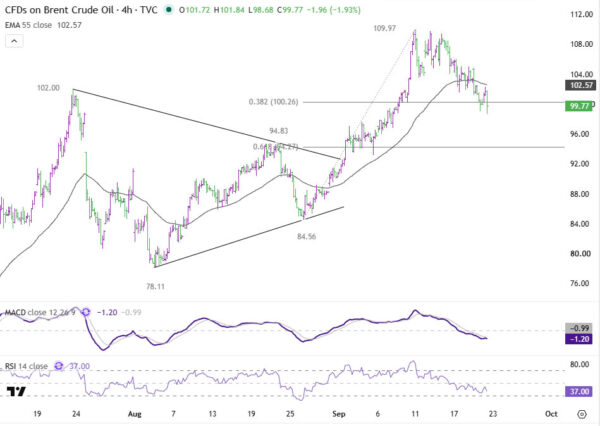
TL;DR: Brent oil broke below $100 after Iran reportedly offered to reopen the Strait of Hormuz within seven days, but the quick recovery toward 99.55 shows markets are testing the story, not embracing it—making 100.26 the level that separates a genuine break from a false trigger.
The First Break Below $100 Has Arrived—But the Market Is Hesitating
Brent has been falling for more than a week because the shooting between Washington and Tehran has stopped—not because the conflict has been resolved. That remains the central distinction, even after oil briefly broke below $100 on a much more concrete diplomatic headline.
Today Brent dipped to 98.68 after Kyodo News reported that Iran had offered to reopen the Strait of Hormuz within seven days if the US takes initial steps to ease military pressure. Yet the move quickly lost momentum, with crude recovering toward 99.55.
That hesitation is important. If traders believed a genuine breakthrough was suddenly close, the first break below the 100.26 technical pivot should have attracted stronger follow-through selling. Instead, the market appears to be asking a different question: is this a real negotiating opening—or another conditional proposal that Washington may never accept?
Iran Has Put Something Concrete on the Table
The Kyodo report isn’t just another statement that Tehran remains open to diplomacy. Citing a senior Iranian government official, it says Iran has offered to reopen Hormuz within seven days if Washington begins easing military pressure, with the proposal already passed through intermediaries. Tehran would then return to negotiations aimed at ending hostilities permanently.
That’s meaningful because Hormuz is still the central physical bottleneck in the oil market. A credible path toward reopening the strait would justify removing much more of the remaining geopolitical premium than a simple pause in military strikes.
But the story has important limitations. The offer comes from one unnamed Iranian official. Washington hasn’t confirmed receiving or accepting it. Iran is still asking the US to demonstrate “seriousness and commitment,” and Tehran has ruled out a Trump-Pezeshkian meeting on the sidelines of the UN gathering.
So the market has a proposal—but not yet a deal.
That Explains the Lack of Follow-Through
The price action fits that distinction unusually well. Brent’s decline from 109.97 had already brought it down to the 38.2% retracement of 84.56 to 109.97 at 100.26, consistent with a partial removal of the premium attached to active US-Iran strikes.
The Kyodo report finally pushed oil through that level and down to 98.68. But Brent is now back around 99.55 rather than accelerating toward the mid-$90s. The market is testing the story, not embracing it.
That makes 100.26 much more interesting than before. Stay below it, and the break begins to look genuine. Recover above it quickly, and the diplomatic headline starts looking like a false trigger rather than a change in the underlying regime.
The Shipping Crisis Hasn’t Gone Away
There’s good reason for traders to hesitate. Even during the current military stand-down, Hormuz hasn’t normalized. Commercial traffic remains severely depressed, hundreds of ships are still waiting rather than transiting, and war-risk insurance costs remain extreme.
Saudi Arabia has improved its ability to move crude around the strait through land routes, which has reduced the urgency of the supply problem. But that’s a workaround, not a restoration of normal shipping.
The alternative Red Sea route also carries its own risk after Houthi gains around Perim Island and Bab el-Mandeb.
So even if direct US-Iran strikes remain paused, the market is still dealing with a damaged regional transport system. That’s why crude remains far above its roughly $72 pre-crisis reference point.
ActionForex’s Technical View on Brent: $94 Now Needs Confirmation From Diplomacy
Technically, Brent has done enough to put 94.27 on the radar—but not enough to make it the base case yet.
The break below 100.26 opens the way toward the 61.8% retracement at 94.27, which also sits close to the daily 55 EMA around 93.95.
The short-term chart is still weak. Brent remains beneath its declining 4-hour 55 EMA near 102.57, MACD is negative, and RSI has fallen to around the mid-30s.
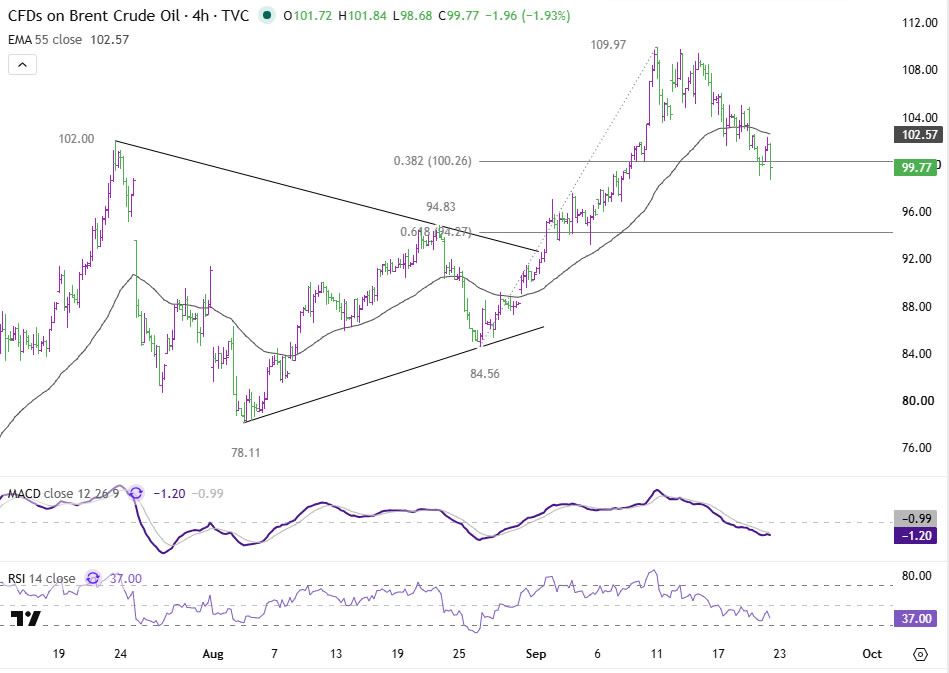
But the crucial issue is now fundamental confirmation. If Washington acknowledges the proposal, intermediaries report concrete progress, or direct negotiations are scheduled, the break below $100 would have the diplomatic catalyst required to extend toward 94.27.
If none of that happens and Brent quickly climbs back above 100.26, the market will be saying Iran’s offer is too conditional—or too uncertain—to justify pricing a near-term reopening of Hormuz.
The $100–110 Band Is Bruised, Not Broken
The original framework therefore still works. Around $100, Brent prices a military stand-down with major shipping disruption still unresolved. Around $110, it prices a return to active escalation.
The new Iranian proposal creates a path below that range, but it hasn’t yet been validated. To make 94.27 the next genuine destination, the market needs evidence the proposal is becoming a negotiation rather than remaining an anonymous-source initiative.
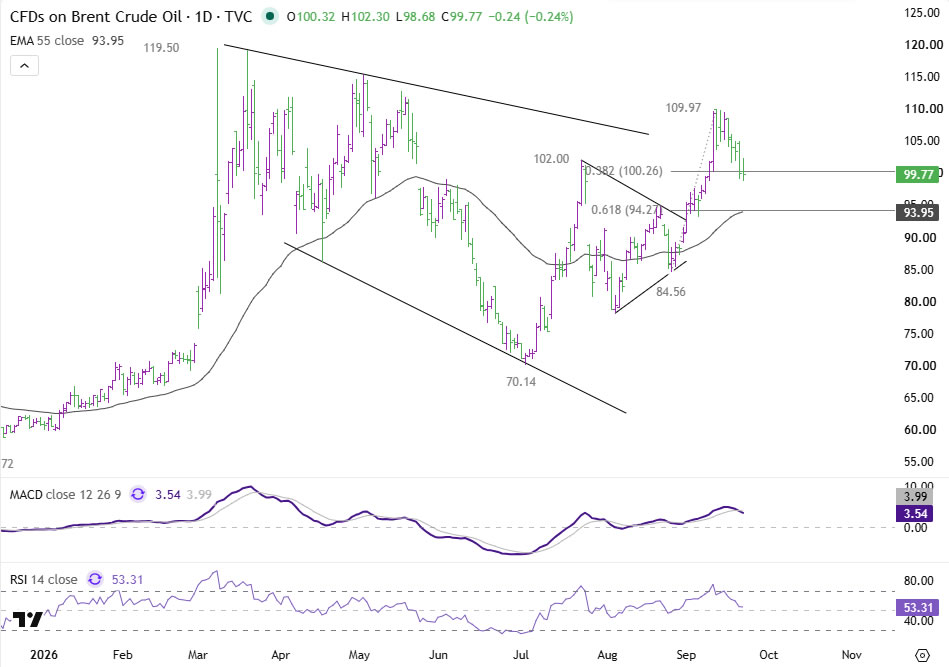
The opposite test is even simpler. If crude quickly regains $100 after dipping to 98.68, traders will have effectively discarded the unconfirmed diplomatic headline and returned to the old framework.
That’s what makes the next move unusually informative. Brent has finally broken below the lower edge of the stand-down range—but so far, it doesn’t appear convinced enough to keep going.
Key Takeaways
- Brent briefly broke below $100 to 98.68 on Iran’s reported offer to reopen Hormuz within seven days, but quickly recovered to 99.55, signaling markets are hesitant, not convinced.
- The offer comes from one unnamed Iranian official, with no confirmation from Washington and Tehran still ruling out a direct Trump-Pezeshkian meeting.
- Hormuz remains far from normalized even during the current stand-down: commercial traffic is severely depressed and war-risk insurance costs remain extreme.
- 100.26 is the key pivot; staying below it would make the break look genuine, while a quick recovery above it would treat the diplomatic headline as a false trigger.
- A confirmed break lower opens 94.27, near the daily 55 EMA at 93.95, but that requires fundamental confirmation, such as Washington acknowledging the proposal or scheduled negotiations, not just the headline itself.