![[Big read] OpenClaw sparks China’s one-person AI start-up boom](https://news.charm-retirement.com/wp-content/uploads/2026/04/google_preferred-CaCGdfP1.svg.svg+xml; charset=utf-8)


China news correspondent, Lianhe Zaobao
China’s young entrepreneurs are embracing a new wave of AI-driven solo start-ups, as the OpenClaw craze reshapes how one-person companies are built, scaled and powered by digital “agents”. Lianhe Zaobao correspondent Yush Chau reports from China.
(Edited and refined by Candice Chan, with the assistance of AI translation.)
In the neon-lit corridors of Wudaokou, Haidian district, the “Genesis Bar” serves as a sanctuary for a new demographic of the Chinese workforce. By day, it is a focused co-working space; by night, a hub where the “one-person company” (OPC) is the sole topic of conversation.
One afternoon in late March this year, Gu Lin (28, pseudonym) hosted an in-person gathering here to introduce his new circle of AI industry acquaintances to his latest project: a piece of intelligent hardware positioned as a “lobster for the mobile phone”. The concept taps neatly into a recent craze in China for “raising lobsters”, a trend that has gained traction since the start of the year with the rise of AI agent OpenClaw.
With a lobster as its logo, OpenClaw has prompted Chinese netizens to liken installing and using it to “raising a lobster”. Unlike traditional chatbots, OpenClaw can integrate communication tools with large language models to autonomously complete tasks such as file management, email handling and data analysis on a user’s computer. Through “skill packs”, it can continuously expand its capabilities, gradually evolving into a “digital employee”.
The rise of OpenClaw has not only reshaped public understanding in China of how AI works, but has also rapidly propelled the concept of OPC into the spotlight, making it a key term in a new wave of entrepreneurship.
… this is a golden era for OPC entrepreneurship: job security and technological maturity are both high, while start-up costs have fallen to a low. — Gu Lin, OPC entrepreneur
Rise of the ‘army of one’
Gu Lin is one such OPC entrepreneur. After Chinese New Year this year, he resigned from a tech company in his hometown of Weifang, Shandong province, to commit himself fully to his venture. He told Lianhe Zaobao that he had been preparing for this moment for years: “If I were any later, I might miss this wave.”

In his view, this is a golden era for OPC entrepreneurship: job security and technological maturity are both high, while start-up costs have fallen to a low.
Another OPC entrepreneur, Guo Jilong, a 24-year-old PhD student in computer science, believes that AI has shifted entrepreneurship from being “idea-driven” to “rapidly validated” — products can be quickly developed, tested, and continuously optimised through iteration.
Over three years ago, the American company OpenAI launched ChatGPT, igniting the large-model boom and laying the groundwork for the rise of OPCs. OpenAI founder Sam Altman once predicted that in the AI era, there would be one-person unicorn companies valued at US$1 billion.
Data from the US fintech company Carta show that about 36% of newly established start-ups in the US last year were led by a single founder…
In the AI era, the solo founder has become a trend in Silicon Valley. Data from the US fintech company Carta show that about 36% of newly established start-ups in the US last year were led by a single founder, an increase of five percentage points from the previous year.
In China, OPC initially originated from the legal concept of a “one-person limited liability company”. However, with leaps in AI technology, its meaning has evolved into a new entrepreneurial paradigm: with AI collaboration, an individual can complete the entire loop from product development to market launch, effectively “becoming an army of one”.
Even before OpenClaw became a hit, several factors had already driven the rapid development of OPCs in China. On the one hand, the sharp decline in computing costs has accelerated the adoption of AI applications; on the other, the maturation of multimodal AI technologies has provided entrepreneurs with a richer set of tools. More crucially, breakthroughs in the industrialisation of AI agents signal a shift from AI as an assistive tool to a digital employee.
Wang Rui, who previously worked at a major internet company in Beijing, joined the ranks of OPC entrepreneurs last year after resigning. In an interview, he admitted candidly: “Without AI, I probably wouldn’t have been able to start a business.”

AI helps him make up for flaws in recruitment and marketing, while also reshaping team structures — many tasks that previously required dedicated personnel can now be handled by AI. More importantly, Wang said, “We can complete many tasks efficiently, thereby leveraging larger product markets.”
OPCs demand extremely high overall capability from individuals: without team support, one must rely on technological leverage to accomplish work that would normally require multiple collaborators.
‘Raising lobsters’ has its barriers
However, becoming an OPC entrepreneur is not entirely barrier-free.
Zou Ling, founder of the OPC community Honghub in Hangzhou, Jiangsu province, emphasised in an interview that OPCs are not the same as freelancers or traditional sole proprietors. The key difference lies in an individual pursuing scalable productive capacity, leveraging AI as a multiplier. At the same time, OPCs demand extremely high overall capability from individuals: without team support, one must rely on technological leverage to accomplish work that would normally require multiple collaborators.
Zhou Hongyi, founder and chairman of Qihoo 360, has observed a common misconception — that simply using a large number of AI tools and building automated workflows constitutes an OPC, “as if the more tools one uses, the closer one is to an OPC”.
In a video posted on his Weibo account, Zhou pointed out that the core of an OPC lies not in the tools themselves, but in the “team” — namely, a person or small group working in coordination with a team of specialised AI agents. These agents are not merely automated processes, but take on distinct roles such as writing, development, marketing, data analysis, auditing and operations.
On whether “raising lobsters” helps entrepreneurship, Guo Jilong said that he currently uses OpenClaw mainly for auxiliary tasks such as schedule management, file archiving and research, while core tasks still rely on other AI tools. He added frankly that mastering OpenClaw involves a certain threshold: “It certainly has the potential to develop into a suitable digital employee, but whether people can train it to that level remains to be seen.”
About 20 kilometres from Genesis Bar, the ZGC (Zhongguancun) AI North Latitude Hub (中关村AI北纬社区) has attracted 135 AI companies since recruitment began last July, including 47 OPCs.

Dong Bo, operator of the community incubator, told Lianhe Zaobao that an OPC does not necessarily mean a single individual; team sizes typically range from one to ten people. He noted that OPC entrepreneurs generally fall into two groups: those with strong AI backgrounds engaged in technical development or research, and those with strong disciplinary or industry expertise who are adept at using AI tools.
In his view, the greatest appeal of the OPC model is its extremely low cost of trial and error — there is no need for large-scale hiring or fixed office space expenses, with core investments being computers, computing power and time.
… the advantage of OPCs lies in speed, where business decisions, user feedback and product iterations can all be completed efficiently. — Wang Rui, Founder, Beijing Huacheng Technology
Wang Rui’s Beijing Huacheng Technology Co Ltd (北京画澄科技), founded with partners, has moved into the community and currently has a team of about ten people. In March this year, the company launched an AI video-generation tool called Zopia, which allows users to generate complete videos with a single click by inputting creative concepts or scripts, and it has received favourable market feedback.
Despite intense competition in the sector, with major players such as ByteDance and Kuaishou entering the field, Wang believes that the advantage of OPCs lies in speed, where business decisions, user feedback and product iterations can all be completed efficiently.
However, computing costs remain a challenge. Wang plans to increase investment in model usage, which means higher computing expenses and greater consumption of tokens. Currently, the company spends hundreds to thousands of US dollars per month on tokens.
Still a dream to scale up
Tokens are the smallest units through which large AI models process information, serving simultaneously as units of measurement, pricing and transaction, and are widely embedded in everyday scenarios such as identity verification and AI services.
Beijing Yuanchu Zhiyuan Technology Co Ltd (北京市元初智源科技), founded by Guo Jilong and his classmates, is developing CasePilot, a platform connecting corporate needs with expert resources, now in the product testing phase. Their weekly token expenditure is around US$400, mainly because the product is being iterated once a week ahead of its planned launch in late April.
A second-time entrepreneur, Guo admitted that his previous venture struggled to achieve sustained revenue and stable growth due to a lack of standardised products — an issue he aims to overcome this time.
As for whether OPCs can grow into unicorn companies, Zou Ling believes that while this is a common aspiration, it often depends on complex external conditions and significant capital.
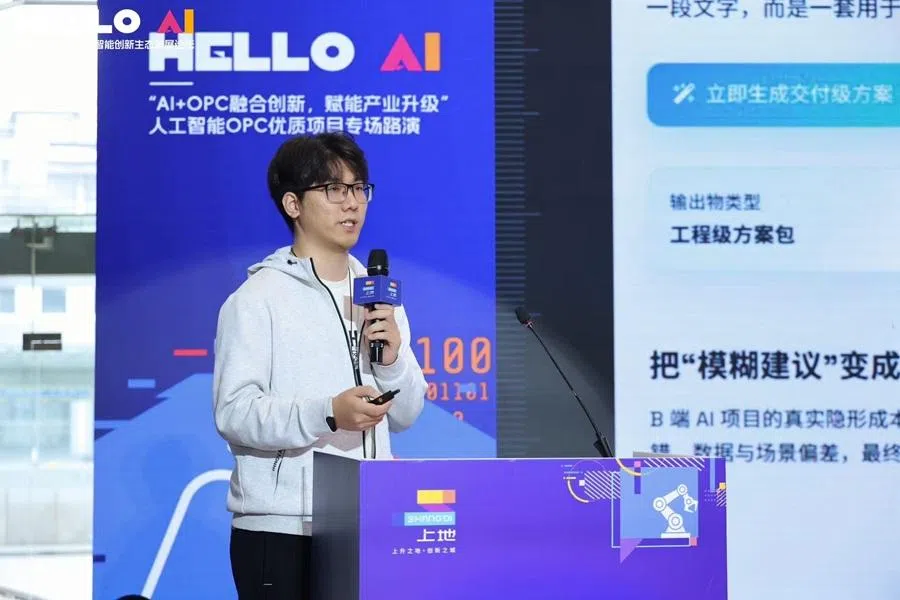
When it comes to commercialisation, Dong Bo suggested that OPCs could focus on two main directions: one targeting enterprise clients by entering niche scenarios with models or AI agents and monetising through software, plug-ins or technical services; the other targeting consumers by creating products with emotional appeal or strong viral potential.
In the longer term, an OPC may be merely an initial team structure in entrepreneurship. Dong pointed out that some companies in the community do not wish to be labelled as OPCs, as they intend from the outset to scale up gradually.
As for whether OPCs can grow into unicorn companies, Zou Ling believes that while this is a common aspiration, it often depends on complex external conditions and significant capital. By contrast, he places greater value on diversified paths to success: becoming a company with stable cash flow, developing into a highly efficient organisation with high per capita output, or gradually expanding from a single-person team to a hundred-strong workforce.
Zou added that if an OPC can scale to a team of 100 people, it would largely validate the viability of its business model. “How it develops in the future is another matter.”
Local governments compete for the OPC trend
Against the backdrop of China’s push to deepen its “AI+” initiatives, local governments are actively competing to capitalise on the OPC trend. Over the past six months, a wave of supportive policies has been introduced, with a “talent grab” first emerging in the Yangtze River Delta.
In November 2025, Suzhou proposed to build itself into the “preferred city for OPC entrepreneurship”, aiming by 2028 to establish over 30 OPC communities, cultivate 1,000 companies and attract 10,000 talents. Soon after, Shanghai’s Lingang area released an action plan to build 10 OPC communities and open 100 application scenarios within three years, attracting 1,000 teams.
This year, Shenzhen and Beijing’s Yizhuang area have followed suit, introducing more targeted support measures centred on OpenClaw. The “ten lobster policies” or “Lobster 10” in Shenzhen’s Longgang district — focusing on OpenClaw development, deployment, data services and application implementation — have drawn particular attention.
On 16 March, Guangdong province introduced China’s first provincial-level OPC policy, proposing to build 100 ecosystem communities and cultivate 1,000 benchmark companies by 2028, further intensifying regional competition.
Dong Bo believes that OPCs are becoming a “low-cost lever” for activating regional innovation ecosystems, as compared with traditional tech start-up models that rely more heavily on laboratories and capital-intensive investments.
For entrepreneurs, there is a gap between government officials’ enthusiasm for policies and on-the-ground experience.
However, Wang Xiaofan, president of the Shanghai Institute of Technology, told Nanfang Metropolis Daily that while enthusiasm for supporting OPCs is high, the rush to build OPC communities and provide workspaces and accommodation risks falling into homogeneous competition.
For entrepreneurs, there is a gap between government officials’ enthusiasm for policies and on-the-ground experience. Gu Lin, who has yet to settle into any OPC community, said that after engaging with various local governments, he has found many policies being announced, but “very few actually implemented”.

He said being a graduate from a top-tier university with an AI background, technically he should be a key target for support, but he still encounters obstacles at every turn. In his view, free office space is not a pressing need for OPC entrepreneurs; rather, computing support, funding and access to industry resources are more critical. His new company has not yet been registered, and he is currently in close discussions with Shenzhen’s Longgang district, hoping to move in there soon.
Zou Ling further stressed that the value of OPC communities lies not only in providing infrastructure, but also in fostering interaction and collaboration among talents, thereby generating opportunities. This is especially crucial for entrepreneurs — working alone often means lacking information channels and access to resources, and may even stall during the commercial validation stage.
OPC is not a universal path suitable for everyone, but rather for a small number of individuals with specific capabilities and conditions. — Zou Ling, Founder, OPC community Honghub in Hangzhou
OPCs not a cure for employment challenges
In response to the increasingly challenging employment situation for young people in China, some believe that the rise of OPC communities could better stimulate entrepreneurial vitality among the younger generation, including university graduates. Official estimates suggest that the number of graduates this year will reach 12.7 million, an increase of 480,000 from last year.
Zou Ling, however, pointed out that OPC is not a universal path suitable for everyone, but rather for a small number of individuals with specific capabilities and conditions. “For the vast majority of young people, stable employment remains a more realistic need.”
From a policy perspective, he believes the key lies in providing effective support measures for those truly capable of pursuing OPC entrepreneurship. If OPCs are packaged as a “cure” for employment problems, this could negatively affect the industry’s development and even distort their original value and intent.