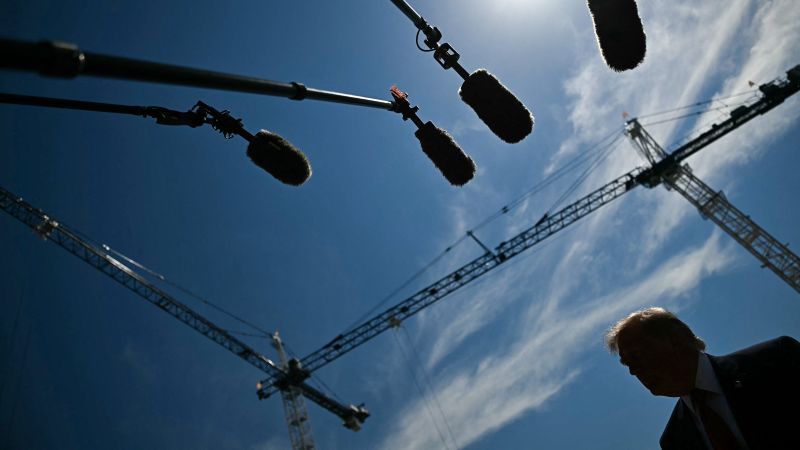
President Donald Trump on Tuesday decided to take reporters on a tour of the construction of his highly unpopular ballroom — harping on his public obsession with a project that’s giving his party political fits.
Hours later, he endorsed Texas Attorney General Ken Paxton in his primary runoff with GOP Sen. John Cornyn next week, despite the institutional GOP’s major concerns about Paxton’s electability.
Just 24 hours earlier, Trump pulled his $10 billion lawsuit against the government he controls in favor of having it pay his allies $1.8 billion.
And all of that comes shortly after Trump said he doesn’t “think about Americans’ financial situation” when trying to resolve the Iran war.
Given the volume of Trump’s politically unhelpful gambits these days, it’s almost like he is trying to create political problems for his party ahead of an increasingly fraught 2026 midterm election.
And Republicans might want to start asking themselves what they do if Trump doesn’t cut it out soon.
Republicans are facing what increasingly looks like it could be a pretty brutal election, with some recent polls showing Democrats leading by double-digits on the so-called generic ballot. Yet Trump is proceeding as if he doesn’t care one bit — or doesn’t believe it.
“Everyone tells me it’s unpopular, but I think it’s very popular,” Trump said Tuesday. He was talking about the Iran war, but that thinking seems to apply to plenty of other things.

The big new entry on Trump’s list of highly suspect gambits is his $1.776 billion fund to compensate allies who claim they were unfairly targeted by previous administrations.
We don’t yet know specifically who would benefit from it. But some logical beneficiaries would seem to be the many Trump allies who have been investigated and/or convicted — people like Paul Manafort, Michael Flynn and Roger Stone — as well as defendants from the January 6, 2021, attack on the US Capitol. MyPillow founder Mike Lindell, for example, has told CNN he expects to be compensated after facing legal problems following his bizarre 2020 voter fraud claims.
Setting aside the potential legal issues, paying off those people would not seem to be a good idea, politically.
For one, while Trump and his allies have long claimed these people were victims of a weaponized justice system, the American people don’t seem to agree:
-
A 2018 Washington Post/ABC News poll, for example, showed 67% of Americans said the prosecution of Manafort was “justified.”
-
A 2017 CBS News poll showed 67% of Americans said the case in which Flynn pleaded guilty to lying to the FBI about his contacts with Russians was “serious.”
-
And a 2020 NBC News poll showed those who had opinions of Trump commuting Stone’s sentence opposed it 2-to-1 (36%-16%).
-
Even when it comes to Trump personally, clear majorities of Americans have consistently said that the legal scrutiny of him and his indictments were legitimate. (The fund cannot pay Trump directly under the terms of the settlement, but these numbers would seem telling.)
Trump could get into even more dicey territory by handing money to those who stormed the Capitol. Polling last year from the Pew Research Center and the Washington Post showed majorities opposed Trump’s pardons of nonviolent January 6 defendants. That number shot up to three-quarters or more for the violent people he pardoned.
And Americans seem to have real concerns about corruption and self-dealing in the Trump administration.
An April Reuters/Ipsos poll showed Americans disapproved of Trump’s handling of corruption by a 2-to-1 margin (59%-29%). And other polling has shown 6 in 10 people believe Trump uses the presidency to enrich himself and his friends and family.
Corruption and self-dealing haven’t been Trump’s and the GOP’s biggest political problems. But imagine the administration in the runup to the 2026 election occasionally doling out large amounts of taxpayer money directly to convicted Trump allies, with little in the way of a legal process — and doing so even as Americans think the president is neglecting their inflation concerns.
Lately, this is just par for course for Trump. He’s governing like someone more interested in using his time as president to enrich himself, help his allies and pursue pet projects rather than helping Republicans avoid a blowout in 2026.
There have been whispers that he’s largely given up on the latter, and that tracks.
The ballroom is 2-to-1 unpopular. But Trump not only can’t stop talking about it; he’s now asking for taxpayer money for it — despite previously saying it would be totally privately funded. Though the GOP might get a lucky break there since the proposed funding has hit a major snag in the Senate.

Equally as puzzling are Trump’s other efforts to renovate the nation’s capital in ways that almost nobody seems to be asking for, including occasionally plastering his name on things. The latter is especially discordant given Trump is now a historically unpopular president.
The Iran war is, of course, his and the GOP’s biggest political liability right now. The administration’s blatant mishandling of the war hasn’t helped matters, but its unpopularity was also entirely predictable from the beginning. Trump launched it in an election year even though as many as two-thirds of Americans opposed it beforehand.
And you could throw so many other things on the pile, from Trump’s quixotic and highly unpopular pursuit of Greenland, to his moves to enrich himself while in office, to his increasingly unvarnished comments on dead political foes, to his social media posts and comments about Black people.
And while Republicans occasionally raise concerns about his behavior, much of the party ignores it and seems to just hope it goes away.
Obviously, it’s not going away. There’s less than six months until the midterms. Trump is already a historically unpopular president — more unpopular than ever before, including after January 6. And he’s increasingly governing like someone with nothing to lose.
But his party has plenty to lose. And the last week has shown how Trump could soon force many of them into an incredibly difficult choice: a president who demands loyalty — and punishes disloyalty — or their own political futures.