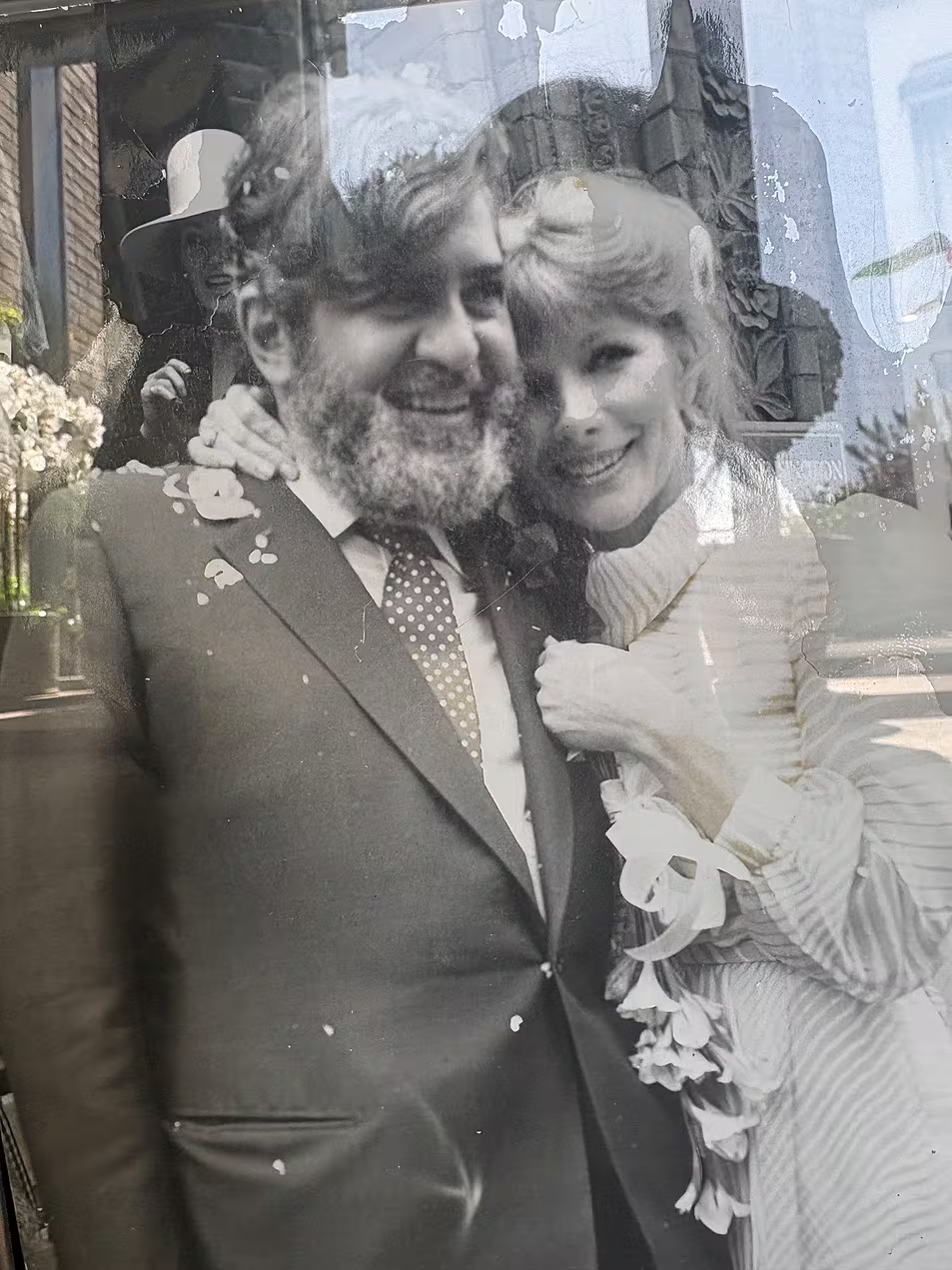
Known for starring in film and TV classics like The Forsyte Saga and Vanity Fair, actress Susan Hampshire took on a different, and far more challenging, role in her later years.
The three-time Emmy award winner gave up acting to care for her husband, entrepreneur and theatre impresario Sir Eddie Kulukundis, after he was diagnosed with dementia.
But far from resenting the enforced change, Hampshire, 89, describes caring for her husband as a “privilege”.

“He was my husband and being able to step away from work to care for him full-time allowed me to spend so much time with him,” she tells the Press Association.
“That’s something I’ll always be grateful for. Yes, I gave up work to look after him, but if I hadn’t, I would have missed that time with him.”
Although the Alzheimer’s Society says people with dementia may sometimes be physically or verbally aggressive as the disease progresses, Hampshire says her husband, who died in 2021 at the age of 88, was never like that.
“I felt very fortunate that despite everything, he remained kind and gentle throughout,” she remembers fondly of her second husband – she was previously married to French film producer Pierre Granier-Deferre, with whom she had a son. “That never left him – he was always good-natured, and always appreciated everything I did for him. He was never nasty, he was always very nice to me, and always very thoughtful. I’m heartbroken to lose him.
“It was a privilege to look after him.”

Since Kulukundis’s death, Hampshire, who is based in London, has fundraised for Alzheimer’s Research UK (ARUK) in his memory and has raised over £1 million to support the charity’s search for a cure.
But she says she feels strongly that more needs to be done to spot the signs of dementia earlier, including the link with hearing loss. So ahead of Dementia Action Week (May 18-24), she’s partnered with Boots Hearingcare to shine a light on how hearing loss can mask the early signs of dementia.
Research led by University College London suggests nearly half of dementia cases worldwide could be prevented by tackling 14 key health and lifestyle factors, including hearing loss.
Yet ARUK research found only 3% of UK adults name hearing loss as a risk factor for developing Alzheimer’s, even though further ARUK research shows that taking steps to protect and manage hearing health alone could result in seven fewer cases of dementia for every 100 people who develop the condition.
ARUK says it’s not yet known whether hearing loss causes dementia directly, perhaps through it leading to the brain getting less stimulation and therefore becoming more vulnerable to dementia, or whether it causes other conditions, such as loneliness and depression, that increase the risk of developing the disease.

“Taking care of hearing health is a practical and effective way to look after brain health and help reduce dementia risk,” stresses Samantha Benham-Hermetz, executive director at Alzheimer’s Research UK.
“Evidence shows that looking after hearing through regular hearing tests and using hearing devices when recommended could help reduce the number of dementia cases. Despite this, awareness of the link between hearing loss and dementia remains low.”
Although Kulukundis didn’t have any issues with hearing loss throughout most of his life, Hampshire says: “We did notice his hearing start to decline as the dementia progressed.
“I’m absolutely convinced losing your hearing is connected to dementia. In my age group a lot of people have hearing loss but they’re quite prepared to just turn the TV up. For people above a certain age, it’s worth getting their hearing checked out.”
Hampshire says signs of her husband’s dementia were initially subtle, but she recognised there were changes to his normal behaviour.

“There were a few early signs that made me think Eddie had the onset of dementia,” she recalls. “Things he’d loved all his life gradually became confusing and challenging for him.
“He’d always had a brilliant brain and could do complex maths in his head, but suddenly he couldn’t. He was also an avid reader, always had a book on the go and read several newspapers every day. He was the kind of person who could finish a book in one sitting, but I began to find him staring at the same page for long periods without actually reading it.”
She says another change was his behaviour on the phone. “He used to love chatting, but he started avoiding calls or would say ‘Speak to my wife’. Over time, his most common phrases became ‘Where’s Susan?’ or ‘Ask Susan’.
“He found reassurance in knowing I was nearby, which is why we eventually moved to a flat where he could always see or hear me.”
But even just being able to hear his wife had to be carefully managed, and Hampshire explains: “I found it helped to always speak gently to him, with love and respect, calmly and reassuring – a strong or raised voice would just make Eddie clam up.
“I also tried to help him feel independent by giving him choices so his ideas felt like his and not mine – simple things like ‘Would you like hot or cold breakfast?’ or ‘Shall I wear this or that jumper?’”
She says the way people with dementia lose their independence is one of the many terrible things about the disease, stressing: “One of the truly awful things about dementia is the loss of independence and not being able to care for yourself. I think that’s really tough.”

But while she reflects on caring for her husband for more than 10 years as being “incredibly hard,” she says she’d do it again “in a heartbeat”, and reminds other people looking after loved ones with dementia: “Caring for someone you love is incredibly hard and exhausting, but it’s something you’ll never regret.
“There are sleepless nights, long days and so much patience required, but your devotion means you won’t be left wishing you’d done more. It’s better to feel tired than to carry regret, in my opinion. I certainly would do it again in a heartbeat.”
Despite losing her husband five years ago, Hampshire, who was made a CBE for services to drama and charity in 2018, has maintained her own healthy lifestyle. She makes a point of doing 10,000 steps every day, eats a nutritious diet including lots of nuts and vegetables, and spends a lot of time gardening.
When asked what her secret is, she simply replies: “Don’t sit in a chair all day or in front of the TV – get outside whatever the weather.
“Listen to the birds singing.”
Susan Hampshire has joined Alzheimer’s Research UK and Boots Hearingcare to raise awareness of the potential link between hearing loss and dementia, and encourage people to look after their overall brain health through the Alzheimer’s Research UK Think Brain Health campaign.