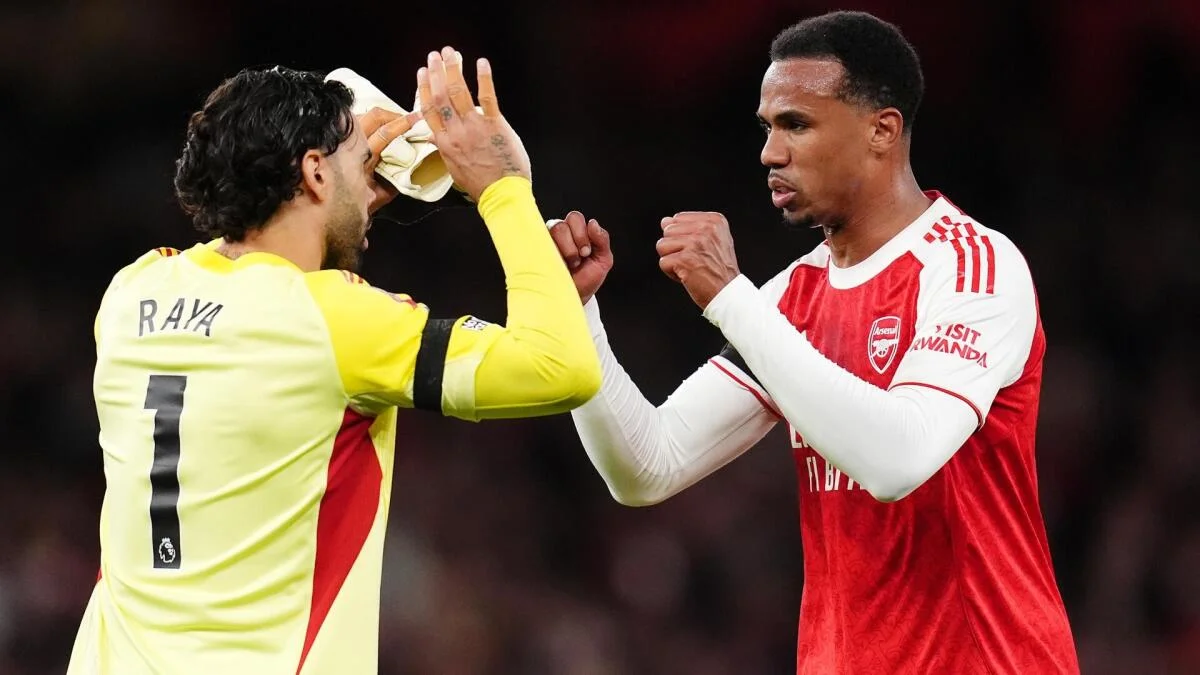
LONDON — Arsenal have made it to the brink. This wasn’t the sort of free-flowing, high-scoring demolition job of your usual champions in waiting when they run into Championship-bound roadkill, but then, Arsenal are not your usual sort of champions. They might have closed the goal difference route to the title — if Manchester City win out as they must, then their tally on that metric will inevitably better the Gunners — but a 1-0 win over Burnley was good enough.
Elegant open play that didn’t quite click, a set piece that pushed them into the lead, a thunderous defense that barely gave up a sight at David Raya’s goal: this was the blueprint that had gotten Arsenal to the cusp of the title, applied with relentless efficiency. Style points might not be what they are for other champions of England, but historically, those have not actually been used to decide who lifts the trophy at the end of the season.
With an aggressive starting XI, Arteta might have hoped for a few more goals in the column, but that’s not really Arsenal’s style. Even when they wanted to cut loose, it came with the caveat that they’d have to keep their posture ready for any counter repostes. It might seem perverse that a team one game from the title should be sitting back to hold out Burnley. It quite possibly is. However, it is also true that when this team have given so little to so many who are so much better, why shouldn’t they trust themselves to grit and grind their way home?
“Make sure that we are extremely efficient in defending certain moments,” was how Arteta described his side’s response to the bright early moments not resulting in too many goals. “Not giving anything away to the opponent and winning the three points.
“The desire every single player shows in their defensive duties, their behaviours, is phenomenal and the work by the coaches as well. We all know the importance of that and how many results and wins we have because of that.”
As we enter the post-Pep Guardiola age, it still feels curious that the 19th-placed team in the league shouldn’t be buried under an avalanche of goals, but that is the Premier League of old, the pre-not quite parity but actually not all that far off, given that your average English team is the 25th richest in the sport era. Even the worst of those teams can make themselves rather hard to beat. A champion has to be harder.
For much of the first half, Arsenal played pretty, pretty good. Hardly the best they’d been this season, in spite of Arsenal’s claims to the contrary, but this was the first time they’d lined up with a front five of Leandro Trossard, Eberechi Eze, Martin Odegaard, Bukayo Saka and Kai Havertz. In fact, these were the first competitive minutes they’d shared as a quintet ever.
You could tell. The talent wasn’t the issue; it was the rhythm that most frontlines have built up long before now. Odegaard threaded one of his customarily excellent through balls into the right channel, just where Havertz would have wanted it a second earlier. A dreamy back heel from the Arsenal skipper found Saka in place to attack, but his rolled pass to the edge of the box didn’t find any of his forwards in rhythm. These were the right instruments, they just couldn’t find the right tune.
CBS Sports
The familiar drumbeat of a corner gave them what they needed. Burnley had been softened up by a few worked short from Saka’s side. Maybe that explains why no one bothered picking up Havertz, one of the biggest of Arsenal’s many big boys. The floodgates were broken. The torrent never came.
Perhaps that was a reflection of a team that veered too far towards technical precision without the penalty box oomph Viktor Gyokeres might have provided if he had entered the contest before the 73rd minute. Then again, when the Swede did come on his greatest impact was down the flanks, his thundering into Burnley players in pursuit of throw-ins earning cries of relief from an increasingly tense Emirates Stadium.
Maybe before his introduction, there was a little too much proclivity for working the ball around, for taking their time and building with patience. Alternatively, perhaps this was just a game where the little things went against them: the penalty that wasn’t when Lucas Pires impeded Saka before he could get a shot away, Eze’s volleyed shot into the ground that clipped the bar, a Trossard shot that cannoned back off the post and didn’t quite land at Havertz. Basically, it was an evening where you’d be doing a totally normal footballing action and you’d find yourself sprawled on the ground, your rear end there for the world to see. Sorry to bring that up again, Piero.
Of course, one massive break did go Arsenal’s way, a raking challenge by Havertz down the back of Lesley Ugochukwu that Paul Tierney deemed worthy only of a yellow card. That the referee had had such a good view was all that saved Havertz.
“It’s a red card,” said Burnley manager Michael Jackson. “He’s dangerous. He’s leaving the floor; it’s a cynical foul anyway to break up play. We’re disappointed we didn’t get it; it would have changed the game in our favor.”
A red card might have been the only way back in for Burnley. It was certainly moments like that which inculcated the Emirates with a strange sort of tension, less about what Burnley were doing to them and more what Arsenal might commit on themselves. Everyone felt that, even Arteta.
“I thought the amount of hair I have is never going to go away, but this job is going to test it to the limit,” he joked.
CBS Sports
Dreams of running up the scoreline faded. This was the time to hunker down. And they did that in style. From the 57th minute until the final whistle, Burnley did not have a shot. Their last touch in the penalty box came in the 64th minute. Without ever really causing any threat of their own, Arsenal throttled this game.
In doing so, they robbed themselves of one path to the title. They cannot win the league on goal difference. If City win out, Arsenal have to do the same at Selhurst Park. Either Bournemouth or Aston Villa do them a favor, or they have to go to Crystal Palace and win. That’s not quite as ideal an endpoint as Arteta might have hoped for going into Monday night, but it’s nothing to complain about. Ninety minutes from immortality. That’s no bad place to be.