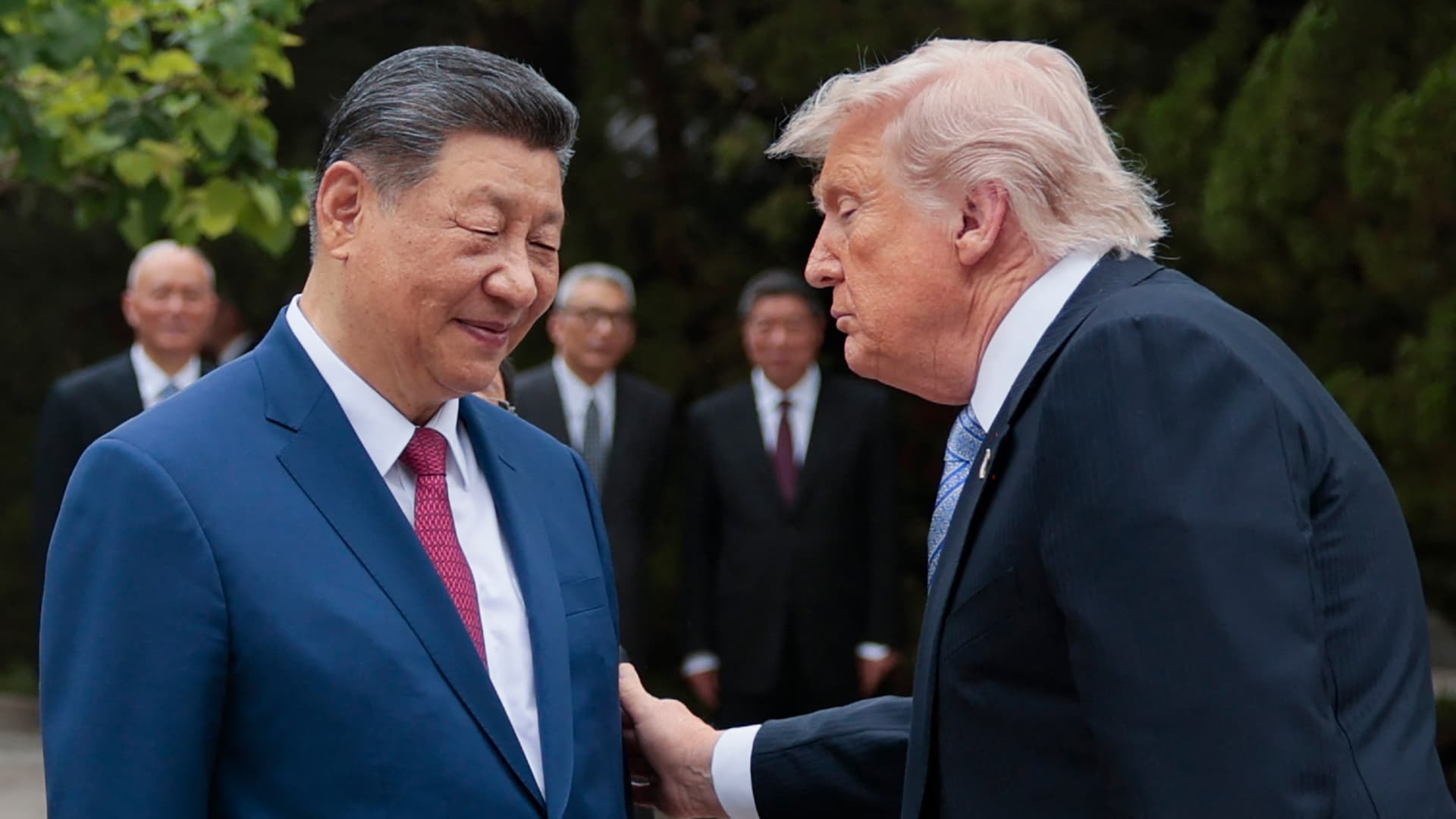
U.S. President Donald Trump (R) gestures to China’s President Xi Jinping as he leaves after a visit to Zhongnanhai Garden in Beijing on May 15, 2026.
Evan Vucci | Afp | Getty Images
Hi, this is Evelyn, writing to you from Beijing. Welcome to the latest edition of The China Connection — a succinct snapshot of what I’m seeing and hearing from local businesses.
U.S. President Donald Trump has left Beijing after a highly anticipated two-day visit with Chinese President Xi Jinping. Fanfare aside, what’s changed for business?
The big story
After a momentous Trump-Xi summit in Beijing last week with over a dozen American executives in tow, the U.S. and Chinese readouts agree on one phrase: constructive strategic stability.
But what does that really mean?
From an economic and trade perspective, the term amounts to “a form of commercial détente,” James Zimmerman, chairman of the American Chamber of Commerce in China, told me.
In practical terms, it signals intent to talk and creates room to resolve disputes without a return to trade war uncertainty — a boost for business confidence, he said.
China emphasized that the framework would set the tone for at least three years, or the rest of Trump’s presidency.
“This is a fundamental change from the previous unilateral definition of strategic competition,” said Hai Zhao, a director of international political studies at the Chinese Academy of Social Sciences, a state-affiliated think tank.
He said that the two countries could use the months before Xi’s planned visit to the U.S. on Sept. 24 to lay the groundwork for greater cooperation on fentanyl, immigration, increased human interaction and tourism.
3 major shifts
Getting here was not possible without changes on several fronts.
First, U.S. Secretary of State Marco Rubio joined Trump on his trip to Beijing, despite Chinese travel sanctions imposed on him in 2020 when he was still a senator.
Rubio, who is also serving as interim security advisor, is the “designated interlocutor” right now, Zhao said. “So there’s no reason China [would not] invite him on this trip and work with him [in] the future.”
Beijing also hopes that Trump can keep anti-China forces at bay domestically even after the midterm elections in November, and preserve bipartisan support for stable U.S.-China relations, Zhao said.
Second, Beijing has made its bottom line on Taiwan clear.
Xi warned Trump that the island — which the Chinese leader described as the biggest issue in U.S.-China relations — could put the bilateral relationship into “great jeopardy” if mishandled.
Trump, meanwhile, pushed back against the idea that Taiwan should pursue independence, especially with U.S. backing, according to an interview with Fox News that aired Friday afternoon, while urging both sides to “cool it.”
The comments offered a much clearer stance on Taiwan than during the Biden administration, when the White House had to reaffirm the longstanding U.S. position after the president’s comments hinted otherwise.
Third, China is increasingly playing the long game on technology.
Nvidia CEO Jensen Huang was tight-lipped on China chip sales when he stopped to speak with reporters on his way to a group meeting with Chinese Premier Li Qiang.
Trump “asked me to come,” Huang said, adding that he was in Beijing to support the president during the summit.
But when Trump was asked about the Nvidia H200 chips, he indicated that China had chosen not to buy them, while leaving open the possibility that this could change.
“This is a calculated defensive maneuver by President Xi,” Nomura’s Chief China Economist Ting Lu said in a note.
“Beijing is reluctant to lock its major tech companies into a U.S.-regulated system that directly enriches the U.S. Treasury via a 25% surcharge and weakens Beijing’s efforts to support China’s own AI chipmakers.”
Just as China in 2025 was far more prepared to withstand U.S. tariffs than in 2018 , the strategic stakes in the technological race are now becoming clearer.
Need to know
China’s April economic data underwhelms, with retail sales growth slowing to lowest since 2022
Retail sales rose by just 0.2% in April from a year ago, while fixed asset investment fell on a year-to-date basis as the real estate drag worsened. Industrial production rose by 4.1%, also slower than expected.
U.S. can hold AI talks with China because ‘we are in the lead,’ Bessent tells CNBC
The U.S. and China are “going to set up a protocol in terms of how do we go forward with best practices for AI to make sure nonstate actors don’t get a hold of these models,” U.S. Treasury Secretary Scott Bessent told CNBC’s Joe Kernen on Thursday
A state banquet, selfies with Musk and Huang’s noodle run: The spectacle of Trump’s Beijing visit
Alongside the Trump-Xi summit, videos and photos emerged on social media of U.S. executives, especially Tesla CEO Elon Musk and Nvidia CEO Jensen Huang, mingling with locals or exploring Beijing.
Coming up
May 18-19: APEC senior officials meet in Shanghai
May 19-20: Russia’s Vladimir Putin pays a state visit to China
May 21: Xiaomi holds launch event for YU7 GT SUV in Beijing
May 20-23: APEC trade ministers meet in Suzhou
May 24-27: IEEE International Symposium on Circuits and Systems in Shanghai