Key Points
-
It also helped lift the tech giant’s fundamentals over the consensus analyst estimates.
-
But investors were concerned that growth rates and margins might be down in the subsequent quarter.
- 10 stocks we like better than Apple ›
Apple (NASDAQ:AAPL) published its fiscal third-quarter results and held a conference call just after market close on Thursday, and its share price slumped in after-hours action. It was still down, by 7%, shortly before the start of Friday’s trading session.
Marking Tim Cook’s lastearnings callas CEO — he’s transitioning to executive chairman on Sept. 1 — the tech giant surprised many observers by posting double-digit growth from an unexpected source. Read on for more about this surprise, plus how the company did in other aspects of its business.
Where to invest $1,000 right now? Our analyst team just revealed what they believe are the 10 best stocks to buy right now, when you join Stock Advisor. See the stocks »
Calling on a hot product
Apple notched a new all-time high revenue figure for the quarter, which ended June 30. It earned just over $109.4 billion on the top line, up 16% year over year.
Image source: Getty Images.
The surprise was packed inside that number. The tech giant splits its revenue between product and service sales. For years, the latter tended to be the motor of its overall growth. Not this quarter, however, as products zoomed 18% higher to almost $78.7 billion.
Revenue from services rose by 12% to $30.7 billion. While that lagged products, it’s still very respectable, especially considering that — like overall revenue — it notched a new all-time high.
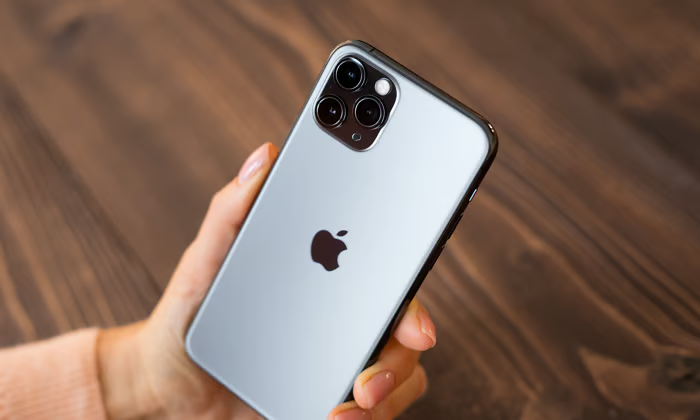
Returning to products, it was the company’s now-almost-20-year-old device brand that put the zip in the category’s growth. This, of course, is the iPhone, now in its 17th iteration. iPhone sales leaped by 22% over the year-ago quarter to just below $54.3 billion. That take was 69% of total product revenue.
Apple attributed the iPhone surge to sustained demand for the 17. Typically, consumer hunger for a new iPhone peaks during the pre-holiday and holiday periods, then tapers in the subsequent months. Among the factors responsible for the shift was the company’s decision to pack advanced features into standard 17 models rather than limit them to the pricier Pro versions.
The one other hot grower was another long-standing Apple line, Mac desktops and laptops. Mac brought in nearly $10.4 billion and was responsible for 13% of sales. Meanwhile, iPad sales slumped by 6% to under $6.2 billion, while wearables, home, and accessories rose by the same percentage to $7.9 billion.
Skipping to the bottom of the profit and loss statement, headline net income was nearly $29.79 billion, or $2.02 per share, for sturdy (27%) growth over the year-ago period.
Both revenue and profitability topped the consensus analyst estimates. Collectively, pundits tracking Apple stock were expecting a top line of $108.86 billion and earnings per share (EPS) of $1.89.
Guiding for some disappointment
In the conference call discussing Apple’s recent performance, management proffered guidance for the current (fourth) quarter. Overall revenue should rise by 9% to 11% year over year, with foreign exchange headwinds affecting it to some extent. Extreme supply constraints on memory components will impact production and, in turn, the company’s fundamentals.
This includes profitability, of course. Although Apple hasn’t explicitly provided bottom-line guidance for years, it does offer a gross margin projection. For the fourth quarter, this is expected to be 47% to 48%.
If achieved, all of these numbers would be down from their third-quarter counterparts. I feel this is the main reason for the post-earnings sell-off. Again, top-line growth for the trailing quarter was well higher, at 16%. And the gross margin was a shade over 50%.
Those supply constraints and the increased costs that derive from them should continue for some time. Until they ease, Apple will feel the pressure to get those numbers up. Investors are accustomed to high, impressive growth rates and thick margins at this company, and it might be a quarter or several before they see them.
Apple is a splendid business, and its always-premium products are becoming even more compelling — even as consumers are being more careful with their spending. The company will get past any fourth-quarter slump, but growth in its stock will probably be sluggish, at best, while it does so.
Should you buy stock in Apple right now?
Before you buy stock in Apple, consider this:
The Motley Fool Stock Advisor analyst team just identified what they believe are the 10 best stocks for investors to buy now… and Apple wasn’t one of them. The 10 stocks that made the cut could produce monster returns in the coming years.
Consider when Netflix made this list on December 17, 2004… if you invested $1,000 at the time of our recommendation, you’d have $397,081!* Or when Nvidia made this list on April 15, 2005… if you invested $1,000 at the time of our recommendation, you’d have $1,166,221!*
Now, it’s worth noting Stock Advisor’s total average return is 889% — a market-crushing outperformance compared to 203% for the S&P 500. Don’t miss the latest top 10 list, available with Stock Advisor, and join an investing community built by individual investors for individual investors.
*Stock Advisor returns as of July 31, 2026.
Eric Volkman has positions in Apple. The Motley Fool has positions in and recommends Apple. The Motley Fool has a disclosure policy.
The views and opinions expressed herein are the views and opinions of the author and do not necessarily reflect those of Nasdaq, Inc.