If you ask Ursula Adams how dating apps make her feel, the answer will be “fatigued”.
“The constant repetitive chats over text is really tiring,” she said.
“The tedious swiping and saying no to people over and over and over and over again. I think that’s quite brutal.”
More than 3 million Australians use dating apps, according to the eSafety Commissioner, with one-third of relationships now formed online.
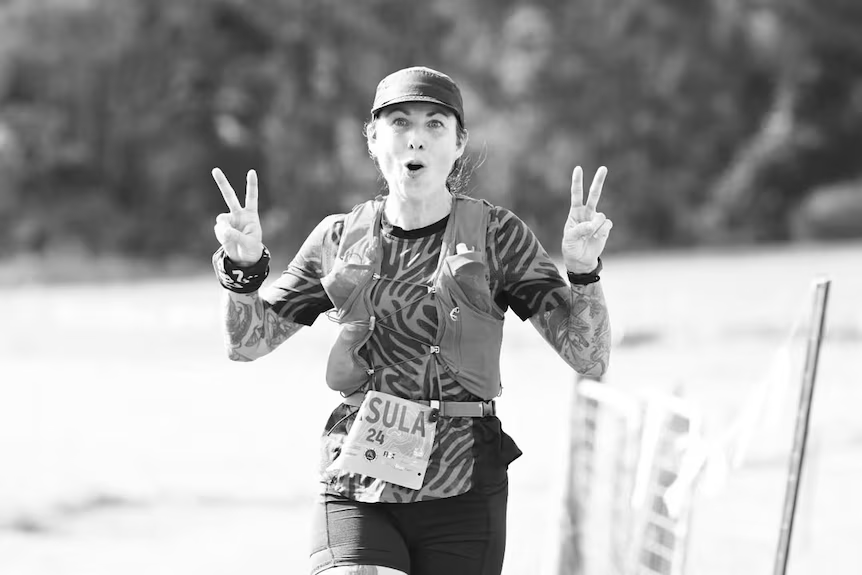
Ursula Adams says dating apps only offer a glimpse into who people really are. (Supplied: Ursula Adams)
Dating apps have rewritten the rules of intimacy.
Chance encounters have given way to predictive algorithms, while getting to know someone has turned into a cycle of swiping and split-second decisions.
“We’re stuck in the phones and we’re losing that human connection,” Ms Adams said.
“You are promoting a small portion of your life via a handful of photos or a few statements, and I don’t think that really gives the true essence of who an individual is as a person.”
‘Small snippets’ of a person
Ms Adams said people made judgements on apps based “off those small little snippets of people’s lives”.
“All this tedious swiping and chatting ends up feeling like it’s for nothing,” she said.
Ursula Adams has been organising group meet-ups instead of only using dating apps. (Supplied: Ursula Adams)
This can warp our view of relationships, according to University of California Davis psychology professor Paul Eastwick.
“It feels like you’re shopping. It feels like you’re selling yourself and you’re evaluating other products,” he said.
Professor Eastwick said this perception of endless choice was “a bad model of attraction”.
“It’s going to lead people to be a little bit too stringent early on and less likely to give people more of a chance,” he said.
Apps give people a lot of options, but finding true romance can take time. (Pexels: Ravi Roshan)
But with “tons of options out there”, Professor Eastwick said apps encouraged quantity over quality.
“This tendency to date so many people in rapid succession, you think you can kind of use your gut instinct after a few minutes and know how you feel about somebody,” he said.
“[But] what draws people in are things like self-disclosure, being able to joke and banter. Something like that takes a little while to come into focus.”
Why it is hard to stop swiping
Apps create a world of minimal commitment and maximal pleasure, according Adelaide University distinguished professor of sociology Anthony Elliott.
“What’s particularly intoxicating for people is the immediacy,” he said.
“Looking at particular photos, representations of people and the stories that are put around that, and deciding, virtually within about three to six seconds, whether you want to swipe left or swipe right.”
Dating apps have redefined how we form relationships. (ABC Gold Coast: Dominic Cansdale)
Professor Elliott said the apps lured people back by making connection easy, often using pre-written prompts.
“[It] starts to redefine what we mean by sexual relationships and eroticism,” he said.
“These relationships are fluid, they’re fast, and in the same way that you can connect with someone, you can disconnect at the push of a button.”
But behind every swipe is an algorithmic bias deciding who will be shown next.
“It’s important for people to try to be digitally literate about these influences and the fact that what’s coming, what’s being pushed towards you, is not neutral, it’s not value-free,” Professor Elliott said.
It takes time
Professor Eastwick said attraction had become thought of as something that could be curated and shaped in advance.
“It means that we’re generally resistant to have casual interactions with people that we might not normally interact with or people who seem different from us,” he said.
“When people first meet, you kind of have a sense of whether you’re clicking with somebody, but it’s actually relatively unstable.”
Paul Eastwick says attraction takes time to spark and build. (ABC Gold Coast: Dominic Cansdale)
But Professor Eastwick said apps should be “a supplement to a healthy dating diet, rather than the central piece”.
“I suggest going out with fewer people, but going on more dates with them before you decide [and] don’t just keep doing the same restaurant or bar,” he said.
“Do something that’s a little bit more interactive — anything that gives you a chance to talk, but also doing something at the same time.”
Rather than deleting dating apps altogether, Ms Adams has started looking elsewhere too.
Ursula Adams has side-stepped the dating apps and tried her own approach to meeting new people. (ABC Gold Coast: Dominic Cansdale)
She has organised her own group meet-ups, where about half-a-dozen strangers take their dogs for a beach walk or go for a mountain bike ride.
“If I spend 15 minutes a day on these apps, could I have just gone out to some new event for an hour a week and potentially met one other person?” she said.
“Would that not have been more fulfilling, I wonder?”