Welcome to the Free edition of How They Make Money.
Over 300,000 subscribers turn to us for business and investment insights.
In case you missed it:
📊 Check out 100+ companies visualized in our latest monthly report.
Muse launched on September 8 as Meta’s latest attempt to catch up in AI.
Despite being available only in the US and Canada, Meta’s new personal agent has reached more than 3.4 million downloads, according to Sensor Tower. Muse climbed to the top of the US app stores, and sent investors scrambling to understand what consumer agents could mean for everything from shopping and travel to banking and insurance.
At Meta Connect this week, the company made clear that Muse will not remain confined to an app, with plans to extend it across computers, communication channels, and smart devices.

Muse is Meta’s attempt to give consumers a digital Alfred. It’s “heavily inspired” by OpenClaw, according to product chief Nat Friedman. It can understand what you want, handle tasks, and increasingly act on your behalf. In doing so, Meta is making a play for the consumer AI interface that goes far beyond the chatbot.
If agents increasingly research, compare, communicate, and transact on our behalf, the implications stretch far beyond Meta. They could reshape who owns commercial intent, where advertising happens, which businesses get bypassed, and how much computing infrastructure it takes to run it all.
The internet was built around getting humans to click and scroll. The agentic internet may increasingly be built around AI choosing and acting for us.
Today at a glance:
-
💬 Meta’s new aggregation play
-
📦 Why Amazon is fighting back
-
🛒 Who wins when the interface moves?
-
🤖 Fewer clicks but more compute

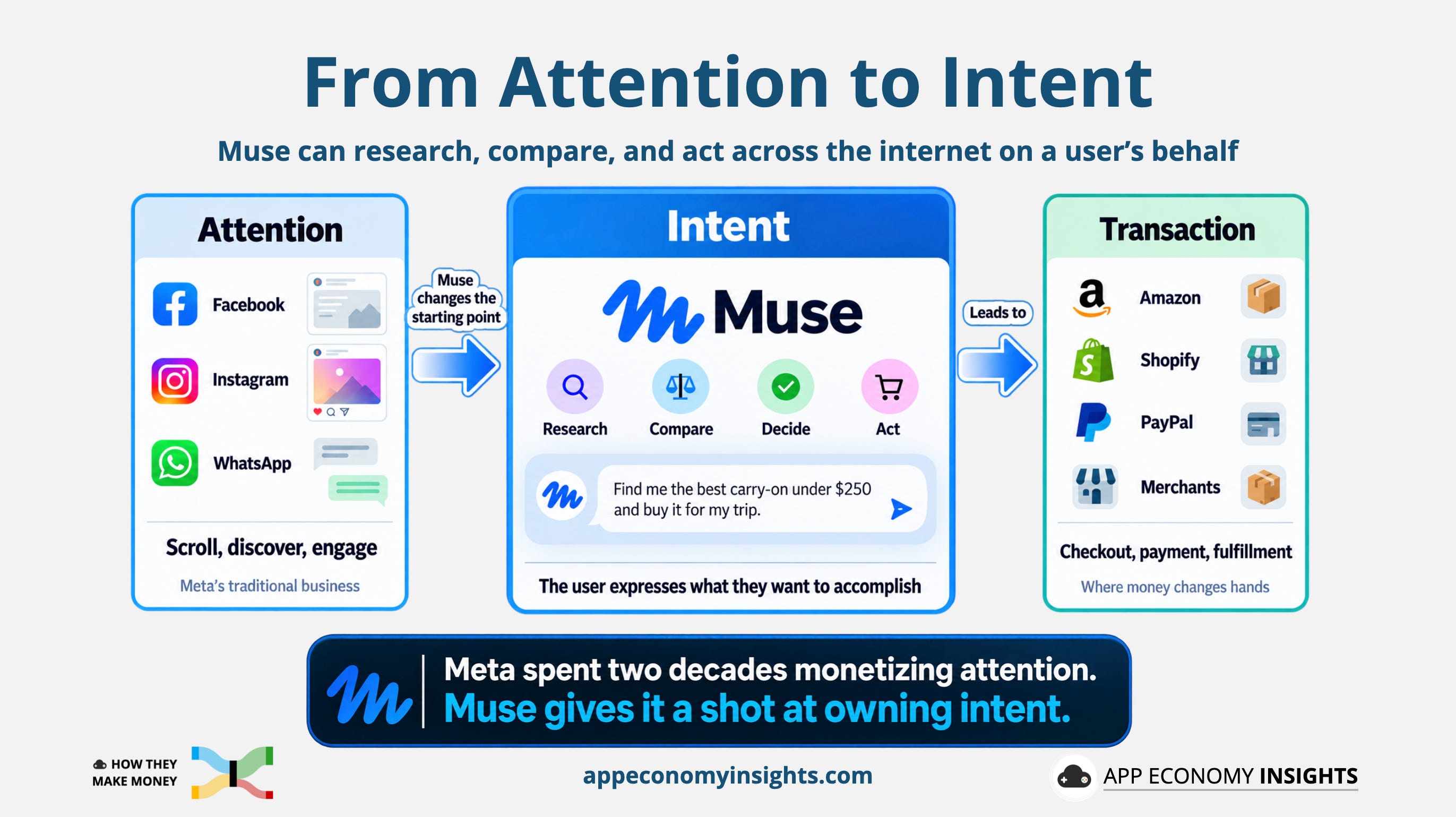
What makes Muse different is that the agent can increasingly operate outside Meta’s own apps. Instead of keeping users inside Facebook, Instagram, or WhatsApp, Muse can sit between them and the rest of the internet, helping research a trip, compare products, book a restaurant, or buy something across multiple services.
These capabilities blur the boundaries between the internet’s traditional aggregators. Google aggregated information, Meta aggregated social attention, and Amazon aggregated shopping demand. Muse is trying to aggregate intent itself.
Meta wants to turn Muse into a persistent consumer service that knows your context and can keep acting on it. Meta gives the example of Muse turning a recipe saved on Instagram into a grocery list, remembering friends’ dietary restrictions, planning the dinner, and sending invitations. Those capabilities aren’t unique on their own. But combining memory, context, action, and distribution into one always-available consumer agent creates something much closer to a personal operating layer than a chatbot.
Meta is extending that idea into the physical world. Muse will come to its AI glasses, where it can act on what users see, including helping them shop for products in front of them. Meta is also dramatically expanding the hardware itself, with more than 100 glasses options expected across Ray-Ban, Oakley, and Meta Glasses by year-end.
Glasses can potentially capture the context in which intent emerges. See a product, restaurant, landmark, or problem in the physical world, and the agent increasingly has the context to understand what is happening and act from there.
Zuck’s “one more thing” made that ambition even more explicit. Muse Charm is a Tamagotchi-esque palm-sized device built specifically around Muse, giving users a way to talk to their agent without unlocking a phone or opening an app. He described it as the fastest way to access Muse when you are not wearing glasses, with Meta planning to ship it for the holidays.
The timing is notable because OpenAI is also preparing its first consumer device with former Apple design chief Jony Ive. The exact form factor remains uncertain, but Meta is already trying to establish Muse as an always-available interface before OpenAI enters the category.
Extending Muse into the physical world gives Meta access to high-intent activity close to the transaction. The company still says conversations and data inside Muse’s virtual machine are not shared with its advertising systems, reducing one obvious concern for users being asked to grant an agent access to more of their digital lives.
Meta also offered its clearest monetization roadmap yet at Connect. Zuck said Muse is free for most users, but Meta also offers $20 and $100 monthly subscription tiers for heavier usage. Meta is eventually expecting to make money by taking a small fee from transactions. That makes owning intent even more important: Meta does not necessarily need to show an ad or own the merchant if it can participate economically when Muse helps complete the purchase. Advertising could still find its way into Muse over time.
Takeaway: Meta spent two decades monetizing attention inside its own apps. Muse gives it a chance to own the layer where users express intent before money changes hands.
No company illustrates the stakes of this shift better than Amazon. It has spent decades becoming the default starting point for online shopping, owning both the final transaction and the discovery process leading up to it.
Consumers arrive knowing roughly what they want, search Amazon’s catalog, compare products, and buy. Amazon gets the data, the customer relationship, and the opportunity to monetize demand before checkout.
Muse challenges that sequence. If an agent can research products, compare options, and decide what to recommend before the user ever reaches Amazon, then Amazon may still fulfill the purchase while losing control of the journey that led there.
That helps explain why Amazon moved quickly to block Muse from shopping on Amazon.com.
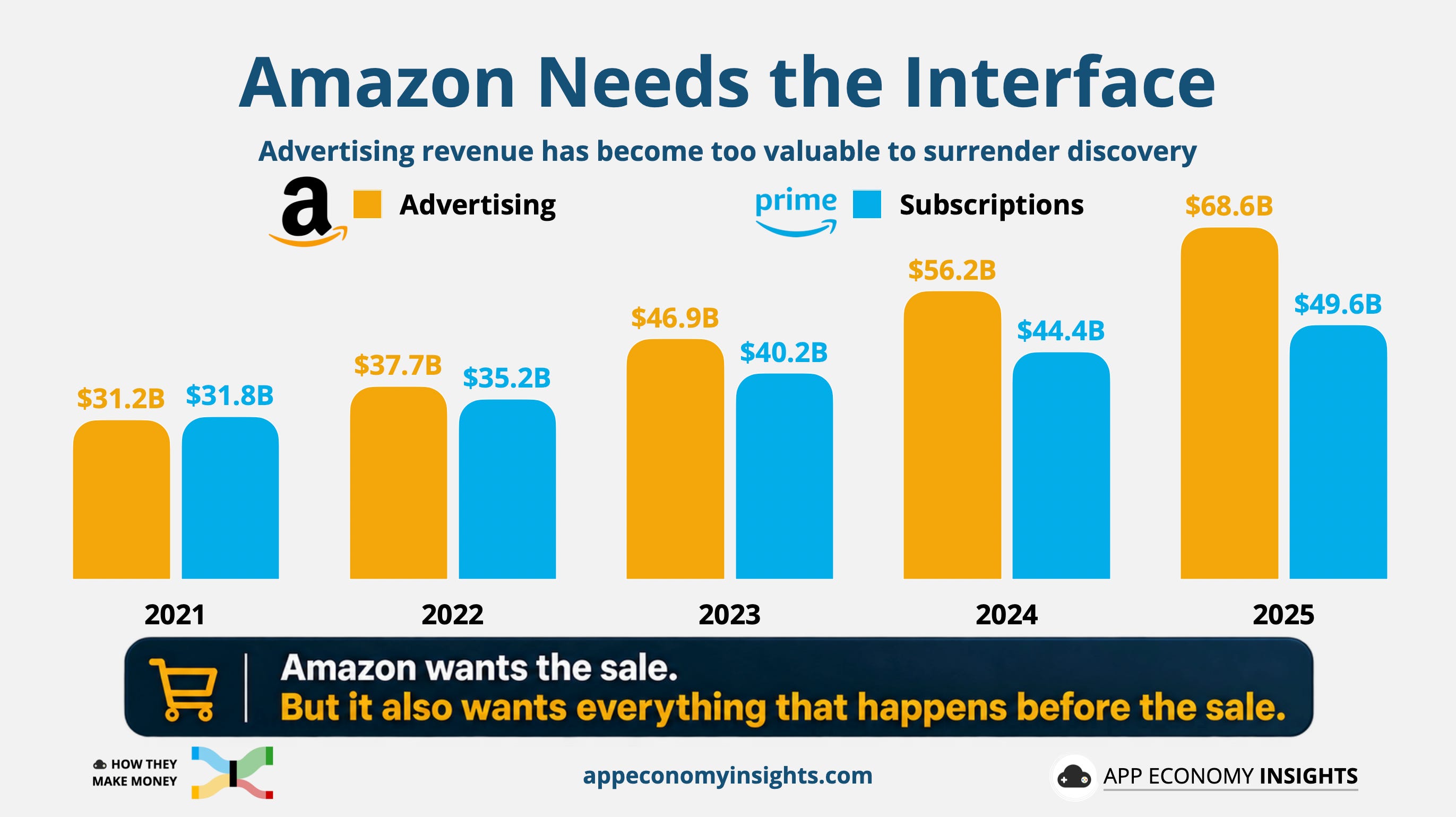
The economics are substantial. Amazon generated $68.6 billion in advertising revenue last year, up 22% Y/Y. Advertising has more than doubled since 2021 (the fastest-growing segment), and now exceeds Amazon’s subscription revenue by nearly $19 billion.
For context, Amazon’s non-AWS segments generated $34.4 billion in operating income in 2025. Amazon does not disclose advertising margins, but ads alone generated twice that amount in revenue. It’s entirely plausible that Amazon’s underlying retail and logistics operations would be loss-making without the high-margin advertising layer sitting on top.
Instead of searching Amazon for headphones, imagine you tell the agent, “Find me the best noise-canceling headphones under $300 for long flights.” Muse can research the options, compare reviews and specifications, and make a recommendation before the user ever reaches Amazon.
The transaction might still happen there, but Amazon risks losing much of what happens beforehand, including search, sponsored-listing impressions, product discovery, and opportunities to increase the basket. Evidence already shows retailers give something up when an outside agent controls the experience. Walmart reportedly found that purchases through OpenAI’s Instant Checkout converted at roughly one-third the rate of customers shopping directly and produced smaller baskets.
That dynamic raises a new question about unit economics. If Muse takes a fee on purchases it completes, what does that look like? An affiliate-style take rate, a flat routing fee, or sponsored placement? Moving the interface forces a renegotiation of where the margin lives. If agents shrink baskets or reduce retailers’ ability to upsell, merchants will resist paying another toll on top.
Amazon has something Muse cannot easily replace. Over the past decade, it has built warehouses, transportation, inventory placement, and last-mile delivery infrastructure that lets it get products to customers incredibly quickly. AI can’t replace that physical network.
But that physical moat also depends on enormous volume. Amazon has spent heavily to build infrastructure with high fixed costs, which become more efficient as more purchases flow through the network. If agents gradually divert transactions toward Walmart or other retailers, every lost order spreads those costs across slightly fewer purchases.
Takeaway: Muse threatens Amazon’s control of discovery far more than its ability to fulfill the purchase. The battle is over who owns the customer before checkout.
Amazon is only one side of the story. Companies will respond very differently to agents depending on where they sit in the value chain. Shopify and PayPal are leaning in because neither depends on owning a consumer search surface filled with ads. Shopify wants its merchants and Shop Pay accessible wherever consumers choose to shop, while PayPal is opening its merchant network to Muse. Both can benefit even if Meta owns the interface.
The incentives also look different for challengers. Walmart was quick to experiment with ChatGPT shopping because, as a distant number two in e-commerce, capturing demand that might otherwise go to Amazon can be worth giving up some control over the interface. Muse may be even more attractive because Meta is not trying to own the checkout itself.
That leaves us with a useful distinction. Companies that make money by owning discovery have more to protect, while companies that make money from the transaction or infrastructure underneath it can afford to be more open to agents.
Advertising itself probably does not disappear either. It may simply move closer to the agent. We are already seeing this with ChatGPT, where Amazon advertisers can reach users inside AI conversations. Amazon extends its ad business beyond Amazon.com, while OpenAI monetizes the intent generated inside ChatGPT.
Muse could eventually create similar arrangements. Meta has promised not to feed private Muse conversations into its own advertising systems, but that does not prevent commerce partners from paying to participate in the experience with user permission. One possibility is that Meta eventually monetizes some Muse activity through someone else’s advertising or transaction infrastructure rather than immediately building its own.
The consequences extend beyond advertising. Another class of business may be exposed for a different reason. Companies that benefit from consumer inertia. A chatbot can tell someone that their savings account pays too little. An agent can identify excess cash, compare yields, and move the money. The same logic can extend to insurance, brokerage, and other categories where incumbents benefit from customers not continuously shopping for a better deal.
Agents can shorten the distance between recognizing a better option and acting on it. For banks, the real proof would eventually show up in higher deposit costs and greater movement of customer balances.
The broader shift is more important than any one partnership. Today, advertisers largely pay to influence what humans click. In an agentic world, they may increasingly pay to influence what agents consider, making product data, availability, pricing, fulfillment, and trusted merchant relationships more valuable while reducing the importance of some of the webpages and ad placements that sit between intent and purchase.
Takeaway: Agents may not eliminate advertising. They could move the most valuable ad opportunity from winning the click to earning a place in the agent’s consideration set.
There is one more economic shift. While agents simplify the internet for users, they make the underlying infrastructure much more demanding.
A traditional search might involve a few queries and clicks. An agentic task can involve repeated cycles of planning, searching, retrieving information, comparing options, calling tools, checking results, and eventually taking action. The user may see a much simpler experience, but the machine is doing considerably more work behind the scenes.
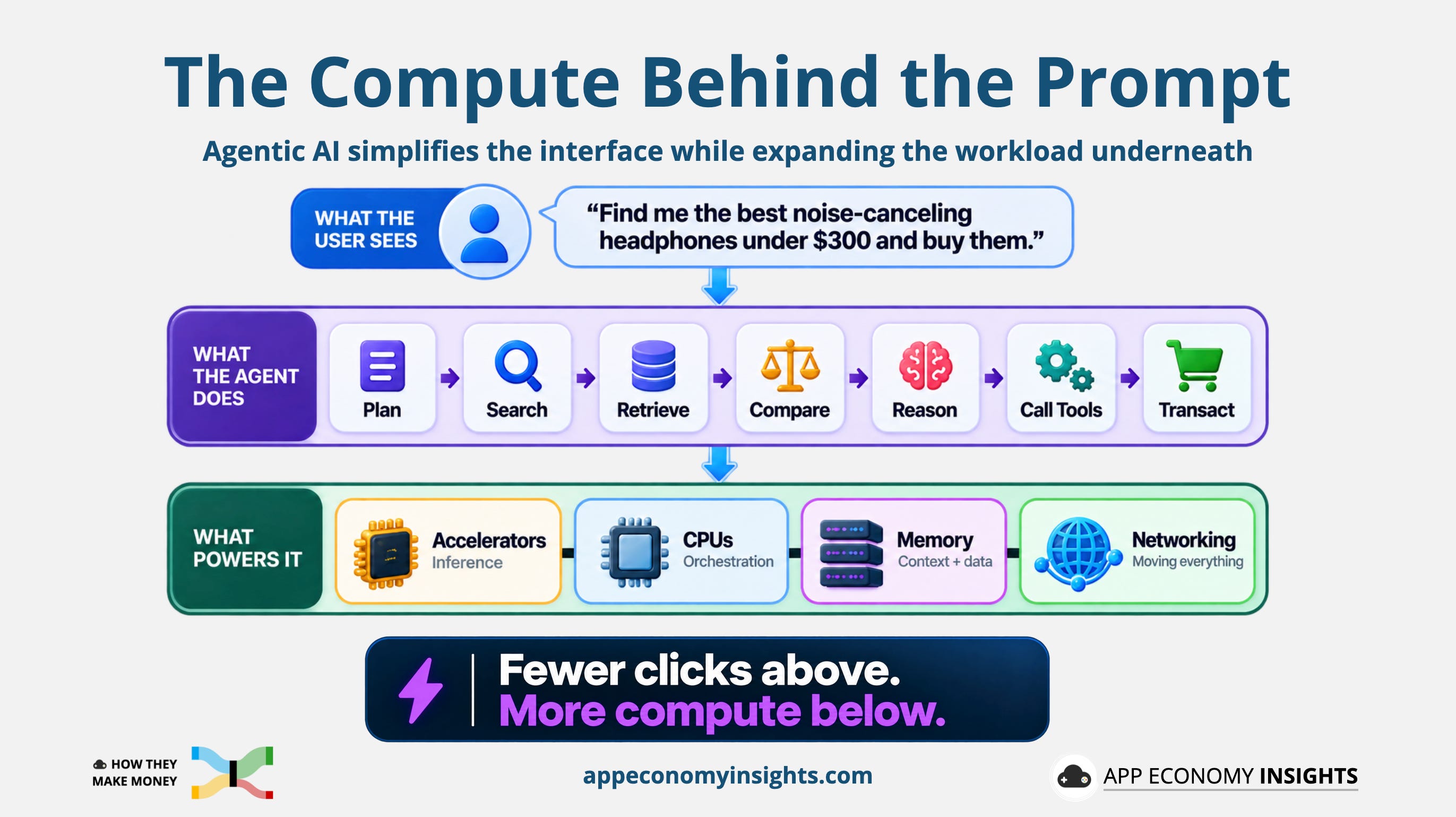
Muse’s early traction suggests consumer agents could dramatically expand the inference workload. If AI shifts from responding to discrete prompts toward agents continuously researching, communicating, and acting in the background, each user can generate considerably more computing activity.
Meta Connect offered a glimpse of what that requires. The new Muse Realtime Avatar required Meta to redesign its real-time inference stack to continuously generate synchronized voice and video. Meta says the resulting optimizations increased serving capacity 8x, allowing 12 concurrent video sessions on a single GB200 while keeping latency below one second.
The broader shift goes well beyond avatars. The first phase of the AI boom was dominated by training increasingly large models, concentrating attention on GPU accelerators. Agentic AI moves more activity toward continuous inference and orchestration, which can broaden demand into CPUs, memory, networking, and high-speed interconnects alongside GPUs.
AMD is a prime example of this architecture shift. Beyond competing in data center GPUs, its high-core-count EPYC server CPUs are increasingly important to agentic workloads, handling orchestration, data retrieval, tool calls, and the enterprise services that sit between prompts and accelerator inference. That’s one reason AMD has been a core pillar in App Economy Portfolio, where it recently became a 56-bagger and remains my largest holding.
Memory is another example. Agents continuously move between models, context, external data, and tool outputs, increasing the importance of larger pools of system memory rather than relying only on memory attached directly to accelerators.
The result is an interesting inversion:
-
Above the model, AI could compress the internet by reducing searches, webpages, calls, and ad surfaces.
-
Below the model, it could expand the infrastructure required to execute those same tasks, from compute and memory to communications, payments, and transaction software.
That’s it for today.
Happy investing!
Thanks to Fiscal.ai for being our official data partner. Create your own charts and pull key metrics from 50,000+ companies directly on Fiscal.ai. Save 15% with this link.
Disclosure: I own AMD, AMZN, ANET, GOOG, META, and NVDA in App Economy Portfolio. I share my ratings (BUY, SELL, or HOLD) with App Economy Portfolio members.
Author’s Note (Bertrand here 👋🏼): The views and opinions expressed in this newsletter are solely my own and should not be considered financial advice or any other organization’s views.