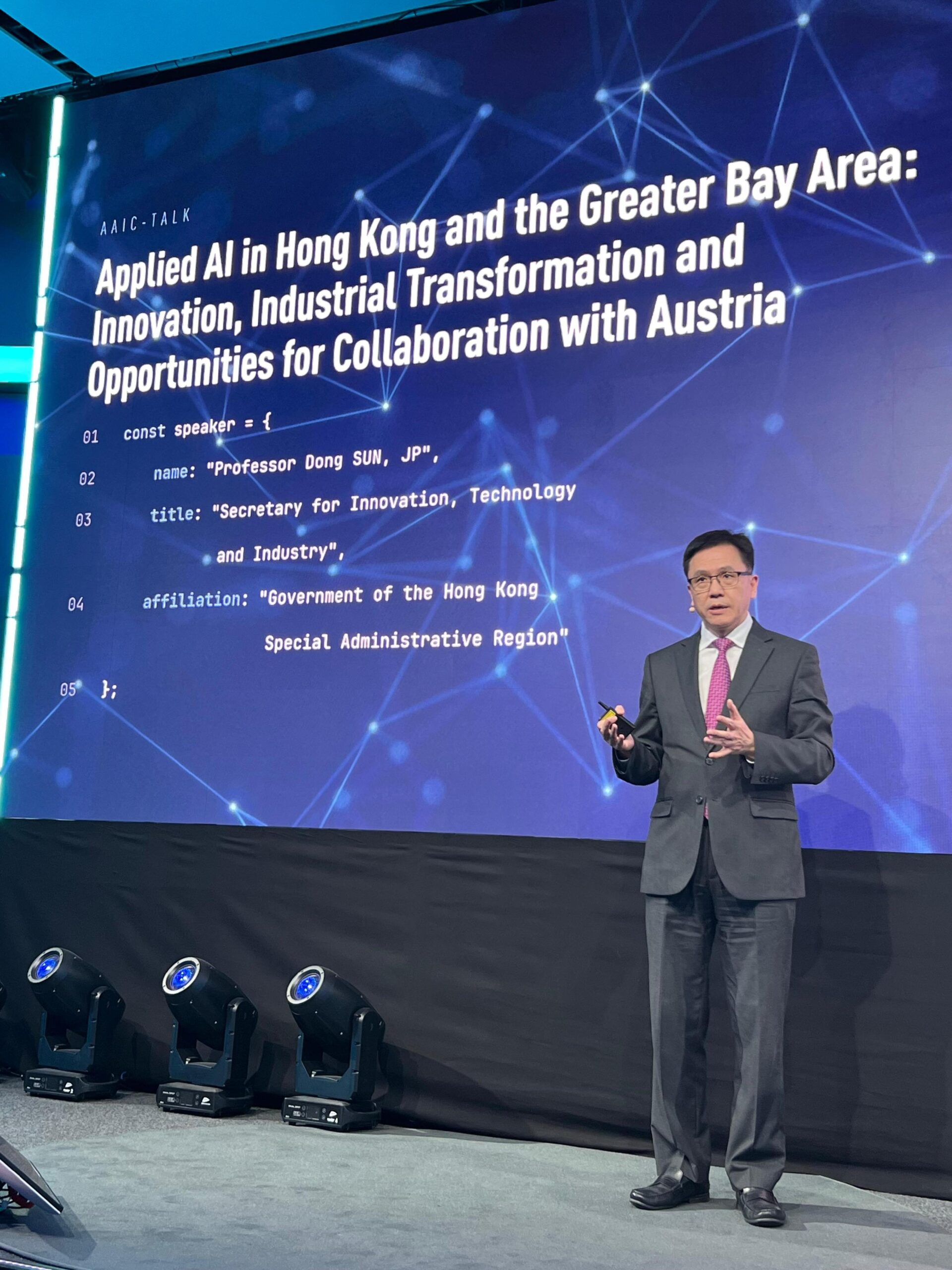
Hong Kong has outlined its plans to strengthen artificial intelligence (AI) research, computing infrastructure and international collaboration during a keynote speech at the Applied Artificial Intelligence Conference 2026 in Vienna.
Speaking on 24 September, Secretary for Innovation, Technology and Industry Prof Sun Dong described AI as a strategic priority for the Hong Kong Special Administrative Region (HKSAR) Government, with policies aimed at supporting industrial transformation, public service modernisation and cross-border innovation links. Details of the speech were published by the HKSAR Government.

Prof Sun said Hong Kong is positioning AI as one of its core industries under a strategy focused on “industries for AI” and “AI for industries”. The approach combines investment in research capabilities with wider adoption of AI technologies across business and society. He also highlighted Hong Kong’s role as a gateway linking international research and technology ecosystems with opportunities in the Greater Bay Area.
Research capacity and computing infrastructure
The speech highlighted Hong Kong’s existing research base, including universities with strong international rankings in data science and AI. Prof Sun also pointed to the recently established Hong Kong AI Research and Development Institute, which has been tasked with advancing AI research and encouraging practical applications across industries.
Hong Kong’s InnoHK initiative was presented as a key platform for international collaboration, bringing together universities and research institutions from multiple economies. Within the programme, the AIR@InnoHK research cluster focuses on AI and robotics research, with an emphasis on translating academic work into deployable technologies.
Computing capacity was identified as another central component of Hong Kong’s AI ambitions. The Sandy Ridge Data Facility Cluster, currently under construction, is expected to provide 180,000 peta-floating point operations per second of computing power by 2032. According to the government, this would represent a 36-fold increase from current levels. The expansion builds on wider efforts to strengthen digital infrastructure, including projects linked to the high-performance computing hub and broader initiatives to modernise public and industrial technology systems.
Greater Bay Area seen as regional innovation platform
Prof Sun emphasised Hong Kong’s role within the Guangdong-Hong Kong-Macao Greater Bay Area, which he said has a population of 88 million and an annual gross domestic product of RMB15 trillion (approximately US$2.1 trillion). He described Hong Kong as a highly open economy supported by legal protections, intellectual property safeguards and access to international capital.
According to the speech, infrastructure projects such as the Hetao Hong Kong Park and the San Tin Technopole are intended to strengthen cross-border innovation activity. The Hetao development, opened in December 2025, is designed to facilitate collaboration between Hong Kong and mainland Chinese research institutions through shared laboratories, data access and talent policies.
The San Tin Technopole is expected to support industrial activities ranging from prototyping to large-scale manufacturing. Together, the projects are intended to connect international technology companies and researchers with supply chains and markets in the Greater Bay Area. Hong Kong has also been expanding advanced computing initiatives through projects such as the advanced computing centre and quantum computing programme.
Talent attraction and international collaboration
The address also focused on talent development and international recruitment. Prof Sun noted that Hong Kong is home to five universities ranked among the world’s top 100 and said the government has introduced the Frontier Technology Research Support Scheme to attract overseas scientific researchers to lead frontier projects in the city.
He said Hong Kong aims to promote responsible AI adoption while balancing innovation with ethical oversight. This commitment has been reinforced through the territory’s First Five-Year Plan and the 2026 Policy Address, both of which place AI adoption and industrial upgrading among the government’s priorities.
Prof Sun also referred to Hong Kong’s recent performance in international competitiveness rankings, including second place in the 2026 IMD World Competitiveness Yearbook and fourth in the 2025 World Digital Competitiveness Ranking. He added that the number of start-ups in Hong Kong had risen by 40 per cent over five years to more than 5,200.
The speech concluded with a call for closer international co-operation on AI development. Prof Sun said Hong Kong intends to position itself as a bridge between research and industry, and between Asian and European innovation ecosystems. The strategy aligns with ongoing infrastructure expansion plans, including efforts to align computing infrastructure with national development priorities.
This article is created with the assistance of OpenGov AI.