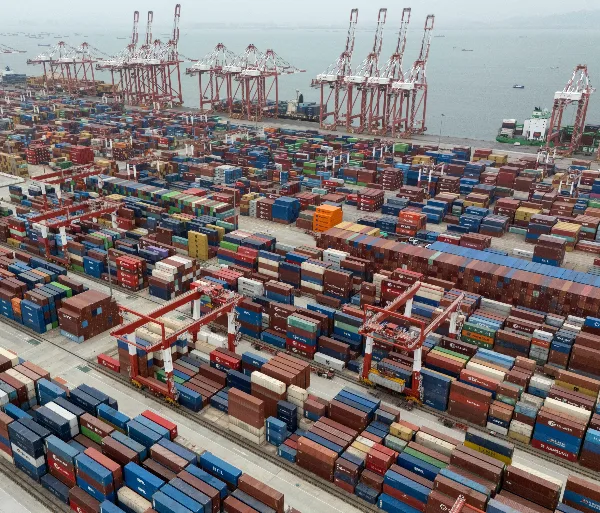

Shipping containers are seen ready for transport at the Guangzhou Port in the Nansha district in southern China’s Guangdong province. (AP)
Treasury Secretary Scott Bessent said Wednesday that the United States and China have agreed to extend their trade truce through Jan. 10.
The move preserved an economic détente reached last year as Chinese President Xi Jinping arrived in Washington for a high-profile state visit with President Donald Trump.
Bessent announced the extension after meeting with Chinese Vice Premier He Lifeng in Washington, saying the two sides had agreed to extend what is known as the “Busan Agreement,” which had been scheduled to expire Nov. 10.
Bessent made the announcement in an interview with Fox News’ “Special Report,” with Reuters and NBC News also reporting his comments.
“We have agreed today that we will extend what we call the Busan Agreement,” Bessent said, adding that the agreement will remain in place until Jan. 10.
The extension gives the two countries additional time to work through unresolved trade issues and potentially negotiate a broader economic agreement, with Bessent saying Washington remains open either to maintaining the existing framework or pursuing a larger deal.
The confrontation is significant beyond the bilateral relationship because the United States and China are the world’s two largest economies, with their trade ties deeply connected to global manufacturing, technology, agriculture, and supply chains.
The two economic powers’ trade tensions have already reshaped trade flows and increased uncertainty for businesses around the world, while the International Monetary Fund has warned that renewed trade tensions could weigh on global growth and financial markets.
The trade truce grew out of a sharp escalation in the U.S.-China trade confrontation last year, when successive rounds of tariffs and retaliatory measures pushed bilateral tariff rates above 100% at their peak and raised concerns about an even broader economic rupture.
Trump and Xi reached the Busan arrangement during their meeting in South Korea in October 2025, agreeing to roll back or suspend a number of measures that had fueled the confrontation and giving negotiators time to address longer-term disputes.
Under the arrangement, China suspended retaliatory tariffs on a broad range of American agricultural products and committed to increased purchases of U.S. soybeans, while also suspending new export controls involving rare earths and other critical minerals.
China also agreed to measures involving fentanyl precursor chemicals and to remove or suspend various retaliatory actions against American companies.
The United States, meanwhile, suspended or reduced certain tariff measures and other trade restrictions, including measures involving export controls on Chinese companies.
The truce substantially lowered tariff levels that had resulted from the tit-for-tat escalation, but it did not resolve the fundamental trade disputes between Washington and Beijing.
Those disputes remain evident in the negotiations leading up to Xi’s visit.
U.S. officials have pressed China over implementation of commitments involving rare-earth minerals and magnets, with American officials saying Chinese deliveries of rare earths “have not been up to par,” according to Reuters.
Bessent said Wednesday that some Chinese commitments under the existing arrangement had not been fully carried out.
“There are some deliverables that have not been perfect on the Chinese side,” Bessent said, according to NBC News, indicating that Washington wants to see more thorough implementation over the coming months.
The additional negotiating period could also produce new tariff reductions on selected goods.
U.S. Trade Representative Jamieson Greer has said the two countries are working through a “Board of Trade” process that could identify categories of goods for reciprocal tariff reductions, including Chinese consumer and low-tech products and U.S. energy, agricultural and potentially medical-device exports.
The administration also has been seeking greater Chinese purchases of American agricultural products and other U.S. exports.
The Jan. 10 deadline therefore does not represent the conclusion of the trade negotiations, but rather an extension of the existing framework while the two sides determine whether they can reach a larger agreement.
The announcement came as Xi arrived in Washington for a three-day state visit, with Trump personally welcoming the Chinese leader and his wife, Peng Liyuan, at Joint Base Andrews on Wednesday evening.
Trump and Xi are scheduled to meet at the White House Thursday, with trade expected to be among the central issues on the agenda.
The leaders also are expected to discuss artificial intelligence, critical minerals and other economic issues, as well as security matters including Taiwan.
The trade discussions follow several days of negotiations between Bessent, Greer and their Chinese counterparts intended to prepare for the Trump-Xi summit.
Those talks also produced an agreement to establish a communications mechanism for the two countries to discuss significant AI safety incidents, with officials expected to continue discussions in coming months.
For now, the extension keeps the existing U.S.-China trade truce in effect through Jan. 10, giving Trump and Xi additional time to decide whether to preserve the current arrangement or use it as the foundation for a broader trade agreement.
© 2026 Newsmax. All rights reserved.