If you read The Diplomat, you probably follow Asia-Pacific affairs – and thus you probably already know that Chinese President Xi Jinping is due to arrive in Washington, D.C. today for a much-anticipated summit with U.S. President Donald Trump.
According to the White House’s itinerary, Xi will land at Andrews Air Force Base on September 23, where he will be personally received by Trump himself. The next day, he’ll receive a formal welcome ceremony at the White House, followed by the actual summit and a state dinner. On September 25, Trump and First Lady Melania Trump will host Xi and his wife for tea; both couples will then visit the National Archives, “where they will view a variety of important records and documents significant to the American and Chinese relationship throughout history.” Then Xi and his delegation will fly home.
What’s most remarkable about this itinerary is what it doesn’t include: a stop in New York, where the United Nations’ General Assembly is currently holding its 81st session. Heads of state and government from around the world are making the trip to New York just for the UNGA, including top leaders from Bangladesh, Japan, Indonesia, Kyrgyzstan, Nepal, Mongolia, South Korea, and Vietnam, just to name a few from The Diplomat’s coverage region.
Meanwhile, Xi is making a trip across the Pacific Ocean and the entire continental U.S. and not bothering to take an extra jaunt up the coast to attend the United Nations’ most important annual event.
Instead, Vice President Han Zheng will be in New York from September 24 to 26 to represent China at the UNGA. According to China’s Foreign Ministry spokesperson Guo Jiakun, “On the sidelines of the general debate, Vice President Han will attend the High-Level Dialogue on the Fifth Anniversary of the Global Development Initiative hosted by China, and meet with [the] U.N. secretary-general, president of the 81st UNGA session, and leaders of relevant countries.”
Apparently, these are meetings Xi couldn’t be bothered to attend himself, despite being just an hour’s plane ride away.
Xi’s absence from the UNGA would seem to undermine China’s consistent rhetorical emphasis on the United Nations’ importance. China’s white paper on global governance, released in June 2026, repeatedly emphasized the U.N. as the “core” of the international order. “The United Nations is the primary platform for practicing multilateralism and advancing global governance,” the white paper declared. “Its leading position must be upheld and remain rock solid; its role can only be reinforced, not weakened.”
In the same press conference where Guo announced Han’s trip, the spokesperson repeated a similar line: “The United Nations is the core platform for global governance, and the general debate of UNGA is a vital opportunity for countries to build political consensus and coordinate multilateral actions.” But if the United Nations, and the UNGA, are so important, why can’t Xi be bothered to attend?
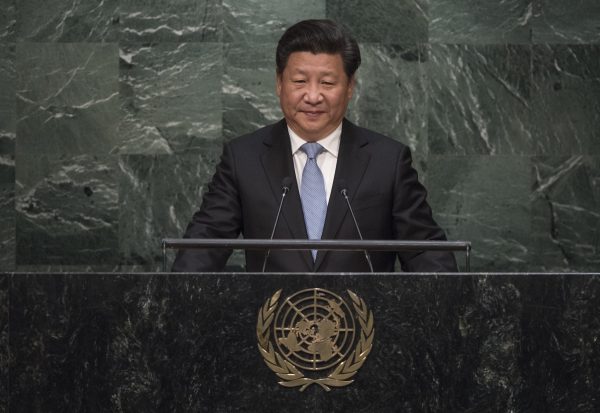
Xi has gone to the UNGA just once since becoming China’s top leader in late 2012. He went in 2015, to commemorate the United Nations’ 70th anniversary, and addressed the UNGA in person for the first and only time.
Notably, this coincided with Xi’s last state visit to the United States, when he included attendance at the UNGA within a broader itinerary that saw him also hold a summit with then-U.S. President Barack Obama. That makes the decision not to do the same thing in 2026 all the more notable.
In 2021, Xi gave a video address to the UNGA, in which he announced China’s Global Development Initiative. He has not delivered a speech before the UNGA since.
Perhaps most notably, Xi chose to skip last year’s UNGA – the 80th session. China puts much stock in these round-number anniversaries, pegging trips abroad and major upgrades in bilateral relations to special dates. Remember that Xi took the time to attend the United Nations’ 70th anniversary in person. That wasn’t an aberration – China’s top leader had attended every decennial anniversary of the U.N. since Jiang Zemin in 1995. That made Xi’s absence from the 80th anniversary in 2025 all the more conspicuous.
As I wrote at the time:
Instead [of attending the UNGA], Xi stayed in China, where he “extended festive greetings” for the farmers’ harvest celebration and visited Urumqi to mark the 70th anniversary of the founding of the Xinjiang Uyghur Autonomous Region.
Those events were duly splashed across the front-page headlines of People’s Daily, the official newspaper of the Chinese Communist Party. Premier Li Qiang’s presence at UNGA received just a one-line mention on the front page for September 24.
Xi has also stopped announcing China’s major global initiatives at the United Nations. He unveiled the Global Development Initiative at the UNGA back in 2021, albeit in a virtual speech. But in 2025, Xi chose to announce the new Global Governance Initiative – even more directly related to the United Nations’ mission – at the Shanghai Cooperation Organization (SCO) summit held in China a month before the UNGA.
Similarly, China founded its own World Artificial Intelligence Cooperation Organization (WAICO) – “an independent intergovernmental international organization that… aims to promote international cooperation and global governance on artificial intelligence” – rather than working within the United Nations to legitimize its efforts toward the same ends. China announced WAICO at its own AI conference, rather than at the U.N. Global Dialogue on AI Governance held a month earlier.
Meanwhile, as Trump reduces U.S. funding for the United Nations, China hasn’t stepped up to fill the gap. Its own U.N.-assessed contributions have been chronically late and remain a mere fraction of what the United States was contributing prior to Trump taking office.
No matter the lip service China pays to the United Nations’ “core role” in global governance, Beijing clearly prefers to give attention, money, and prestige to settings where it exerts more control. That includes China-led groups like the SCO, but also purely bilateral meetings like the summit with Trump.
Nikkei Asia theorized that Xi’s decision to skip the UNGA was an attempt to position China as a true equal to the United States – a message that apparently would have been diluted by Xi rubbing elbows with leaders from smaller states in New York. That in itself is telling. For all China’s rhetoric about a multipolar world where all states have equal representation – and equal say – in global governance, when push comes to shove Beijing defaults to a different perspective.
As China’s top diplomat put it, fairly undiplomatically, in a heated ASEAN meeting back in 2010: “China is a big country and other countries are small countries, and that’s just a fact.” One of the perks of being a “big country,” as Trump has repeatedly shown, is the privilege of ignoring the United Nations to pursue national interests in other settings.