
Listen to this article
Estimated 5 minutes
The audio version of this article is generated by AI-based technology. Mispronunciations can occur. We are working with our partners to continually review and improve the results.
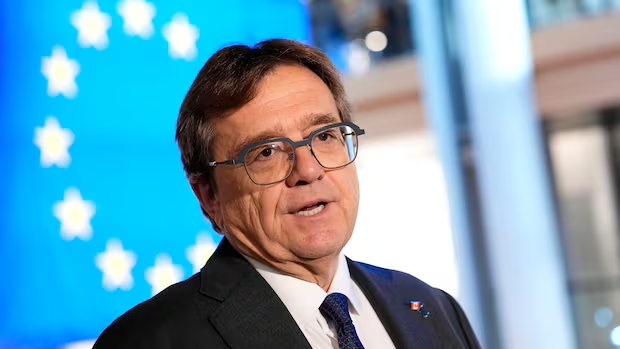
As Prime Minister Mark Carney presses toward creating a “unique alliance” with the European Union, Canada’s ambassador is ruling out paying directly into the 27-nation bloc’s budget.
“We would be very selective,” Canada’s incoming EU ambassador Jonathan Wilkinson said in an interview with CBC’s The House airing Saturday morning. “This is not across the board. It’s certainly not membership in the European Union.”
But Wilkinson did say there are programs which may require some degree of funding. As an example, he pointed to the EU’s Security Action for Europe (SAFE) program, which offers loans to member states for defence investments.
Canada is currently the only non-European country to join the program. Wilkinson said there are other areas for co-operation, like enhancing Canada’s ability to sell critical minerals by having Europe make investments in the sector or working with the EU on AI and other digital technologies.
“It’s a number of specific areas that the prime minister has described as strategic capabilities — those areas where countries really need to have access to certain things that enable them to actually make sovereign decisions,” said Wilkinson, who will be sworn in to his new role in the coming weeks.
Carney formally unveiled his interest in moving Canada closer to the EU during his speech to the European Parliament on Thursday. Some details of his vision were revealed, including:
- “Seamless, digital” trade in non-agricultural goods and services.
- Canadian membership in Erasmus+, the EU’s program to support education, training, youth and sport in Europe, which includes cross-border student exchanges.
- Canadian membership in the next generation of Horizon, the EU’s research and innovation funding program. Canada has partial access to the current program, which ends after 2027.
- Co-operation on computing capacity, broadband connections and AI safety protocols.
- Exploring an integrated market for financial services.
Still, it’s unclear whether Canada will need to give up anything in return, or whether EU members and the Canadian Parliament would approve the deal. Carney has promised a vote and debate in Parliament on the structure of any alliance with the EU.
Wilkinson said he would be “very cautious” about jumping to conclusions on key concerns some opposition parties have raised, like whether Canada would need to amend migration policies.

A day after the door was opened for Canada to become an ‘associate member’ of the EU, Prime Minister Mark Carney delivered a speech at the European Parliament pledging deeper ties with Europe, though questions remain on what that includes.
“Are we talking about mass ability to move across [the two areas]? No, and the idea that somehow it’s related to the irregular migrant issues in Europe.… The borders in Canada are so different from Europe,” Wilkinson said.
“Canada will retain fully its sovereignty.”
European politicians weigh in
Thomas Byrne, Ireland’s minister of state for European affairs and defence, told The House the two parties share a lot in common, like commitments to democracy, free trade and the rule of law.
“We know that the U.S.A. is not as committed to the type of tariff-free trade that we support as it used to be. So I suppose we have to develop other connections,” Byrne said. “And that brings a level of commonality into us.”
Byrne also said what he thinks is being looked at right now is mutual benefits for both parties, not imposing obligations on one another.

Prime Minister Mark Carney addressed the European Parliament on Thursday, saying an alliance between Canada and Europe would ‘safeguard our abilities to live our lives as we choose.’ Roland Paris, foreign policy adviser to Justin Trudeau when he was prime minister, and Arash Saeidi, a member of the European Parliament, discuss what an alliance between Canada and the European Union could look like.
“We’re equal partners across the Atlantic,” Byrne said.
But Arash Saeidi, a member of the European Parliament representing France, said he’s concerned about the proposal because “if we talk about this, we’re going to lose our time and it will last 10 years and we won’t do anything.”
Instead, Saeidi said, the focus should be doing the work of deepening ties — in areas like diplomacy, culture and academic research — rather than debating a formal process.
The Trump factor
The hitch to Carney’s plan is U.S. President Donald Trump, who called the idea of closer Canada-EU ties “laughable” and then threatened new tariffs if it’s “a hostile act.”
“It’s fair to say Europe will act on its own interests,” said Fen Osler Hampson, co-chair of the Expert Group on Canada-U.S. Relations.
“There are many Europeans who are already calling for greater European strategic independence from the United States for the same reasons we are.”

U.S. President Donald Trump threatened the European Union with ‘very serious tariffs’ or to ‘stop trading’ if it makes a trade deal with Canada ‘with bad intentions.’
Trump needs to remember that Europe and Canada are major investors in American equity markets, and Canada holds a large chunk of U.S. debt, Hampson added.
“And so when he talks about cutting off trade.… If he acts on it, he’s shooting himself in both feet,” he said.
Asked whether Trump’s threats could scare off the EU from making a deal with Canada, Wilkinson said “I guess it’s up to the Europeans,” but doubts that will occur.
Canada is not “proposing a third bloc in order to become a great power — only with better manners,” Carney said in his speech.
“We do not seek power to dominate others. On the contrary, we are pursuing resilience so no one, no one can control our open markets, impair our sovereignty, threaten our territorial integrity or undermine our freedoms, our democracies, our rule of law.”