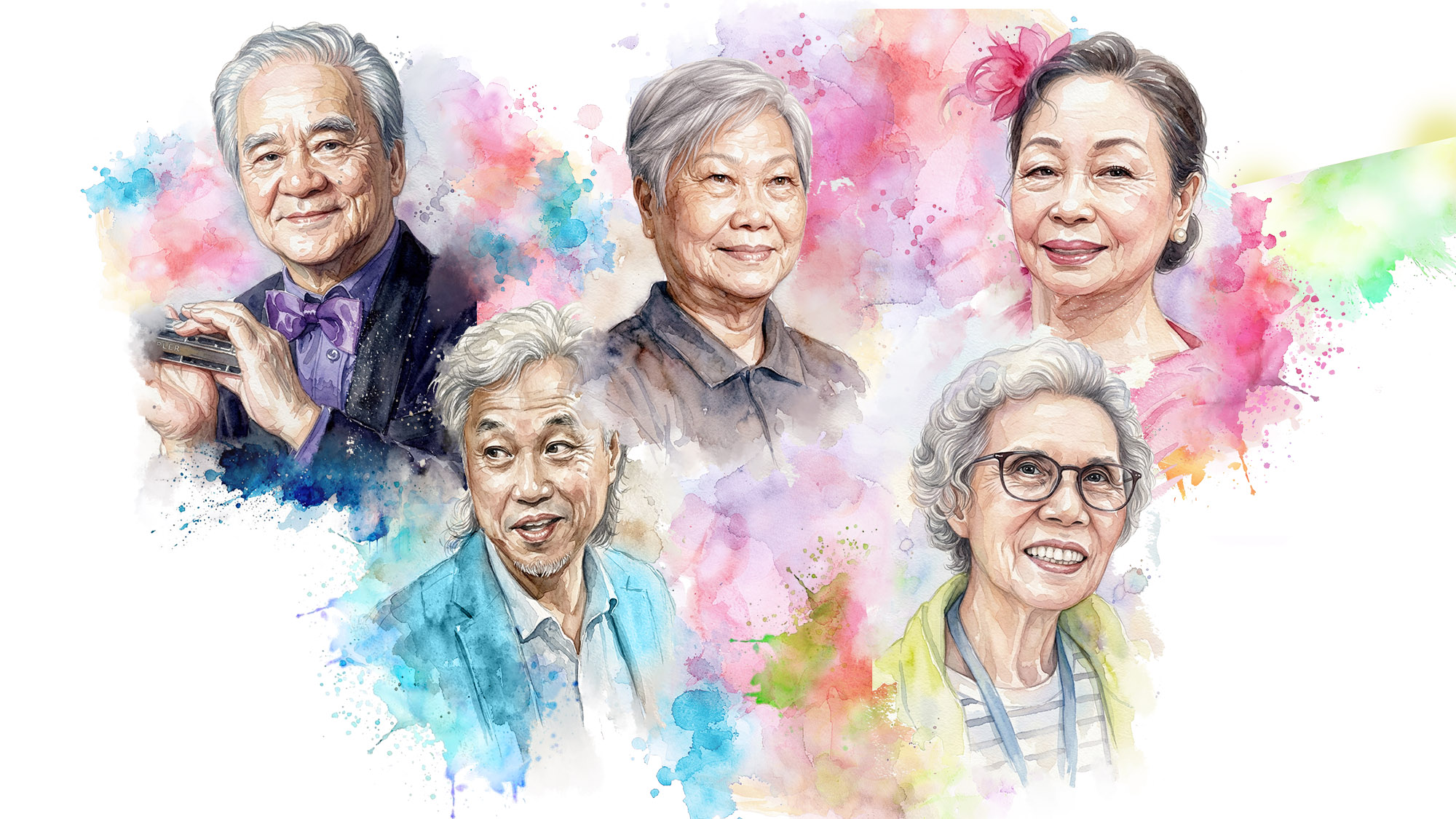
With the return of the Hong Kong Creative Aging Arts Festival, Mariella Radaelli wonders if programs to foster creative expression in older people can make a real difference to their lives.
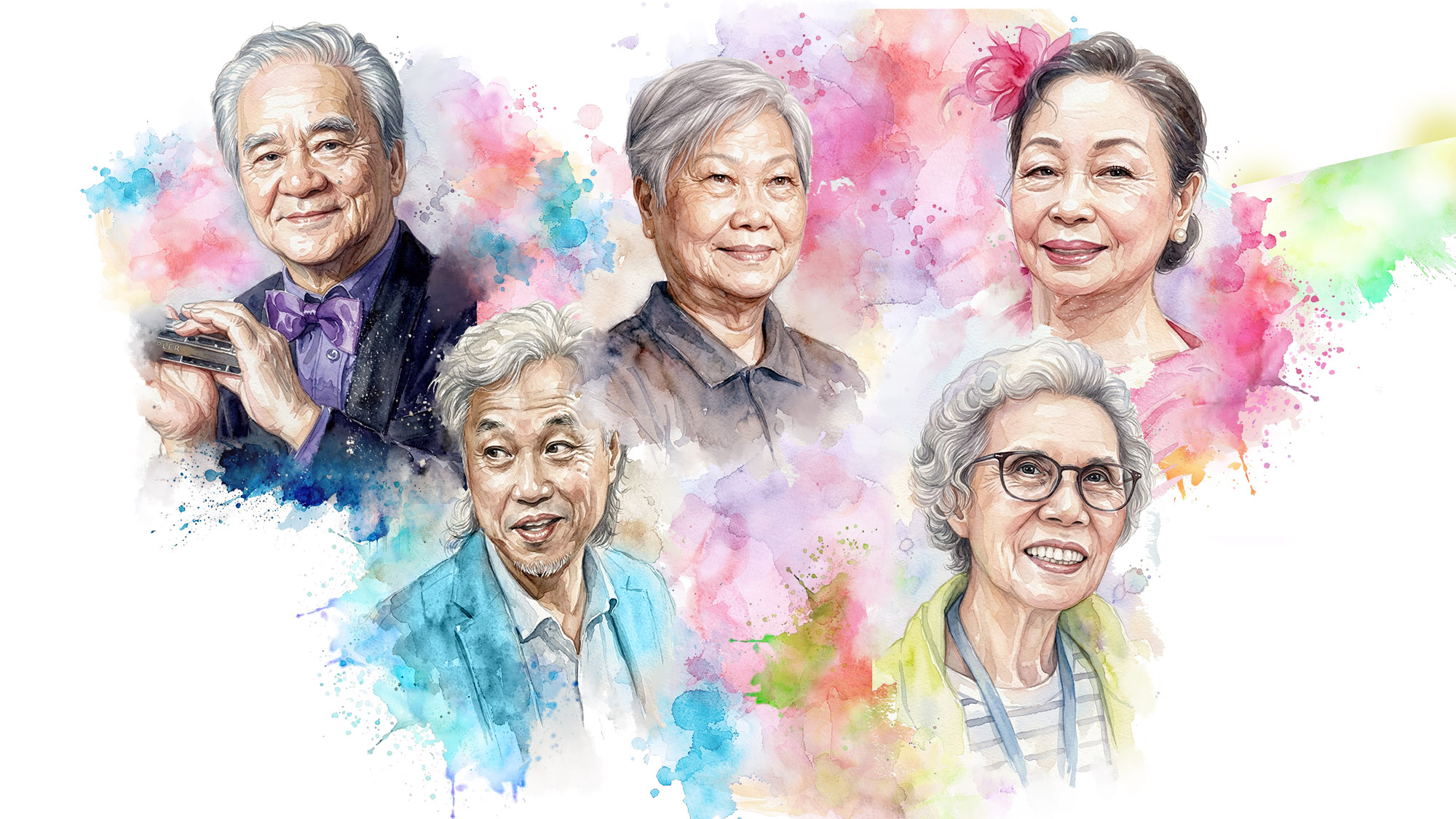
The second Hong Kong Creative Aging Arts Festival, now on at the Jockey Club Creative Arts Centre, continues the good work of offering senior citizens a platform to showcase their creative talents. Its first edition was held in 2024.
“The theme this year is ‘Bold in pursuit of the arts’, reflecting our belief that older adults can pursue the arts with courage, imagination and ambition,” says Rebecca Po, executive director of Arts’ Options, the organization behind the festival. “We hope they will not be seen only as beneficiaries of the program, but also as artists, creators and active cultural participants.”
Since 2019, Arts’ Options has been offering theater training to senior citizens. The festival’s 2024 edition featured 100 older artists and 30 programs spanning drama, music, dance, and visual arts, attracting over 5,000 attendees. This year, the festival has expanded to include 190 artists aged 55 to 90, and from diverse backgrounds.
READ MORE: Never too late to shine
“When older adults create art, their memories, humor, resilience and life experience enrich Hong Kong’s cultural voice,” Po says.
Festival highlights include the Silver Resonance Chinese Music and Harmonica Concert. There are exhibitions of visual art and photography. The latter, called Ye Art Thou, is curated by Evelyna Liang, and invites viewers to take an empathetic view of aging. The Bold in Gold – Live on Stage series is a mix of performance forms, including clowning, a cappella, Cantonese opera, theater, ventriloquism, and stand-up comedy.
Writing a part, and playing it too
Law Yuet-hung, 76, sounds thrilled to have an acting role in a stage adaptation based on her own script, 26K — soon to be published by the Chinese University of Hong Kong Press (CUHK Press).
“Learning that 26K was selected to feature in a CUHK Press anthology feels like a dream!” says the self-confessed introvert who is now ready to claim her place in the limelight. “In the past, I always acted in other people’s plays, but performing in my own story feels completely different — there’s an unmatched sense of dignity and accomplishment to it. Who says getting older means we have to stop?”
At the Silver Resonance concert last weekend, 81-year-old Lee Sheung-ching was seen leading the Chung Lok Lok Harmonica Ensemble.
Growing up in a working-class family, Lee could only afford a musical instrument “that was inexpensive, portable, and easy to learn”.
“The harmonica is a unique instrument that requires both blowing and inhaling to produce music. It’s musical qigong!” he says, comparing the experience of playing the harmonica to a traditional Chinese wellness practice involving slow movements and controlled breathing.
After he had attended a few music sessions at a community center for seniors, Lee decided to put together a harmonica ensemble comprising fellow senior musicians. Since then, the Chung Lok Lok Harmonica Ensemble has been going places.
“In 2018, we traveled to Beijing for the Asia Pacific Harmonica Festival. We were placed third among nearly 20 teams,” Lee says, with well-earned pride.
His students span the age range of seven to 89. “I believe in teaching the harmonica without discrimination,” Lee says. “As long as I am able, retirement is not on my mind.”
In step with the times
Many, if not all, of the nine major performing arts groups supported by the Hong Kong Special Administrative Region government have senior-focused activities on their agenda. For instance, Hong Kong Ballet’s (HK Ballet) Silver Ballet: Dare to Dream program, launched in partnership with a medical team from the Chinese University of Hong Kong, hosted its first senior ballet camp in August 2024. Soon afterward, the event had evolved into a year-round program. Beginning with a single cohort of just 10 participants, the program has since expanded to 12 cohorts with 15 to 20 attendees in each, reveals Vency Kwok, HK Ballet’s senior education and community outreach manager.
Most of the dancers are in their 60s, a few in their 70s, and the oldest is 82. Remarkably, 10 male students have signed up.
As the leader of the instructors, Kwok makes sure that movements, such as plié — bending one’s knees while rest of the body remains erect — leaves a very gentle impact on aging bodies in order to “ensure safety to joints, knees, and backs”.
“Our emphasis is on proper posture, balance, and coordination, allowing participants to enjoy the experience of ballet performance in a safe and supportive environment,” says Kwok. The most rewarding part of her job is, of course, getting to watch elderly ballet students go through a remarkable phase of transformations.
“We love seeing their happy faces.”
Mary Chan, 82, joined the Silver Ballet classes two years ago. As a child, she would be fascinated watching the twirling ballerina figure in a music box she had received from her father, but got a chance to try out the real thing only in her ninth decade.
Besides the joy of “finally getting closer to something I have loved since I was young”, dancing also helps Mary to navigate the city streets better. “I can walk faster now, and my legs feel lighter. I also feel that I move more gracefully. My balance has improved as well. Whether I am taking public transport or going up and down stairs, I feel steadier and more confident.”
Her message to fellow senior citizens who might be keen but unable to muster up confidence yet is, “Don’t be afraid to start. You won’t be left behind! The teachers are very patient. Put your heart into it, learn patiently, and keep going.”
A bona fide actor
Mike Chow, head of Outreach and Education at the Hong Kong Repertory Theatre (HK Rep), says that senior citizens aged 60 and above comprise 10 percent of the company’s adult drama enrollment.
“The older people we work with are enthusiastic, open-minded and eager to take on new challenges in a variety of classes, from physical theater to musical theater,” he says. “Our instructors adjust the pace of training and physical intensity to ensure safety and inclusion,” Chow says. “Rehearsal time is broken down into short segments with regular rest breaks to balance energy levels.”
Guidance with pronouncing Cantonese words helps students to tap into their native speech patterns and memories: “It fosters immediate trust in the room,” Chow adds.
Tsang Kin-man, a student in his 60s, enrolled in the Professional Certificate in Stage Performance program co-hosted by Hong Kong Metropolitan University LiPACE and HK Rep.
“I fell into the rabbit hole of drama, and love it more and more. There is anticipation, excitement, and a sense of achievement. I look forward to more performance opportunities,” says Tsang, who continues to participate in community theater and workshops hosted by the HK Rep Education Hub.
But has two years of theater training made any tangible difference to his lifestyle?
Tsang says while his memory has always served him well, “through drama training and performances, I have been able to continue exercising and maintaining my skills of remembering”. For instance, while trying to bring a scene to life, Tsang often finds himself reaching inside the well of his past, unearthing “certain memories that wouldn’t normally surface”.
When on stage, Tsang says he feels like a bonafide artist: “I am an actor; I am the character. In my everyday life, I am a retiree who loves exploring drama, and I have many other interests as well.”
Never too late to learn
The experimental theater company Zuni Icosahedron hosts specially tailored programs targeted at elderly participants. At the company’s recent Big Adventures with Brush and Ink event, held at the Yuen Long Theatre, elderly participants were joined by children. Led by master calligrapher Chui Pui-chee, the workshop combined a class in traditional ink art with music, dance, as well as a bit of exposure to technology-driven art.
“The calligraphy class was lovely, and the music was so beautiful,” says an 83-year-old participant universally referred to as Grandma Hui. “Clapping along with the kids, it felt like I’d gone back in time. This was so different from the classes I went to as a child.”
The writer is a freelance contributor to China Daily.