Dating apps are in a weird place right now.
Culturally, people are starting to hate them. Whether out of personal distaste or for safety and privacy, more people want to return to the real world to find connections. But dating apps are still big business. Match Group reported net income of $613.5 million in 2025, up from $551.3 million in 2024 but down from $651.5 million in 2023. (Match Group owns Tinder, Hinge, and a slew of other dating apps.) So, despite the complaints, they’re still making money, and a lot of it.
Gen Z has a new dating app profile rule, apparently
And the ecosystem is getting increasingly niche. There’s an app for conservatives. For leftists. Farmers. Christians. Christian Farmers. The rich. The famous. People who like movies. Double daters. Freaks who use 4chan. And now, entering the field as of last week, the dating app for people who read.
Hookup apps for everyone
AdultFriendFinder
—
readers’ pick for casual connections
Tinder
—
top pick for finding hookups
Hinge
—
popular choice for regular meetups
Products available for purchase through affiliate links. If you buy something through links on our site, Mashable may earn an affiliate commission.
Hearing that a dating app for readers now exists is, at this point, not novel. But what piqued my interest is that the app was being developed by Co-Star, the astrology app. Now that’s novel. Beyond that, with the backing of the Co-Star brand and ecosystem, it commands interest among young adults who like astrology and are considered popular and fashionable, i.e., socialite New Yorkers and Brooklyn-based culture writers.
Readme is a book reader’s dating app, and its mission is to match people spiritually, much like the classic “meet cute” at the bookstore. And maybe, just maybe, spark relationships where they don’t have to expose their (male) partners for being illiterate.
It’s a book-series-sized task from the Co-Star creators. However, from my brief experience with the app, I found it to be ambitious but not well-crafted enough to justify waiting for the next installment.
Getting started with Readme
Setting up an account is no different than any other app.

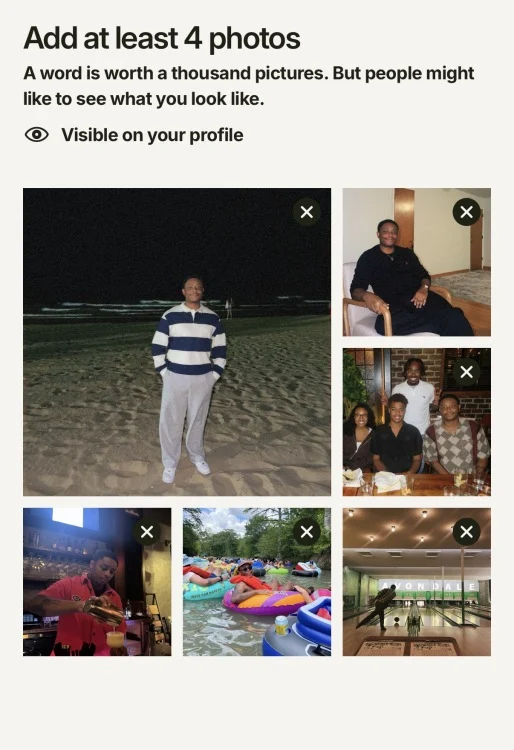
Needed an excuse to show off the fits.
Credit: Chance Townsend / Readme screenshot
Users fill out their name, age, gender, dating preference, and what they’re looking for. One of the app’s two big hooks is that your queue of potential matches is built or can be filtered around your friends and people that are associated within two or three degrees of them. Kinda like old-school Hinge or Tinder’s short-lived Friends of Friends feature.
Within the app, one of the filters lets you see only your friends, your friends’ friends, or your friends’ friends’ friends. It’s interesting in theory, in that Readme wants to replicate those meet-cute type moments that you read about in books. Not in practice, though, because none of my friends are on the app or know it exists. It just launched, after all. But maybe this is my sign to start hosting more parties.
The other big hook is the quiz that “uses psycholinguistics to explore the hidden links between how you read and how you relate,” according to the app. It’s 25 questions, with the bulk asking you to pick which of two quotes you like or dislike the least. After you pick, it reveals which author it was.

What does your language preference say about you?
Credit: Chance Townsend / Readme screenshot
For example, some of the authors I got were Henry Miller, Robert Frost, Casey McQuiston (of Red, White, & Royal Blue fame), and Jonathan Safran Foer. The latter was personally embarassing cause I really, really dislike Extremely Loud & Incredibly Close, as a book and a movie.
Between the quotes are questions about your political beliefs, communication style, and the genres of books you like to read. The latter was particularly irritating because much of the copy in the app has millennial-esque snark that tries to be “smashpunk” but is just grating. I like reading historical non-fiction, and the closest option to that was “straight up facts.” Another genre option was “the writing on the wall,” which is so eye-rolling. Obviously, these are my own personal misgivings, but Readme somehow tries too hard not to be like the other apps, yet also wants you to know it’s cool, hip, and too irony-pilled to be authentic.
Mashable Trend Report

God forbid I like historical non-fiction.
Credit: Chance Townsend / Readme screenshot
At the end of the day, language like that is fine, but seeing “communism will win” and “nostalgic for Barack Obama” as options under “political beliefs” did get a laugh out of me.
Something not included in the questionnaire, or seemingly anywhere on Readme, is astrological signs. Nowhere to put my birthdate, time, and place. So if you’re looking for astrological compatability, Readme isn’t it. (Yet?)
After the questionnaire, you get a report on what your language preferences “reveal about who you are and how you love.”
I got “Former Gifted Child” because I prefer metonymy over metaphor. The app’s way of telling me I lack imagination. “You rely on structures and systems to make sense of the world,” the app tells me. I wouldn’t say it’s wrong, because my parents always believed I was a precocious kid. Turns out I had ADHD the whole time, so maybe the app was onto something.

Book quiz kind of ate, no lie.
Credit: Chance Townsend / Readme screenshot
The report also details How I Love and What You Need. Overall, the report is neat but a bit basic if you remove the flowery language. I like the book recommendations it gave me, and it even gave me some questions I should ask on a first date. Per my ReadMe report, I’m a lover boy at heart and need someone who’s not as rigid.
“You need someone who finds the social script so uninteresting that they haven’t bothered reading it, and don’t know or care whether they’re following or breaking it,” my report read. Sometimes it’s hard to tell whether the copy was written by a millennial ad executive or by ChatGPT’s poor interpretation of one.
Using the Readme app
So now that the setup is done, what’s the actual app like? It’s….fine. It’s definitely a dating app. You click the heart to like and the minus sign to dislike. At the bottom of every profile, you’ll see a similarity score based on their quiz answers and choices. And that’s it, honestly.
The big glaring issue here is that Readme just doesn’t have the juice yet.
Immediately upon getting to the app proper, my recommended likes all live in New York. I live in Chicago. There’s no filter or setting for distance. The only settings you can change are age, gender, and mutuals. For me, the app is a nonstarter. Not that it can’t be successful, but I live in the third-largest city in the U.S., and Readme’s algorithm is only showing me people who don’t live in my city. Maybe it should’ve had a limited launch in Brooklyn first, gotten some hype, and then rolled out to other major cities.
I swiped right on between 70 and 80 profiles in my selected age range (24-32) before running out of people to see. None of them was based in Chicago. I saw accounts from Vermont, New Jersey, Denver, San Francisco, and even Tokyo. But not one in 70+ swipes lived in Chicago or set their location as Chicago.

An example of what you might see in a Readme profile.
Credit: Chance Townsend / Readme screenshot
I guess on the positive side, unlike the big power players like Hinge and Tinder, you do have unlimited likes. It’ll be interesting to see if that’ll be the case as the app gets more attention — venture capital and vibes can only subsidize an app for so long. Maybe then the dating pool will keep me invested enough not to be on the app when the bill comes due.
To be frank, having a cis hetero male perspective on the dating app for readers probably doesn’t give one a sense of what the dating pool is like. Statistically, people don’t read that much in general, but women read far more often than men. According to a Pew Research Center study conducted in Oct. 2025, “women are more likely than men to say they’ve read a book in the past 12 months.”
One can extrapolate from the many cultural reasons why women read more than men. I imagine the main appeal of an app like Readme for women is that avid reading can be seen as a sign of intelligence, empathy, and curiosity. With the rise of dudebro, Barstool conservatism in young men, an online dating app that, to an extent, filters one from an embarrassing partner, is appealing.
All of that said, this is from my perspective as a 28-year-old Black man living in Chicago. The aesthetic leanings of Readme’s dating pool are what you’d expect from an app that markets itself as a zine-style, indie sleaze, Y2K vintage fashion store you’d find in the more affluent parts of Brooklyn. In short, it’s very white. Which is not bad, and I don’t mean to imply that there aren’t women of color on the app, but as it’s been researched before, dating apps’ algorithms are not kind to Black women, or people of color in general.
It’s a shame because its style and interface are easy to get acclimated with, but beyond the mutuals feature and the quiz, it doesn’t really do enough to stand out. If anything, what sets Readme apart from the crowd of hyper-niche dating apps is that it knows and markets itself exactly towards the audience it wants.
That’s fine, but it’d be interesting to see whether it can expand beyond that — if it even wants to.