HONG KONG — Sentences are expected to be delivered Friday to three organizers of an annual Hong Kong vigil commemorating the 1989 Tiananmen Square crackdown in a case brought under a Beijing-imposed national security law that has effectively stifled the city’s pro-democracy movement.
Lee Cheuk-yan, Chow Hang-tung and Albert Ho, three former leaders of the Hong Kong Alliance in Support of Patriotic Democratic Movements of China, were convicted of inciting subversion and face up to 10 years in prison.
Lee and Chow pleaded not guilty, while Ho entered a guilty plea. Pleading guilty typically can reduce a sentence.
Their now-disbanded group was best known for organizing the only large-scale, public commemoration in China that drew tens of thousands of people annually for three decades until authorities banned it in 2020 following the outbreak of the COVID-19 pandemic.
The case has raised concerns among foreign governments and rights groups over Hong Kong’s deterioration of freedom of expression. But Beijing said the defendants have long advocated “ending one-party dictatorship,” attempting to overthrow the leadership of the ruling Chinese Communist Party.
Here’s what to know about the case:
Commemorating the 1989 crackdown in Hong Kong has become sensitive
The 1989 crackdown on the student-led pro-democracy movement in Tiananmen has long been a political taboo in mainland China, where discussions over it are tightly censored. Some young people there do not even know that tanks then rolled into the heart of China’s capital and troops opened fire in a bloody crackdown that killed hundreds, possibly thousands.

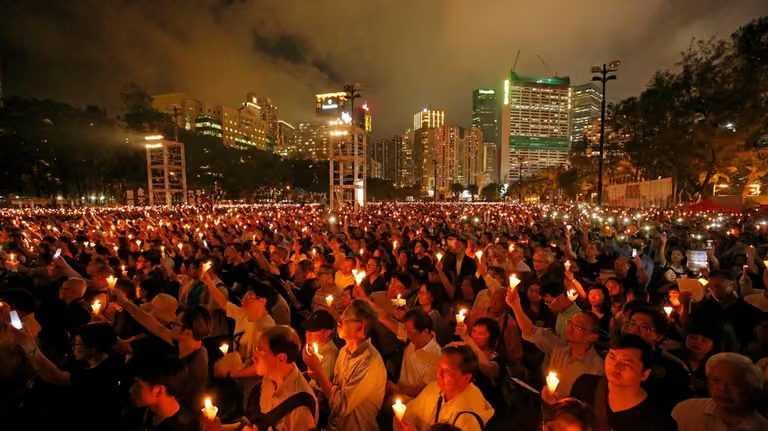
Thousands of people attend a candlelight vigil for victims of the Beijing’s 1989 brutal military crackdown on protesters at Victoria Park in Hong Kong, on June 4, 2019. Credit: AP/Kin Cheung
Hong Kong, a former British colony that returned to Chinese rule in 1997, helped keep the memories alive by hosting the annual vigil, a reflection of greater freedoms granted to the city under Beijing’s “one country, two systems” governing framework. But authorities banned it during the pandemic, citing risks to public health.
After the lifting of COVID-19 restrictions, the former vigil site was instead occupied by a carnival each year. Some people who brought flowers or lit a candle near the site on the crackdown anniversary in recent years were taken away by police.
Critics said the disappearance of the vigil symbolized the erosion of freedoms in Hong Kong.
Tiananmen organizers convicted, but Chow stood firm
After the security law took effect in 2020, many leading activists were arrested, including the pro-democracy former media tycoon Jimmy Lai and former student leader Joshua Wong. Dozens of civil society groups disbanded, including the alliance.

A man looks at a photo, believed to be taken by a former People’s Liberation Army soldier during Beijing’s June 4, 1989 Chinese military crackdown on the pro-democracy movement displayed in Hong Kong on June 4, 2012. Credit: AP/Vincent Yu
Lee, Chow and Ho were charged in September 2021 and have spent years in custody.
Three government-approved judges ruled they had intentionally encouraged supporters of the alliance to wait for the right time to carry out one of its core demands to “end one-party dictatorship” through unlawful means. The judges said the call was about ending the Communist Party’s leadership status and carried the notion of overthrowing or undermining it.
During the trial, the defense denied they meant to end the party’s leadership and insisted the alliance had not asked people to adopt any illegal means. Lee earlier testified in court that their call for “ending one-party dictatorship” and moving toward democracy meant letting the people decide who leads them.
The court also heard that co-defendant Albert Ho said in 2018 that the call was not to eliminate the Chinese Communist Party and the party could maintain its ruling position through fair elections.
After the conviction, Chow, a barrister who represented herself, argued the verdict suggested that pursuing democracy is a crime and that she does not deserve one day in prison.
“We have no crime to regret,” she said.
Beijing defends the verdict, but some observers say it shows decline in freedoms
The city government said the court reached its verdict in accordance with the law and evidence without any political considerations. The Hong Kong office of China’s Foreign Ministry said the city is governed by the rule of law and no one should be allowed to engage in unlawful activities under the pretext of “freedom of speech and press.”
Urania Chiu, a lecturer in law at Oxford Brookes University in the U.K., said the possibility of non-violent advocacy used to distinguish Hong Kong from the rest of China. But the national security law has blurred the boundaries between the two systems in the “one country, two systems” principle by privileging the idea of national security and quashing any chance of dissent, she said.
“The guilty verdicts confirm that even peaceful calls for democratic change in the Chinese regime are now criminalized in Hong Kong,” she said.