‘China wants to control and divert rivers.’

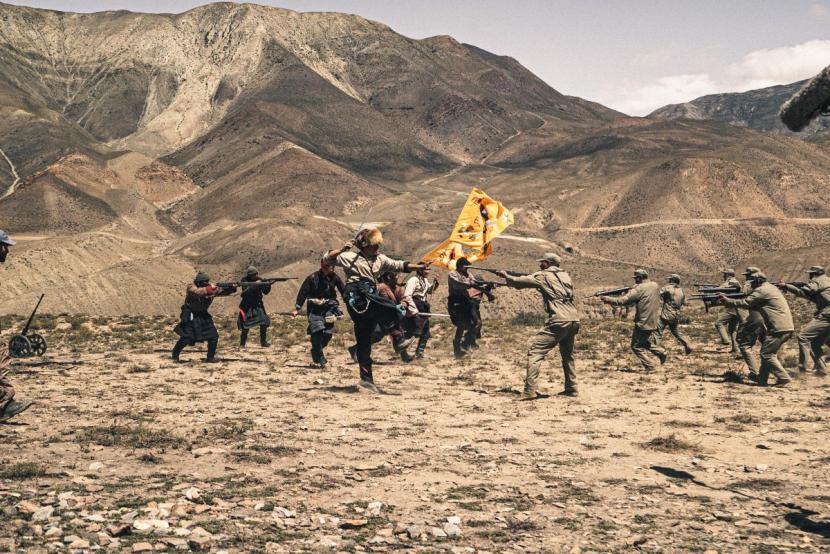
IMAGE: A scene from the film Four Rivers Six Ranges. Photographs: Kind courtesy Shenpenn Khymsar
Key Points
- ‘About 3,800 kilometres of the Himalayan border involves Arunachal Pradesh, Ladakh and Sikkim, and China is already claiming Arunachal as part of China.’
- ‘There is the Siliguri Corridor, the ‘Chicken Neck’, which connects India’s eight north eastern states to the mainland. It’s close to North Sikkim and the Chumbi Valley, where there is a major Chinese military presence.’
- ‘This is a very serious national security issue, and India today is not a submissive country anymore. It is much bolder and has a new stance.’
“I feel like it’s a joke that a little indie filmmaker is making the Chinese government nervous. This film is the first defiant, anti-China film ever made,” says filmmaker and Tibetan activist Shenpenn Khymsar.
Khmysar was born to Tibetan refugees in Darjeeling who returned to the hill town a few years ago after spending 30 years in the United States and Canada.
His film Four Rivers Six Ranges is a historical drama capturing the role of a Tibetan warrior force that rose up again Chinese occupation and provided security to his Holiness the Dalai Lama on his escape from Tibet into India in 1959.
The film will release in India on September 11. Incidentally, Chinese President Xi Jinping is scheduled to be in India that weekend for the BRICS Summit.
In an interview to Rediff‘s Archana Masih, Shenpenn speaks Khymsar about why this small film is making the Chinese Communists jittery, the extraordinary resistance of a band of brave warriors and China’s brutal subjugation of a people.
What has been the reaction in China about your film?
Chinese State media CGTN says that Four Rivers Six Ranges distorts the unity and historical facts of Tibet and China. They say Tibet was always part of China and that filmmaker Shenpenn Khymsar is a separatist and that this is propaganda.
Honestly, I feel like it’s a joke that a little indie filmmaker like me is making the Chinese government nervous.
The film I understand is based on a book written by the producer’s father?
Yes. My producer, Dorjee Wangdi Dewatshang’s father, Kunga Samten Dewatshang, was one of the warriors who protected and escorted the Dalai Lama to India in 1959.
He started writing the book, but passed away, so his son completed it. The book is Flight At The Cuckoo’s Behest.
The film is adapted from that book, particularly through the perspective of Kunga Samten, the warrior. But the larger story is the same: How Four Rivers Six Ranges was formed, how they resisted and fought the Chinese People’s Liberation Army, and how these Tibetans were ordinary people — traders, farmers even monks from monasteries. They were compelled to pick up weapons to protect their Dharma, their nation and the Dalai Lama.
The story has captivated you since you were a boy.
Yes. We heard these stories growing up. I decided to make the film about 13 years ago, and it took me 10 years just to research it.
I read books and PhD dissertations, interviewed surviving warriors, most of who lived in exile in India, and researched the Chinese, CIA, Nepal government and Nepal army perspectives.
Four Rivers Six Ranges began in June 1958 and ended in 1974.
We shot the film in Mustang, Nepal, in September 2023.

IMAGE: Shenpenn Khymsar on the sets of Four Rivers Six Ranges.
What stood out most during that research, beyond what you already knew?
The valour and courage of these people, and the atrocities and obstacles they faced. They weren’t trained soldiers or militia; they were ordinary people who picked up weapons and fought with incredible courage. They didn’t have modern weapons like the Chinese army.
Their wives, the Tibetan women, were also incredibly courageous. There are stories of people having no food or ration and cutting up their leather shoes, boiling them and eating them to survive.
That really impacted me. Everybody knows and loves His Holiness, the Dalai Lama, but I felt it was important to honour these warriors who made his escape to India possible.
What role did the warriors of Four Rivers Six Ranges have when the Dalai Lama made that dangerous journey to India in 1959?
The warrior group had started with about 26 tribal leaders and grew to thousands. The CIA initially took five people to train in Colorado. They were dropped back in Mustang and Tibet, and then trained 100 people, and then 100 back to the US and later trained 4,000. So eventually the resistance numbered in the thousands.
On March 10, 1959, there was a massive uprising in Tibet against Chinese occupation, followed by a huge military crackdown. His Holiness was 23, his life was in danger, and the Chinese government was looking for him.
He was staying at his summer palace in Lhasa.
He, his personal security and team, along with Four Rivers Six Ranges warriors, planned a covert escape. His Holiness was disguised, and they crossed the Himalayas on foot and horseback. There were attacks along the way, and His Holiness became very sick.
But during the escape, the group was very small because they wanted to keep it covert.

IMAGE: A scene from Four Rivers Six Ranges.
Were some of the warriors trained in Colorado by the CIA part of the escape group?
Yes, particularly those trained in radio communication. They were in contact with the Indian government, (Jawaharlal) Nehru and US President Dwight D Eisenhower.
What happened to the warriors after they entered India?
The founder of the warrior group was Lhagyalo Tashi Andrugtsang. After 1959, most of the first group came to India as refugees. Many settled in Darjeeling and Sikkim, while others went to South India, Dharamsala, Bir and Nepal.
The CIA operation, whose code name was Shadow Circus, ended with Richard Nixon’s visit to Beijing which changed the US-China relationship. The operation was effectively shut down, leaving many Tibetan warriors stranded.
The Nepal army ambushed them, killing many and forcing others to surrender. His Holiness sent them a cassette asking them to lay down their weapons. Because they revered him so deeply, they followed his request.
Some, however, said they would never live under the Chinese and chose to die. Some committed suicide, some slit their throats and some jumped into the river. That was the tragic end of Four Rivers Six Ranges.
But the movement still exists through organisations around the world. The Special Frontier Force in the Indian Army was also born because of Four Rivers Six Ranges.
So most of these warriors remained in Tibet until 1974?
No, I think most had already come to Nepal and India by the early 1960s. By 1974, most were in Nepal and India.
The warriors who died by suicide — were they in Tibet?
They were on the Tibet-Nepal border, in Mustang, which was their base camp. That’s also where I shot the film.

IMAGE: Shenpenn Khymsar on the sets of his film.
Your own family came to India around the same time. How did that shape you?
My story isn’t unique. Every Tibetan family went through suffering and trauma after losing our country.
My grandfather always believed he would return to Tibet, but he never did. His Holiness is now 91 and still cannot return to Tibet. We grew up hearing stories of Chinese soldiers coming into homes, torturing and attacking people.
Some of my grand-uncles were killed. On my mother’s side, some were gunrunners, while others disappeared and were never heard from again.
Every Tibetan family has lost someone to Chinese torture or prison.
1.6 million Tibetans have been killed under the Chinese regime. China has exploited our natural resources. 80% of the lithium batteries come from Tibet.
Also, the Tibetan issue is important for India’s national security.
About 3,800 kilometres of the Himalayan border involves Arunachal Pradesh, Ladakh and Sikkim, and China is already claiming Arunachal as part of China.
There are ten rivers flowing from the Tibetan Himalayan glaciers into Southeast Asia, including the Brahmaputra, Yellow River and Mekong. Around 2.5 billion people depend on that water.
China is building dams and wants to control and divert rivers. China has built 30,000 risky dams and continues building more.
Then there is the Siliguri Corridor, the ‘Chicken Neck’, which connects India’s eight north eastern states to the mainland. It’s close to North Sikkim and the Chumbi Valley, where there is a major Chinese military presence.
So this is a very serious national security issue, and India today is not a submissive country anymore. It is much bolder and has a new stance.
This film is the first defiant and anti-China film ever made.
Feature Presentation: Aslam Hunani/Rediff
