The slogan “elbows up” is everywhere in Canada these days, emblazoned on t-shirts, bumper stickers, signs and hats across the country. The phrase comes from hockey, Canada’s national winter sport, where it describes a stance in which a player keeps their elbows raised to protect personal space, shield the puck and ward off opponents.
In the wake of American tariffs on Canadian goods and threats from President Donald Trump to make Canada the 51st state, “elbows up” has taken on a second meaning: a rallying cry for Canadians to stand up, fight back and protect their sovereignty from their bigger, stronger southern neighbor.
It’s fitting, then, that a former collegiate hockey player appears to be embodying that slogan amid the U.S.-Canada trade battle.

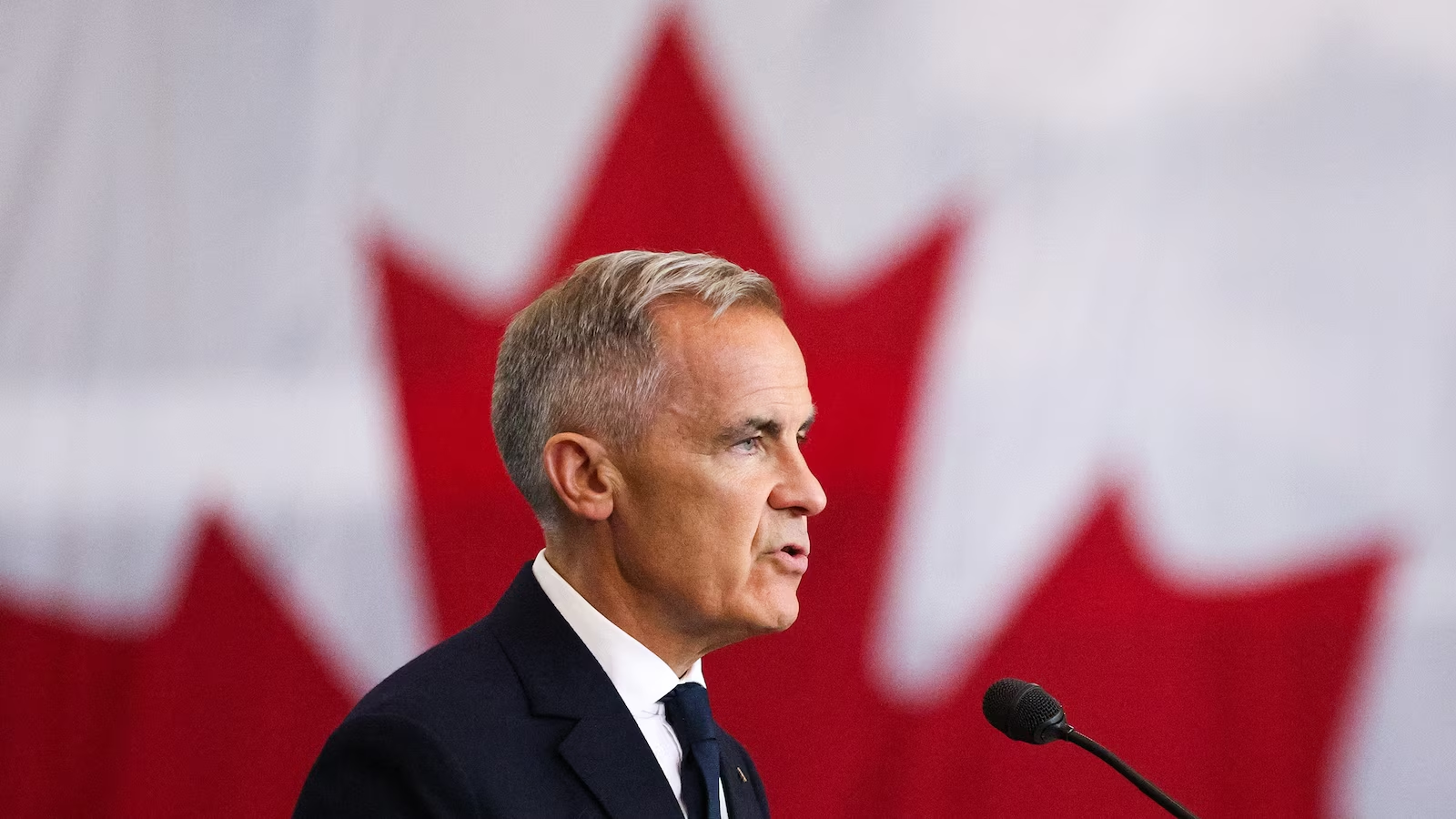
Canadian Prime Minister Mark Carney speaks as he attends a tour of the Fort York Armoury in Toronto, June 9, 2025 in Toronto, Canada.
Cole Burston/Getty Images
Mark Carney, Canada’s prime minister, is pushing back hard in a tariff fight that shows no signs of easing. The two countries failed to reach a trade deal last Friday, with each side blaming the other for derailing three days of intensive negotiations.
Trump’s new tariffs affect some $20 billion of Canadian exports to the U.S., including wine, furniture, dairy products, cement, clothing, fishing rods and hockey equipment. Notably, these duties don’t exempt Canadian products under the three-nation trade deal that has shielded most Canadian exports over the last 18 months.
The standoff reached its climax Tuesday, when Canada announced sweeping retaliatory tariffs ranging from 15% to 50% on imports of roughly 700 American products, matching the Trump administration’s duties “dollar for dollar,” as Carney put it. The new duties take effect Sept. 8, sharply escalating what is now a full-blown bilateral trade war.
“Accepting [the U.S. negotiation terms] would have harmed our workers, people that you see here today, weaken our industries, and compromise principles fundamental to our nation. So we stood up for our workers, we stood up for our businesses, we stood up for Canada,” François-Philippe Champagne, Canada’s finance minister, said Tuesday.
Carney struck the same note the day before, standing before a small crowd in Lévis, Quebec.
“An attitude at the negotiation table that Canada is a subsidiary of the U.S., that Canadian industry is going to be disadvantaged relative to American industry – that’s not something we’re going to accept,” he said. “There is a mutually beneficial deal possible here, but it has to be one that respects Canada’s sovereignty and independence, that uses our complementary strengths to build something better, not tear apart for short-term gain.”

President Donald Trump speaks with Canadian Prime Minister Mark Carney at a working lunch with leaders of G7 and the Middle East, June 16, 2026 in Evian-les-Bains, France.
Evelyn Hockstein/Pool via Getty Images
In hindsight, the signals that Carney would play hardball with President Trump were there from the moment the 61-year-old former banker entered politics for the first time, launching his bid to lead Canada’s Liberal Party and eventually becoming prime minister.
His soft launch came in January 2025, fewer than three months before his election, when he sat across from “The Daily Show” host Jon Stewart and, with a wry smile, said Canada is “not interested” in Trump’s overtures. Carney framed himself as an outsider uniquely positioned to meet the challenges Canada would soon face from America.
“Let’s say the candidate wasn’t part of the government. Let’s say the candidate did have a lot of economic experience. Let’s say the candidate did deal with crisis. Let’s say the candidate had a plan to deal with the challenges in the here and now,” Carney said, laying out the experience he’s built over decades as an economist and central banker.
“You’re sneaky; you’re running as an outsider,” Stewart said.
“I am an outsider,” Carney replied.
In a sense, he was. Carney became prime minister by selling the Canadian public on his experience as a technocratic economic policymaker and former central banker who knows how to operate on the world stage. That outsider status, some former advisors and close watchers of Carney say, is precisely what gives him room to maneuver, with Canadians seeing him as above the grubby backroom dealing of traditional politics.
“I always knew Mark would be good at politics,” Gerald Butts, a close adviser of Carney’s, told Politico. “I didn’t know he would be this good at politics, to be honest. But who did? I’m not even sure he did.”
Carney’s path to power began far from Ottawa. Born near the Arctic Circle in remote Fort Smith, Northwest Territories, to a pair of teacher parents who “wanted an adventure” and “believed in public service,” he was raised in Edmonton, Alberta, excelling at both hockey and scholastics. He went on to play backup goalie for the Harvard University hockey team before continuing his education at the U.K.’s University of Oxford.

Mark Carney, Governor of the Bank of England arrives for a Bank of England Financial Stability Report Press Conference, in London, Dec. 16, 2019.
Kirsty Wigglesworth/AP
From there, Carney spent 13 years at Goldman Sachs and five years as governor of the Bank of Canada, where he steered the country through the 2008 global financial crisis, a track record that eventually led to his recruitment as governor of the Bank of England. In that role, he helped guide the U.K. through Brexit, despite him warning then that leaving the European Union could trigger a severe economic downturn and a sharp drop in the pound’s value.
U.K. headlines dubbed Carney a “rock star central banker” and lauded his skills as a diplomat and negotiator. When his Bank of England term ended in 2020, Carney returned to Canada and took on a new role as the United Nations secretary-general’s special envoy for climate action and finance, an advisory position that gave him a close-up view of Canadian politics before he ever ran for office.
Carney built his campaign around the idea that he was the person best suited to lead Canada through a moment of sweeping change in the global order, pointing directly to Trump’s tariff policies as evidence.

Shipping containers are seen in the Port of Montreal in Montreal, Quebec, August 23, 2026.
Andrej Ivanov/AFP via Getty Images
“It’s not a transition, it’s a rupture. It’s big changes in a very short period of time. And I know from all my experience that in those situations, you have to act big, you have to act bold,” he told Bloomberg’s Mishal Husain late last year.
That framing foreshadowed a moment a few months later that would push Carney even further onto the world stage. During a speech at the World Economic Forum in Davos in January 2026 that quickly went viral, he proposed a global alliance of “middle powers” working together to advance their own interests and resist hegemonic pressure, with an unmistakable side-eye toward the United States.
“There is a strong tendency for countries to go along to get along. To accommodate. To avoid trouble. To hope that compliance will buy safety. It won’t,” Carney said, in part. “This fiction was useful. We participated in the rituals. And we largely avoided calling out the gaps between rhetoric and reality. This bargain no longer works.”
It was “elbows up” foreign policy, articulated in the starkest possible terms.
Leaders and diplomats across Europe and Asia quoted the speech for months afterward, with many casting Carney as a rare figure willing to stand up to Trump and say plainly what others wouldn’t.
“This is a guy who worked at Goldman Sachs, studied at Harvard, he’s part of the business community. He’s not your typical lefty anti-American, if anybody’s trying to portray him that way,” Globe and Mail columnist Andrew Coyne told NPR earlier this week.

President Donald Trump greets Canadian Prime Minister Mark Carney as he arrives at the White House in Washington, May 6, 2025.
Jim Watson/AFP via Getty Images
Now, in the wake of the collapsed negotiations with Washington, Carney appears to be putting that Davos philosophy into practice, positioning Canada, America’s largest trading partner, as one of the only U.S. allies willing to stand up and fight back.
“This is a guy who would like to get deals done. He’s been a dealmaker of one kind or another all his life,” Coyne said. “But I think he also understands the stakes for the country. And I think he understands that this is a moment when he has to lead and has to summon the will of the country to deal with this existential threat. I think a lot of Canadians would say at this point, they think he’s rising to the challenge.”
For now, Canadians appear to be supporting Carney. However, what the long-term economic impact of his approach might be for Canada remains to be seen.
“Whether Carney can achieve his goal of strategic decoupling with the U.S. is by no means clear and will likely be enormously challenging,” Canadian political commentator and legal scholar Jeffrey Meyers told ABC News. “If it can be done, it will be among the most remarkable pivots in Canada’s history and politics.”