

Forex by bigjom jom via Shutterstock
The euro currency is approaching a seasonal period that deserves the attention of both investors and active market participants. The optimal window lasts approximately 75 calendar days, providing enough time for longer-term traders to establish a bearish position while also allowing shorter-term traders to sell into and out of positions when the euro technical setups develop.
Seasonal patterns are not, by themselves, trade signals. They identify periods when a market has historically tended to move in a particular direction. The current fundamental environment, however, may support the euro’s impending bearish pattern.
U.S. Inflation
U.S. inflation remains above the Federal Reserve’s long-term target. The Consumer Price Index rose 3.4% during the 12 months ending in July, while core CPI increased 2.5%. Energy prices were a major contributor, rising 14.7% year over year. Although headline inflation eased slightly from its June level, it remains well above the Fed’s 2% objective. The Federal Open Market Committee left the federal funds target range unchanged at 3.50% to 3.75% at its July meeting. In its statement, the Fed acknowledged that inflation remained elevated and that energy-related supply shocks were contributing to price increases. The meeting minutes also showed concern that an extended period of above-target inflation could affect consumer expectations and future wage and price decisions.
Persistently high inflation could force the Fed to keep rates elevated longer than expected or consider another rate increase. A rate increase is not assured; many economists still expect the Fed to remain on hold through the end of the year. Nevertheless, any shift toward an earlier rate increase could support the U.S. dollar and create pressure on the euro.
Impact of Crude Oil Prices
Crude oil adds another concern to the inflation outlook. Oil prices extended their recent rally after President Trump announced a new economic campaign against Iran and threatened consequences for countries providing it with financial support. The prospect of tighter sanctions, reduced Iranian exports and continued disruption around the Strait of Hormuz pushed crude oil to its highest level in more than three weeks.
Higher crude oil prices affect transportation, manufacturing and consumer costs. If those increases persist, the Fed may have difficulty returning inflation to its target on its preferred timetable.
ECB Rate Hike Expectations
There are risks to the bearish outlook for the euro. Euro-area inflation reached 2.9% in July, while the European Central Bank has also been confronting higher energy costs. Expectations for additional ECB rate increases could support the euro and limit declines.
Euro Futures and Spot Confluence
Euro futures and the euro spot market are highly correlated because both reflect the euro’s value relative to the U.S. dollar. Although futures contracts trade on a regulated exchange and have set expiration dates, while the spot market trades over-the-counter without an expiration date, their prices generally move in the same direction and remain closely aligned through arbitrage. Therefore, the approaching seasonal sell pattern can be applied to either euro futures or the EUR/USD spot market. Traders should still account for differences in contract specifications, leverage, financing costs, and trading hours when selecting the market that best fits their plan.
Euro Technical Picture
Source: Barchart
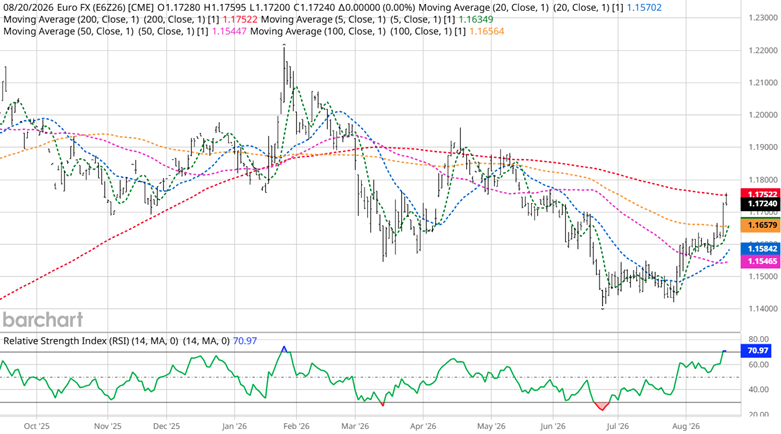
Barchart’s Technical Analysis page shows the price is above the major moving averages and currently trading below the 200-day simple moving average (SMA). Price action shows higher highs and higher lows, indicating an uptrend. Traders may wish to await a trend change before stepping in front of this uptrend to sell. Or at least another analysis indicating a shift in momentum. One analysis supporting the euro seasonal sell signal is the RSI (14), which indicates the euro is overbought. Again, we do not sell just because something is “supposedly” overbought.
Seasonal Pattern
Source: Moore Research Center, Inc. (MRCI)
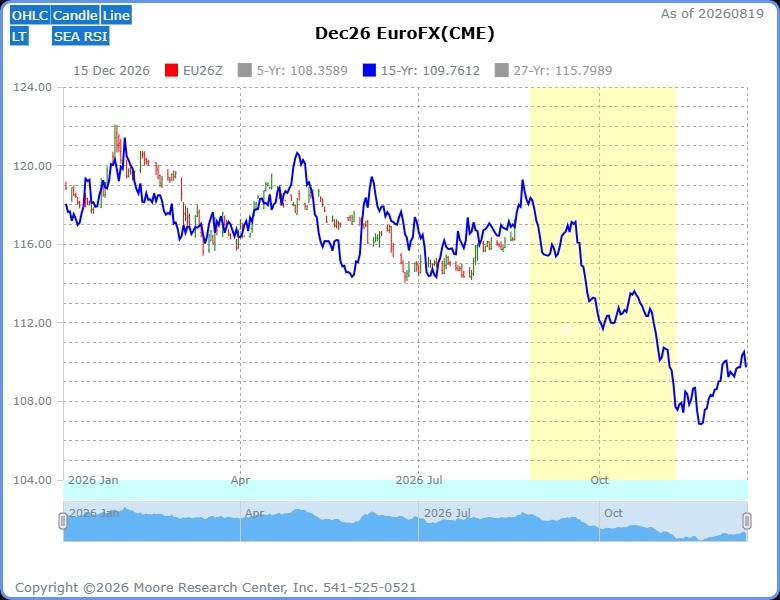
MRCI research has found that the 15-year seasonal pattern (blue) shows a significant shift in its annual range during the upcoming optimal sell window (yellow). The optimal window is 75 calendar days, plenty of time to exercise patience and diligence while waiting for a trigger to sell the euro. The optimal sell window has had a respectable record in hypothetical testing to the extent that the December euro futures have closed lower on November 09 than on August 27 in 14 of the past 15 years, a 93% occurrence. During this testing, the average net profit per contract was $3,654.17. Three of the 15 years tested did not have a daily closing drawdown, an impressive feat given the euro’s volatility.
As a crucial reminder, while seasonal patterns can provide valuable insights, they should not be the basis for trading decisions. Traders must consider technical and fundamental indicators, risk management strategies, and market conditions to make informed, balanced trading decisions.
Key Assets to Trade the Euro Currency:
- Currency Pairs (Forex): Selling the ^EURUSD pair (going short) is the most direct way to play this trend, betting that the euro weakens against the dollar.
- Currency ETFs:
- Fixed Income & Safe Havens:
- U.S. Treasuries: Investing in U.S. government bonds, often seen as a haven when the dollar strengthens.
- Cash (USD): Simply holding U.S. dollars to gain from the strengthening relative to the euro.
- Derivatives:
- Forex Futures & Options: Trading Euro futures on exchanges like the CME to take advantage of price movements in the ^EURUSD pair. Standard lot contract (E6), the micro lot contract (MF). Options on futures contracts or the U.S. dollar index (DX).
- Equities: Buying shares in US-based companies that are expected to benefit from a stronger domestic currency (e.g., importers).
In Closing…
The approaching 75-day seasonal window gives traders time to prepare rather than react to a single market event. Above-target U.S. inflation, rising crude oil prices, and the possibility that the Federal Reserve may keep interest rates higher—or raise them sooner than expected—could strengthen the dollar and add fundamental support to the euro amid its seasonal weakness. Whether trading euro futures or the EUR/USD spot market, traders can use this period to establish a bearish directional bias while waiting for resistance, trend confirmation, and defined-risk selling opportunities. Seasonality does not guarantee lower prices, but when historical tendencies, market fundamentals, and technical conditions align, traders may be presented with an opportunity worth watching.
On the date of publication, Don Dawson did not have (either directly or indirectly) positions in any of the securities mentioned in this article. All information and data in this article is solely for informational purposes. For more information please view the Barchart Disclosure Policy here.