Toplines
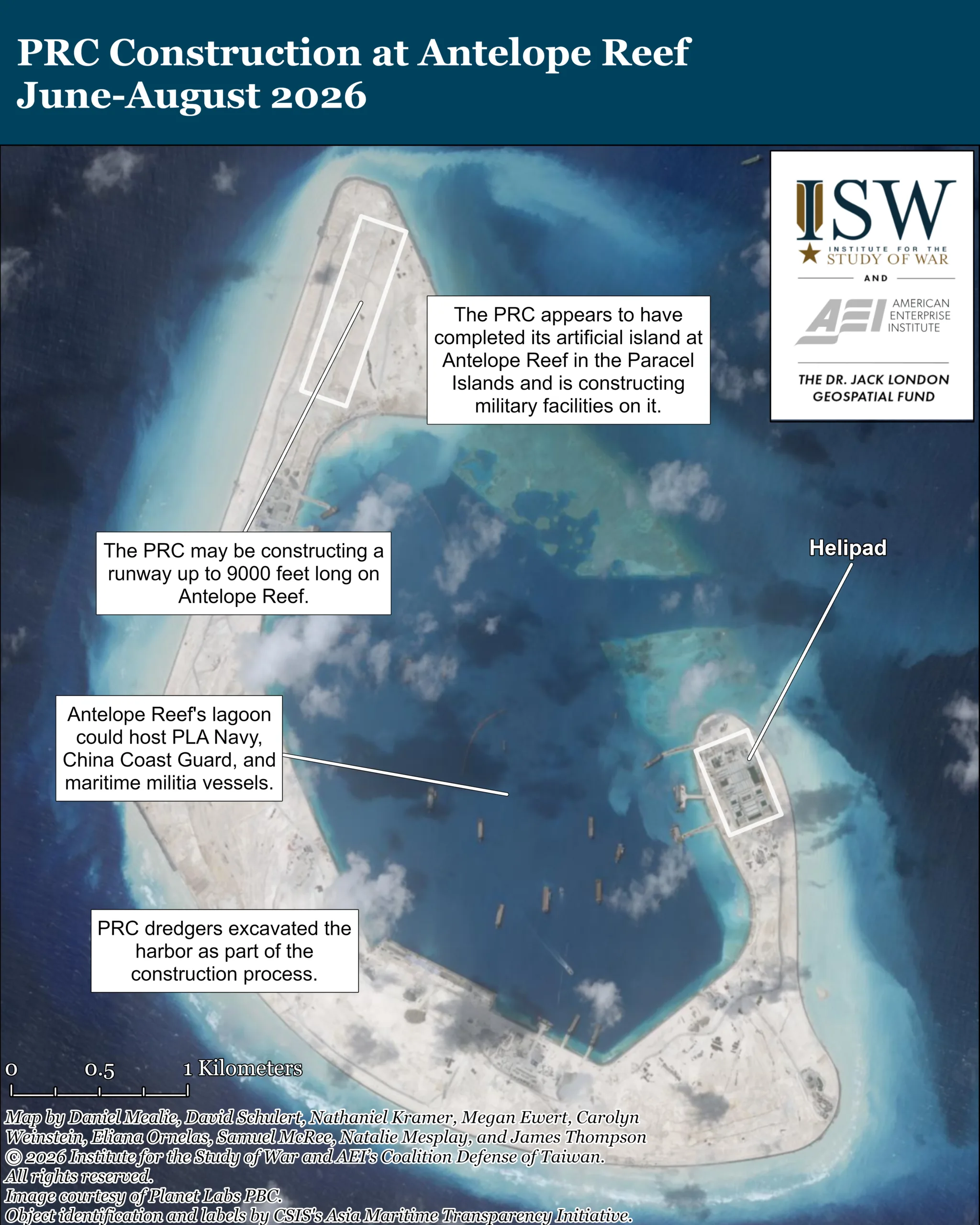
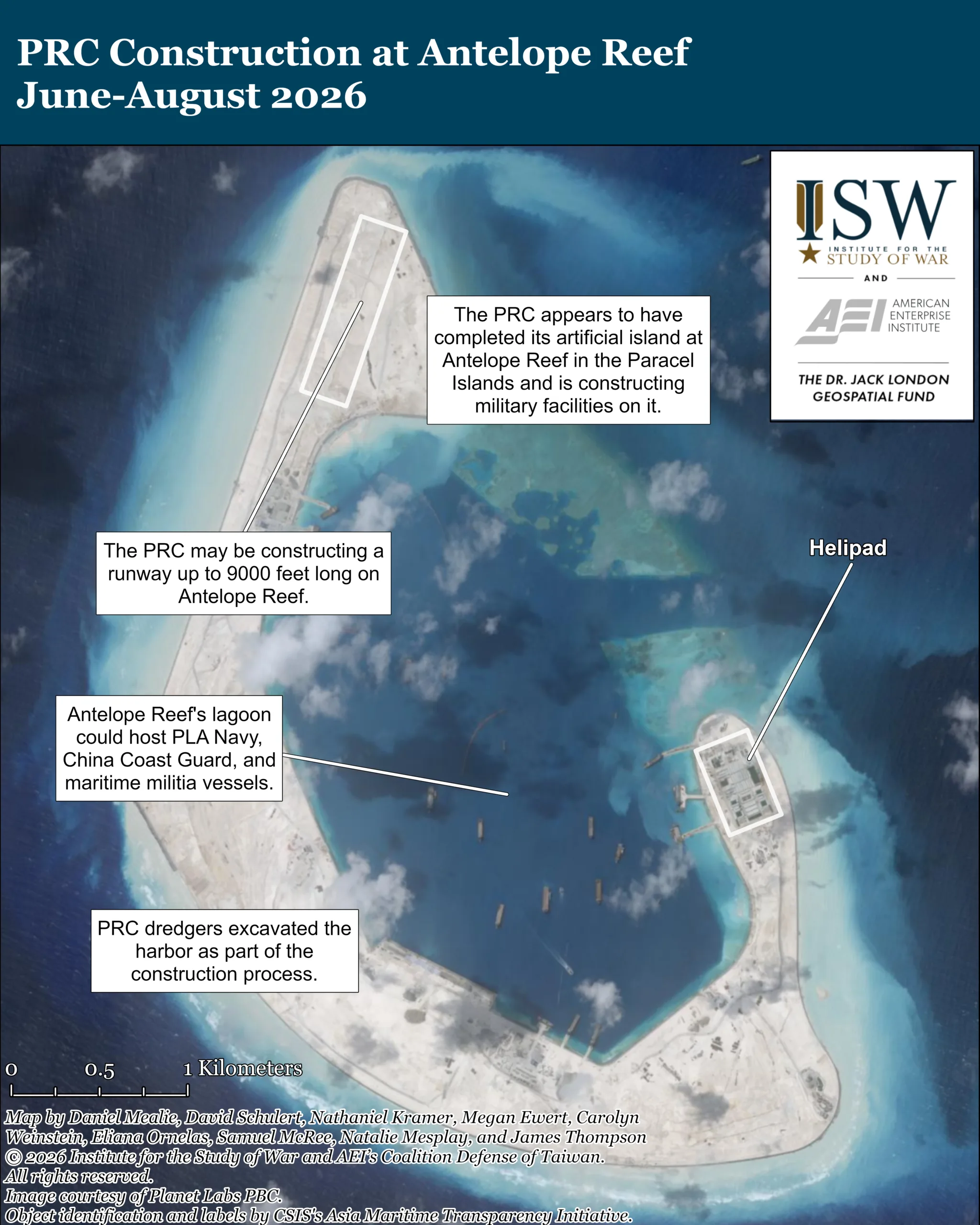
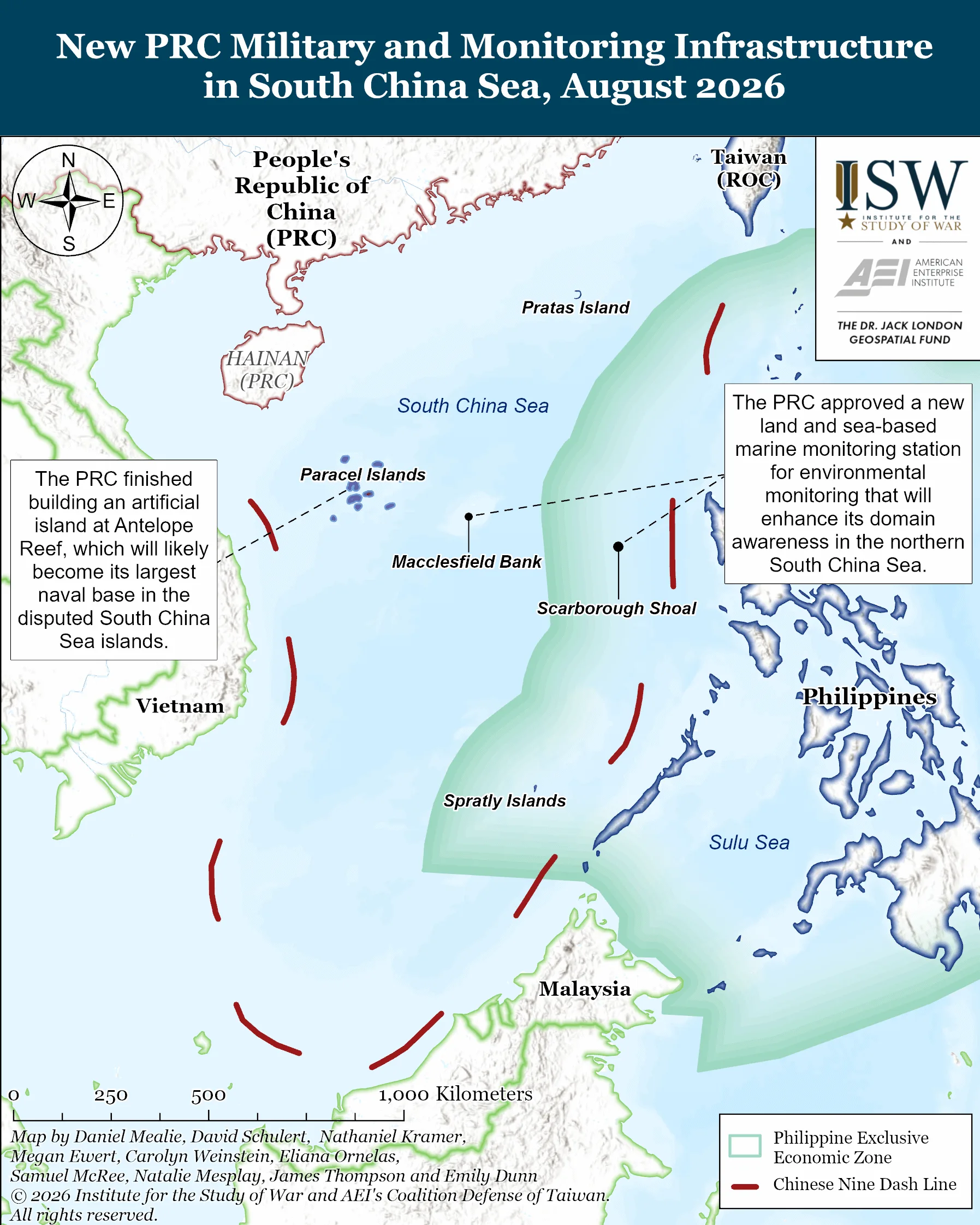
Satellite imagery shows that the PRC appears to have completed construction on an artificial island in Antelope Reef that could serve as the PRC’s largest naval base in the South China Sea. The base would strengthen the PLA’s militarized presence and positioning in the South China Sea. Reuters reported, based on satellite imagery, on August 19 that the PRC had finished the first stage of construction on Antelope Reef in the Paracel Islands, completing a roughly 1490-acre artificial island on top of the reef and dredging the lagoon to make a large harbor.[1] The PRC began the island construction in late 2025.[2] Satellite imagery also shows piers, a helipad, and various buildings on the reef as of August 2026. The Center for Strategic and International Studies (CSIS) Asia Maritime Transparency Initiative reported on August 14 that the PRC may now be building a runway on the artificial island that could measure up to 9,000 feet long.[3] PRC state-owned tabloid Global Times published an article on August 20 claiming that recent construction was carried out to improve the quality of life for residents and fishermen, citing a March statement by a PRC foreign ministry spokesperson.[4]
Antelope Reef is part of the Paracel Islands, which the PRC administers but Vietnam also claims.[5] The PRC has used other Paracel Islands outposts as surveillance and administrative hubs.[6] Antelope Reef’s large lagoon offers a protective harbor for PRC surface vessels and submarines, and its runway and future infrastructure, such as missile launchers and radar, may make it a useful base for the PRC to exert sea and air control over the South China Sea.[7] PRC efforts to militarize the South China Sea may complicate US and coalition efforts to reinforce and defend Taiwan during a war.
The PRC will likely use environmental monitoring as a pretext to enhance and automate maritime domain awareness and enforcement of PRC territorial claims in the South China Sea. The South China Sea Institute of Oceanology (SCSIO), an institute of the PRC state-run Chinese Academy of Science (CAS), announced on August 18 that the PRC approved plans for a marine environmental observation station in the South China Sea that would monitor the “Zhongsha Islands.”[8] The “Zhongsha Islands” is the PRC name for the grouping of the Scarborough Shoal, which the PRC seized from the Philippines in 2012, and the underwater Macclesfield Bank. The SCSIO said that the new station will establish a “three-dimensional marine observation network” covering the entirety of the “Zhongsha Islands” and collaborating with existing monitoring stations in the PRC-occupied Paracel and Spratly Islands.[9] The SCSIO did not disclose the location of the new monitoring station but said it would include a “sea-based dual-core” and “land-based overall support.”[10] The PRC may construct the land-based portion of the monitoring station on the nearby Paracel Islands because constructing directly on Scarborough Shoal — the only above-water feature in the “Zhongsha Islands” — would be unprecedented and potentially provoke a response from the Philippines.
The PRC has repeatedly used environmental protection as a pretext to enhance its legal jurisdiction, information operations, enforcement measures, and domain awareness around disputed features and waters. The PRC established a nature reserve on part of Scarborough Shoal in August 2025 and used this as a justification for expanding measures prohibiting unauthorized foreign activity around Scarborough Shoal in August 2026.[11] The PRC released an ecological report on nine South China Sea features on August 15, which accused the Philippines of causing environmental damage near two Philippine-occupied and PRC-claimed features.[12] The PRC often conducts undersea “scientific surveys” around the region that could serve dual military functions, including mapping undersea terrain, placing sensors and undersea navigation beacons, deploying unmanned underwater vehicles (UUVs), and studying sea conditions, which can aid undersea warfare and area-denial operations. The new Zhongsha monitoring station may similarly enhance the PRC’s ability to conduct undersea operations, detect surface and undersea vessel traffic, and support enforcement of PRC territorial claims.
The PRC may be planning to significantly automate marine detection and law enforcement in the South China Sea by 2030. The PRC Ministry of Ecology and Environment and the National Development and Reform Commission (NDRC) jointly unveiled a plan on July 15 to build a “sky-space-ground-sea integrated monitoring network” between 2026 and 2030.[13] The plan aimed to build early warning and monitoring capabilities to detect pollutants and ecological issues, but the same capabilities could also detect military threats. PRC Vice Minister of Ecology and Environment Dong Baotong said on August 13 that the PRC will increasingly use digital technologies and artificial intelligence (AI) for maritime monitoring and law enforcement.[14] Dong stated that the PRC aims to reduce manual participation in the national ecological and environmental monitoring network by 70 percent by 2030 by building more automatic marine sampling stations, deploying fleets of unmanned vessels, integrating remote sensing satellites, and using big data and AI to identify leads and increase efficiency of inspections.[15] The China Coast Guard (CCG) published a paper in July 2026 that laid out a concept for using a network of unmanned vehicles based at various PRC island facilities to replace human personnel as the main South China Sea defense force, particularly against enemy drones.[16] The CCG could use a similar model to non-lethally enforce Beijing’s territorial claims during peacetime.
Taiwan’s military is enhancing its ability to conduct precision strikes using first-person-view (FPV) drones, likely in an effort to integrate lessons of unmanned systems warfare demonstrated in Ukraine. Improved unmanned systems warfare capabilities in Taiwan highlight the importance of Taiwan’s efforts to procure a large number of combat drones and develop a domestic drone industry. Taiwan’s military conducted its first live-fire FPV drone exercises on August 17.[17] The exercises included drone battalions from Taiwan’s 21st, 43rd, and 58th Artillery Commands, a drone battalion from the Marine Corps’ 66th Brigade, and a Military Police Drone Company.[18] The exercises focused on using FPV drones, either in individual strikes or groups of two, to neutralize enemy armored vehicles.[19] Taiwan’s Unmanned Systems Training Command, which was formed in April 2025, organized the exercises.[20] The exercises reflect Taiwan’s efforts to enhance its use of drones at the tactical level of war to supplement traditional firepower, particularly among its artillery formations.
Taiwan’s ability to train FPV drone operators on precision strike missions and develop tactical procedures for such strikes will be critical to its ability to adapt to modern conflict. The war in Ukraine has demonstrated how the widespread use of unmanned systems can significantly constrain an opponent’s ability to conduct mechanized maneuver.[21] Sustaining this effect requires a large number of drones and personnel capable of operating them.[22] Taiwan would likely benefit from expanding its live-fire FPV exercises across its forces, ensuring all its formations can supplement tactical reconnaissance and fires with unmanned systems without having to rely on specialized battalions within regional artillery commands.
Taiwan’s efforts to train its forces for unmanned systems warfare reflect the importance of properly equipping these forces. Russian and Ukrainian forces use millions of drones annually, and the rapid innovation cycle requires constant modification of existing systems and the development of new platforms to ensure they remain combat effective.[23] Taiwan must, as a result, develop both a pre-war drone inventory and the capability to produce and modify its own drone models to maintain its unmanned systems warfighting ability over time. Taiwanese President Wiliam Lai Ching-te’s administration has proposed an NT$ 210 billion (US$ 6.6 billion) budget to procure over 200,000 unmanned systems, which is currently facing legislative deadlock.[24] Enhanced training is a necessary but insufficient component of adapting to unmanned systems warfare, and a failure to procure the requisite systems and production capacity will severely constrain Taiwan’s ability to conduct a drone-enabled defense of its country.
Key Takeaways
- PRC Artificial Island Construction: New satellite imagery shows that the PRC finished the construction of an artificial island on Antelope Reef, a disputed South China Sea feature in the Paracel Islands. The PRC is also constructing a runway, piers, a helipad, and various buildings on what could be the PRC’s largest South China Sea naval base. The PRC could use this base for surveillance, exerting its sea and air control over the South China Sea.
- PRC South China Sea Construction: The PRC approved plans for a maritime environmental observation station in the South China Sea that would monitor the “Zhongsha Islands,” which include Scarborough Shoal. The PRC has used environmental protection to enhance its operations in the South China Sea and as a pretext for limiting non-PRC vessels’ access to disputed waters. This new station would likely serve a dual-use purpose benefiting PRC military and law enforcement operations in the South China Sea.
- Taiwanese Military Development: Taiwan’s military conducted its first live-fire FPV drone exercises on August 17, likely in an effort to integrate lessons learned from the war in Ukraine. Taiwanese drone procurement efforts are facing legislative gridlock, which will make it more difficult for Taiwan to procure the necessary systems to conduct drone-enabled defense operations.
Cross-Strait Relations
Taiwan
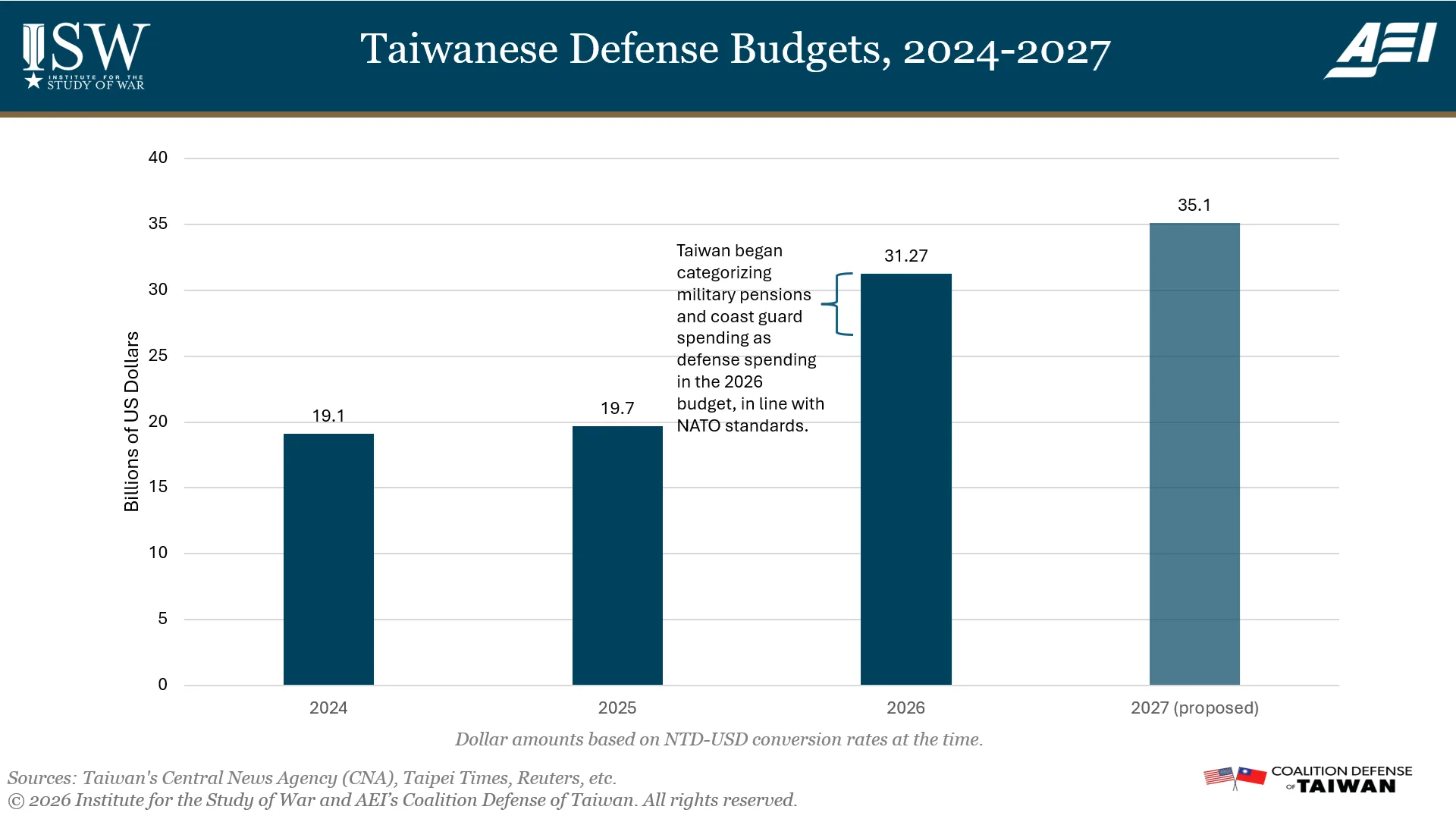
Taiwan’s Executive Yuan (EY) released its general budget proposal for 2027, including a record $35 billion in proposed defense spending. Taiwanese President William Lai Ching-te is continuing to increase Taiwan’s defense spending despite fierce partisan battles with the opposition-controlled legislature. The EY approved the 2027 budget on August 20 and will send it to the Legislative Yuan (LY) for a vote by the end of August.[25] The budget includes approximately $35.1 billion for defense spending: $21.7 billion for the Ministry of National Defense (MND) budget, $6.84 billion in special budgets — including for drone and missile procurement, $1.9 billion in nonprofit special funds, $1.5 billion for the coast guard, and $3.26 billion for military pensions.[26]
The proposed 2027 defense budget is 18 percent larger than the 2026 defense budget (in New Taiwan Dollars), consistent with Lai’s plans to increase Taiwan’s defense spending to five percent of GDP by 2030.[27] Taiwan’s 2026 budget — which passed on August 14 after a record 350-day delay — included about $31 billion in defense spending, equivalent to 3.32 percent of GDP. Taiwanese officials reported that the proposed 2027 defense budget equates to about 3.01 percent of Taiwan’s projected GDP.[28] Taiwan is experiencing rapid GDP growth driven by the AI boom, requiring greater defense spending to meet a “percent of GDP” spending target, even though it is significantly increasing defense spending in absolute terms.[29]
Partisan divides in Taiwanese politics remain a major obstacle to Taiwan increasing its defense spending, particularly in developing indigenous defense manufacturing. A Cabinet-proposed special defense budget passed on May 8 after months of delays, cutting the government’s proposed $40 billion budget to $25 billion and funding US arms packages while excluding funding for domestic drone production.[30] A separate special defense bill for military drone procurement is currently stalled in the LY (and therefore excluded from 2026 defense spending calculations).[31] The bill could fund an arsenal of over 200,000 drones until 2031, but the opposition parties are backing different funding mechanisms that could lead to unstable funding for the program and make it compete with civilian industry development.[32]
The PRC announced twelve new measures on August 18 to integrate Xiamen, PRC with Taiwan’s outlying island Kinmen. The PRC likely views Kinmen as a testing ground for policies it seeks to implement on Taiwan. The twelve measures facilitate tourism, cultural exchange, and trade between Kinmen and Xiamen.[33] One of the measures focuses on the completion of part of a bridge connecting Xiamen and Kinmen, with stipulations to carry out studies on bridge completion on the Taiwan side. Taiwan’s Mainland Affairs Council (MAC) commented on August 18 that the PRC cannot unilaterally create public works projects without approval from Taiwan.[34]
The PRC’s announcement directly references the meeting between opposition Kuomintang (KMT) Chairwoman Cheng Li-wun and CCP General Secretary Xi Jinping in April 2026.[35] The PRC used this meeting to advance ten measures on infrastructure and trade similarly aimed at cross-strait integration.[36] Taiwan’s Public Construction Commission (PCC) raised concerns in April about potential security and political risks of the bridge.[37] Taiwanese National Security Bureau (NSB) Director-General Tsai Ming-yen said that the PRC uses “goodwill” measures before elections as a means of exercising influence and emphasized that bilateral public works projects should require government approval.[38] Taiwan’s local elections will be held on November 28, with candidate registration taking place between August 31 and September 4.[39] Kinmen, a KMT stronghold, is holding elections for its county magistrate in November. The PRC could seek to influence this election in support of a more PRC-friendly candidate by introducing economic incentives for cross-strait cooperation. The PRC uses cross-strait cultural and business exchanges as a means of entrenching economic “integration.”[40] PRC attempts to bolster ties between Kinmen and Xiamen by invoking the support of Taiwanese politicians could reflect a broader PRC effort to attempt to coopt Taiwanese leaders to serve PRC strategic ends.
Taiwanese authorities indicted a noncommissioned officer in Taiwan’s military Reserve Command on August 18 for spying for the PRC. PRC intelligence agencies exploit financial insecurity among junior Taiwanese military personnel to acquire military secrets and conduct cognitive warfare against Taiwan. The Kaohsiung District Prosecutor’s Office stated that the “Wolong Society,” a PRC spy ring targeting active-duty Taiwanese military personnel, recruited a sergeant in the Taiwanese Military Police surnamed Chiang in 2022.[41] Taiwanese prosecutors accused Chiang of recording a video of himself expressing support for PRC annexation of Taiwan and pledging not to resist PLA forces during an invasion in exchange for payment.[42] Chiang also allegedly leaked classified military documents to the PRC spy ring in 2024 and reenlisted in a Taiwanese Reserve Command unit to continue spying after retiring from the military in January 2025.[43]
Taiwanese prosecutors stated that Chiang contacted the Wolong Society through Telegram while searching for loans to help repay his large personal debts.[44] Chiang allegedly agreed to leak military secrets to the PRC in exchange for bribes to cover these debts.[45] Taiwanese prosecutors also indicted two sergeants in Taiwan’s Army and Air Force in March for filming similar “surrender videos” and leaking classified military documents to the Wolong Society for pay.[46] Those two officers were allegedly in debt, and the Wolong Society helped them negotiate debt settlements.[47]
PRC intelligence agencies often exploit financial insecurity among low-ranking Taiwanese soldiers by using financial enticements to recruit them for espionage.[48] PRC agents likely pay Taiwanese military personnel to film “surrender videos” to support the PRC’s cognitive warfare efforts to convince Taiwan that its military is not committed to protecting Taiwan from a PLA invasion.[49]
China
ByteDance and Tencent received their first small shipments of about 10,000 Nvidia H200 chips, with other PRC technology companies likely to receive similar shipments soon. The PRC is likely to use the limited chip supply to improve domestic AI model training with broader aims for military applications and PLA modernization. The United States allows PRC companies to acquire as many as 100,000 H200 chips each.[50] The PRC has allowed these companies to ship the chips to Hong Kong, as the PRC wants to keep the chips outside of the PRC to encourage domestic chip development.[51] The PRC is balancing its goals for its domestic chip industry against its need to keep domestic AI companies at the forefront of AI development.[52] The Financial Times reported that the PRC is using Nvidia chips for the complex training phase where AI systems develop knowledge and track patterns, while maintaining the use of domestic chips for AI inference work, which produces live responses.[53]
The PRC’s intended use of these chips is not in line with the Trump administration’s expectations that selling H200 chips to the PRC could help stunt PRC domestic chip production and increase PRC dependence on US chips.[54] CCP General Secretary Xi Jinping stated that he plans for AI to be an integral part of PLA modernization and to expand the use of AI throughout the PLA, given his expectation that IT systems-level operations will be the primary form of warfare in the future.[55] The PRC will use this limited shipment of advanced US chips to boost its domestic AI capabilities without becoming dependent on US chips, and ultimately indigenize these technological advancements within its broader industrial and military base.
Northeast Asia
Japan
Japan and Australia are cooperating to develop and test weapons systems as part of broader military cooperation, despite PRC pressure against Japanese defense modernization. Australia reported on August 18 that it had successfully carried out a test of the “Boobook” project, a laser system codeveloped with Japan designed for surveillance and threat detection.[56] Australian Defense Minister Richard Marles commented that both land and littoral combat systems could equip the laser system but did not provide details on how the laser system would be used.
The Australian government readout stated that the test “demonstrated Australia and Japan’s ability to jointly develop advanced technologies and conduct multinational testing,” establishing a foothold for future cooperation.[57] Marles and Japanese Defense Minister Koizumi Shinjiro agreed on August 18 to test Japanese stand-off missiles, including hypersonic missiles, in Australia.[58] Japan has a limited ability to test missiles with long ranges domestically. Japan previously tested Hyper Velocity Gliding Projectile (HVGP) hypersonics in California.[59] HVGP and Tomahawk missiles would constitute Japan’s long-range defense mechanism against adversaries such as the PRC.[60] The PRC has waged an economic and diplomatic pressure campaign against Japan since November 2025, when Japanese Prime Minister Sanae Takaichi commented that a Taiwan military contingency could involve Japan.
North Korea
The PRC is supporting North Korean demands for the United States to change its denuclearization policy. PRC Foreign Minister Wang Yi urged the United States to change its “longstanding hostile policy” against North Korea during his August 20 visit to South Korea.[61] Wang added that whether the PRC would facilitate a United States-North Korea dialogue depends on the decision of the two states.[62] Wang met with South Korean Foreign Minister Cho Hyun and reiterated that the PRC will continue to play a constructive role for peace and stability on the Korean Peninsula and expressed his wishes that the two Koreas could incrementally move toward coexistence and peace.[63] Wang did not mention the denuclearization of North Korea during the meeting. Wang claimed that the PRC’s policy on the Korean Peninsula has maintained continuity and stability in a meeting with South Korean National Security Council Director Wi Sung-lac.[64]
Wang’s characterization of the US’s North Korea policy as “hostile” contradicted US President Donald Trump’s recent calls for dialogue with North Korea. Trump directed a reduction in US-South Korea combined exercises and called North Korea “unthreatening” on August 16, after North Korea denounced Washington and Seoul for conducting their annual combined Ulchi Freedom Shield exercise.[65] North Korea rejected the gesture, calling the exercise reduction “meaningless” on August 19.[66] ISW-CDOT assessed that North Korea is unlikely to agree to dialogue with Washington until the Trump administration changes its denuclearization policy.[67] The PRC’s calls for a change in US policy likely aim to pressure Trump to accept North Korean conditions — including the United States accepting North Korea as a nuclear-armed state and stopping calls for North Korea’s denuclearization — ahead of the Asia-Pacific Economic Cooperation (APEC) in Shenzhen, PRC, in November 2026. The Wall Street Journal reported on August 20 that Trump is pushing to arrange an in-person meeting with Workers’ Party of Korea (WPK) General Secretary Kim Jong Un during APEC.[68]
The PRC has abandoned its formal position on denuclearization since Kim and Xi held a summit in Beijing in September 2025, omitting references to denuclearization in diplomatic settings and government documents.[69] The PRC has long held a position urging North Korean denuclearization since North Korea first tested nuclear weapons in the early 2000s. The PRC’s implicit policy change came after North Korea began strengthening its diplomatic and military ties with Russia in support of Moscow’s ongoing war in Ukraine. ISW-CDOT previously assessed that the PRC may be counterbalancing strengthening North Korea-Russia ties to preserve its relative influence over North Korea. Whether the PRC expects an actual change in US policy or is merely displaying political support for North Korea remains unclear, however.
South Korea
The PRC is seeking to improve relations with the South Korean Lee Jae Myung administration. PRC Foreign Minister Wang Yi met with South Korean President Lee Jae Myung on August 20.[70] Wang stated that PRC-South Korea bilateral relations are improving, citing Lee’s “pragmatic” policy toward the PRC.[71] Wang added that this improvement of ties aligns with South Korea’s national interests.[72] Lee stated that his two previous summits with CCP General Secretary Xi Jinping have led to a complete normalization of PRC-South Korean relations.[73] Lee noted improvements in public sentiments between the two countries and strengthening cooperation in the economic sector.[74] Wang’s trip to South Korea is his first since September 2021.[75] Wang likely visited Seoul to reaffirm bilateral ties ahead of the upcoming APEC summit in Shenzhen, PRC, in November.[76] The PRC likely views the Lee administration as more amenable than the previous conservative Yoon Suk-Yeol administration. The PRC, however, has expressed concerns about Lee’s initiative to deploy nuclear-powered attack submarines around the Korean Peninsula and the US Forces Korea’s evolving mission to counter the PRC beyond just North Korea.[77] The PRC may attempt to pose as an alternative diplomatic and economic option for South Korea — while Lee navigates trade and security negotiations with Washington — to prevent South Korea from integrating into the broader US Indo-Pacific strategy against the PRC.
Southeast Asia
Philippines
See Toplines.

[1] https://www.reuters.com/world/china/china-completes-first-stage-work-disputed-south-china-sea-reef-images-show-2026-08-19/
[2] https://amti.csis.org/antelope-reef-could-now-be-the-largest-island-in-the-south-china-sea/
[3] https://amti.csis.org/is-a-new-chinese-runway-taking-flight-at-antelope-reef/
[4] https://www.globaltimes dot cn/page/202608/1368616.shtml
[5] https://www.wsj.com/world/china/china-south-china-sea-military-base-3ebf3dc2
[6] https://www.taipeitimes dot com/News/front/archives/2026/08/20/2003862797
[7] https://amti.csis.org/antelope-reef-could-now-be-the-largest-island-in-the-south-china-sea/; https://www.wsj.com/world/china/china-south-china-sea-military-base-3ebf3dc2
[8] https://www.scmp dot com/news/china/diplomacy/article/3364581/china-build-environmental-monitoring-station-near-disputed-scarborough-shoal?module=top_story&pgtype=section
[9] https://scsio.cas dot cn/news/tpxw/202608/t20260818_8261759.html
[10] https://scsio.cas dot cn/news/tpxw/202608/t20260818_8261759.html
[11] https://understandingwar.org/research/china-taiwan/china-taiwan-update-august-7-2026/ ; https://understandingwar.org/research/china-taiwan/china-taiwan-weekly-update-september-15-2025/
[12] https://www.scmp dot com/news/china/diplomacy/article/3300725/beijing-says-philippines-polluting-south-china-sea-it-releases-waste-burning-film ; https://www.scmp dot com/news/china/diplomacy/article/3364152/beijing-issues-ecological-report-solidify-south-china-sea-claims-amid-us-row
[13] https://www.chinadaily.com dot cn/a/202607/16/WS6a587caca310986e2b4659dc.html
[14] https://www.chinadaily.com dot cn/a/202608/13/WS6a7d87caa31073853ec532ab.html
[15] https://www.chinadaily.com dot cn/a/202608/13/WS6a7d87caa31073853ec532ab.html
[16] https://www.scmp dot com/news/china/science/article/3364440/chinese-coastguard-proposes-turning-south-china-sea-isles-robotic-fortress?module=top_story&pgtype=section
[17] https://www.taiwannews.com dot tw/news/6423567
[18] https://def.ltn.com dot tw/article/breakingnews/5543375; https://www.taiwannews.com dot tw/news/6423567
[19] https://www.scmp dot com/news/china/military/article/3364447/taiwan-launches-first-live-fire-exercise-first-person-view-drones?module=top_story&pgtype=section
[20] https://www.taipeitimes dot com/News/taiwan/archives/2026/05/25/2003857925; https://www.taiwannews.com dot tw/news/6369916; https://www.scmp dot com/news/china/military/article/3364447/taiwan-launches-first-live-fire-exercise-first-person-view-drones?module=top_story&pgtype=section
[21] https://understandingwar.org/research/future-of-war/ukraine-and-the-problem-of-restoring-maneuver-in-contemporary-war/
[22] https://understandingwar.org/research/russia-ukraine/a-defense-of-taiwan-with-ukrainian-characteristics-lessons-from-the-war-in-ukraine-for-the-western-pacific/
[23] https://understandingwar.org/research/russia-ukraine/a-defense-of-taiwan-with-ukrainian-characteristics-lessons-from-the-war-in-ukraine-for-the-western-pacific/
[24] https://understandingwar.org/research/china-taiwan/china-taiwan-update-july-24-2026/; https://focustaiwan dot tw/politics/202606180012; http://news.usni.org/2026/06/24/taiwan-budget-calls-for-6-6b-for-attack-drones-unmanned-surface-vessels
[25] https://www.cna.com dot tw/news/aipl/202608200111.aspx
[26] https://focustaiwan dot tw/politics/202608200011
[27] https://www.reuters.com/world/asia-pacific/taiwan-proposes-boosting-2027-defence-spending-18-record-high-2026-08-20/
[28] https://www.bbc.com/zhongwen/articles/cn85nywv6ppo/trad ; https://understandingwar.org/research/china-taiwan/china-taiwan-update-august-18-2026/
[29] https://www.scmp dot com/news/china/military/article/3364713/taiwan-proposes-record-us35b-defence-budget-2027-plas-pressure-grows
[30] https://understandingwar.org/research/china-taiwan/china-taiwan-update-may-8-2026/
[31] https://www.taipeitimes dot com/News/taiwan/archives/2026/08/20/2003862839
[32] https://www.taipeitimes dot com/News/taiwan/archives/2026/08/20/2003862839 ; https://understandingwar.org/research/china-taiwan/china-taiwan-update-july-24-2026/
[33] https://www.gwytb dot gov.cn/xwdt/xwfb/wyly/202608/t20260819_12783177.htm; https://www.xmtv dot cn/xmtv/2026-08-18/76ddbd372509f5c7.html
[34] https://www.cna.com dot tw/news/acn/202608180292.aspx
[35] https://www.xmtv dot cn/xmtv/2026-08-18/76ddbd372509f5c7.html
[36] https://understandingwar.org/research/china-taiwan/china-taiwan-update-april-17-2026/
[37] https://www.taipeitimes dot com/News/taiwan/archives/2026/04/14/2003855565
[38] https://www.taipeitimes dot com/News/taiwan/archives/2026/04/14/2003855565
[39] https://www.taipeitimes dot com/News/feat/archives/2026/08/20/2003862791; https://www.taiwannews.com dot tw/news/6233184
[40] https://www.gwytb.gov dot cn/xwdt/newsb/202608/t20260818_12782917.htm
[41] https://www.taipeitimes dot com/News/taiwan/archives/2026/08/19/2003862740; https://udn dot com/news/story/7321/9698120; https://focustaiwan dot tw/society/202608180016
[42] https://www.taipeitimes dot com/News/taiwan/archives/2026/08/19/2003862740; https://udn dot com/news/story/7321/9698120; https://focustaiwan dot tw/society/202608180016
[43] https://www.taipeitimes dot com/News/taiwan/archives/2026/08/19/2003862740; https://udn dot com/news/story/7321/9698120; https://focustaiwan dot tw/society/202608180016
[44] https://www.taipeitimes dot com/News/taiwan/archives/2026/08/19/2003862740; https://udn dot com/news/story/7321/9698120; https://focustaiwan dot tw/society/202608180016
[45] https://www.taipeitimes dot com/News/taiwan/archives/2026/08/19/2003862740; https://udn dot com/news/story/7321/9698120; https://focustaiwan dot tw/society/202608180016
[46] https://www.cna.com dot tw/news/asoc/202603040340.aspx
[47] https://www.cna.com dot tw/news/asoc/202603040340.aspx
[48] https://www.aei.org/commentary/china-taiwan-update-august-14-2026/; https://understandingwar.org/research/china-taiwan/china-taiwan-update-august-14-2026/
[49] https://www.cna.com dot tw/news/asoc/202506040186.aspx; https://focustaiwan dot tw/society/202506050018; https://www.aei.org/commentary/china-taiwan-update-april-17-2026/; https://understandingwar.org/research/china-taiwan/china-taiwan-update-april-17-2026/
[50] https://www.reuters.com/world/asia-pacific/nvidia-h200-chips-reach-china-small-shipments-ft-reports-2026-08-19/
[51] https://www.reuters.com/world/asia-pacific/nvidia-h200-chips-reach-china-small-shipments-ft-reports-2026-08-19/
[52] https://www.ft.com/content/6c5650fb-969d-4d4e-80d6-8d11002a8cf7?syn-25a6b1a6=1
[53] https://www.ft.com/content/6c5650fb-969d-4d4e-80d6-8d11002a8cf7?syn-25a6b1a6=1
[54] https://understandingwar.org/research/china-taiwan/china-taiwan-weekly-update-december-12-2025/; https://www.politico.com/news/2025/12/08/u-s-to-allow-nvidias-h200-sales-in-china-trump-confirms-00681619
[55] https://www.news dot cn/politics/20260731/a7b4b1b85a414a58977ab7a2390b092c/c.html
[56] https://www.minister.defence.gov.au/media-releases/2026-08-18/successful-trial-laser-marks-deepening-australia-japan-defence-collaboration; https://www.abc.net.au/news/2026-08-18/defence-ministers-tread-carefully-as-trump-scales-back-drills/107050936
[57] https://www.minister.defence.gov.au/media-releases/2026-08-18/successful-trial-laser-marks-deepening-australia-japan-defence-collaboration
[58] https://www.asahi.com/ajw/articles/16818817; https://www.taipeitimes dot com/News/front/archives/2026/08/19/2003862731
[59] https://www.asahi.com/ajw/articles/16818817; https://news.usni.org/2025/11/17/japanese-forces-test-deployment-of-hypersonic-missile-system
[60] https://news.usni.org/2025/11/17/japanese-forces-test-deployment-of-hypersonic-missile-system; https://understandingwar.org/research/china-taiwan/china-taiwan-update-august-7-2026/
[61] https://www.joongang.co.kr/article/25454552
[62] https://www.joongang.co.kr/article/25454552
[63] https://www.joongang.co.kr/article/25454552
[64] https://www.inews24 dot com/view/1996875
[65] https://thehill.com/homenews/administration/6033853-trump-south-korea-military-exercises-iran/; https://www.reuters.com/world/asia-pacific/north-korea-denounces-us-south-korea-drills-kcna-says-2026-08-13/
[66] https://apnews.com/article/korea-us-military-drills-313e01e4ee305b4c9b1b8bf12643fb17
[67] https://understandingwar.org/research/china-taiwan/korean-peninsula-update-august-19-2026/
[68] https://www.wsj.com/world/asia/trump-pushes-for-kim-jong-un-meeting-this-year-2a9f9ae0
[69] https://www.cnn.com/2025/09/04/china/china-xi-kim-meeting-military-parade-intl-hnk
[70] https://kr.news dot cn/20260821/54cfc658db58455eb7c53fad285669be/c.html
[71] https://kr.news dot cn/20260821/54cfc658db58455eb7c53fad285669be/c.html
[72] https://kr.news dot cn/20260821/54cfc658db58455eb7c53fad285669be/c.html
[73] https://www.korea dot kr/news/policyNewsView.do?newsId=148970377&call_from=media_daum_bottom
[74] https://www.korea dot kr/news/policyNewsView.do?newsId=148970377&call_from=media_daum_bottom
[75] https://biz.chosun dot com/international/international_general/2026/08/19/NZ74VSKNTVEVBC3TZ4MDBRUKEI/
[76] https://biz.chosun dot com/international/international_general/2026/08/19/NZ74VSKNTVEVBC3TZ4MDBRUKEI/
[77] https://www.joongang.co dot kr/article/25383116; https://www.donga dot com/news/Politics/article/all/20260528/134012672/1