Who are the greatest players in Manchester United’s history? The Athletic gave Andy Mitten the task of compiling his top 25, and we are counting them down this summer, in reverse order.
He explains his thought process here.
Benfica away, European Cup quarter-final second leg, 1966.
Manchester United held a narrow 3-2 lead from the first leg of this European Cup quarter-final. Few thought it would be enough but then people didn’t know how disappointed the United players had been to be beaten 5-0 by Benfica’s rivals Sporting CP in Lisbon two years earlier. They were ready for revenge.
Benfica held up the kick-off of the second leg by 15 minutes so that the legendary Eusebio could be presented with the 1965 European Player of the Year award. United’s men thought the delay was because their opponents wanted to get the home crowd at it; that same crowd which had been holding five fingers up at the United team coach and beating on the windows as it edged towards the stadium. That wound the players up even more.
Manager Matt Busby’s tactics were to play it safe, especially in the opening 20 minutes to quieten the 75,000 Estadio da Luz crowd.
George Best ignored him.
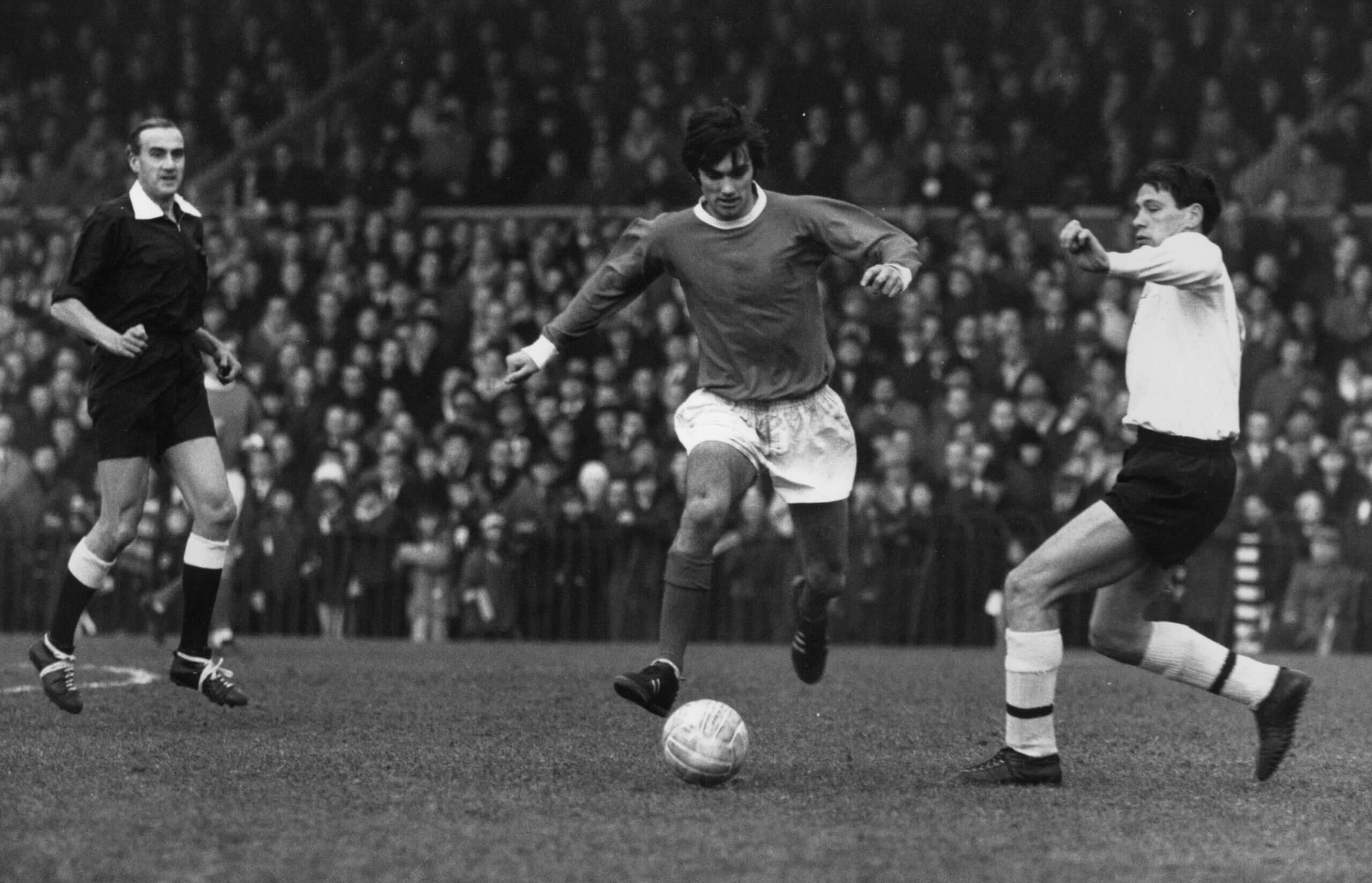
After 20 minutes, United led 3-0, with two from Best. His second goal was remarkable. Goalkeeper Harry Gregg sent a long kick down the middle for striker David Herd to head on. Best fastened onto the ball and weaved past three defenders to create a sensational piece of magic.
“When we made our plans, George Best must have stuffed cotton wool in his ears,” said Busby with a smile.
“George Best ran amok from start to finish and absolutely slaughtered Benfica,” recalled team-mate Paddy Crerand. “Pulverised them. He scored his first in the sixth minute, his second in the 12th. Two minutes later, he set up John Connelly to make it three. We were so dominant that we had two further efforts disallowed in the first half. George was 19.” The Portuguese press nicknamed him “the fifth Beatle”.
A right winger, the Belfast Boy scored 179 goals in 470 appearances for United between 1963 and 1974. That puts him joint-fifth in United’s all-time top goalscorers chart with Dennis Viollet. Best played in a team with two of the players above him in that list in Bobby Charlton and Denis Law. He’s 15th in the all-time appearance chart, 10 games behind Roy Keane. Imagine how high that figure could have been had Best not made his last United appearance aged just 26.
George Best made his top-flight debut for Manchester United as a 17-year-old (Allsport Hulton/Archive)
But it wasn’t just about the numbers of goals he scored or that he was always first name on the team sheet. It was the way he played, his attitude in matches, his style, balance and elegance. Best was a thrilling, beautiful footballer. People wanted to be him and emulate him. In 1969, he was given a golden miniature pair of the boots he endorsed to mark record sales of 250,000. By then, he was an established star but it had been coming.
“He has a tremendous temperament; no situation is bigger than him. He can rise to any level and with experience, he will be a giant,” said Sir Matt Busby of Best at the start of his career. Within a few years, Busby said that Best was the best of everything at the club: fastest runner, hardest shot and best tackler. Pele, no less, said: “George Best was the greatest player in the world”.
Benfica at Wembley, European Cup final, 1968
“George Best, more than any other player, brought the European Cup to Old Trafford,” said team-mate and goalkeeper Gregg, who was also from Northern Ireland and who was one of the first to recognise his ability in training.
“One of the boys, the skinny one, brought the ball to me and sent me diving the wrong way as he tapped it in at the other side. I thought that any kid can get lucky once but he did it to me a second time.
“I had always prided myself that I could make forwards do what I wanted but this slip of a boy had just shaken his hips and had me diving at fresh air. I knew at that moment that Manchester United had a very rare talent on their hands.”
At Wembley in ’68, Best scored the second in a 4-1 win at the start of extra time to send United on their way to their first European Cup triumph.
“Out of our whole team, George Best was the fittest of the lot and he was the only one still running around,” said goalkeeper Alex Stepney, who started that final. “He ran onto Brian Kidd’s flick-on and got past Mario Coluna before rounding Jose Henrique in the goal, and passing the ball into the net. That lifted all the players. They were suddenly running again.”
“My only reaction upon hearing that George Best had been named Footballer of the Year by claiming 60 per cent of the vote was to ask my informant: ‘Who on earth did the remaining 40 per cent vote for?’,” said TV’s Michael Parkinson after Best became European Footballer of the Year in 1968.
Best, in blue, was a European champion, but such continental success would be limited to club and not country.
Best was called up for Northern Ireland after just 21 first-team games for United. He went onto win 37 caps but it was not a great time for Northern Irish football and Best never participated in a World Cup or European Championship. He produced some incredible performances, though. He took England’s defence apart in one 1965 game and one of his best displays was against Scotland in a 1-0 win in 1967 when he entranced the Windsor Park crowd with his dazzling skill on the ball, dropping his shoulder and surging past defenders.
“I always wanted more — more of everything’, said Best in one of his many autobiographies.
For many United fans, his name was apt.
He was the best they ever saw, the greatest footballer of the generation; not merely a genius on the pitch with balletic balance, but a man completely emblematic of Swinging Sixties cool. Best was idolised and not only by football fans.
Heartthrob, fashion model, trendsetter and pin-up, Best was conflicted and contradictory, evocative and elegant. His feints and swerves, dribbles and dazzle; one team-mate described him as being built like a matchstick and they wanted to protect him and his prodigious talent.
Having been spotted by legendary scout Bob Bishop near his Belfast home, Best made his United debut aged 17 in 1963. The timing was fortuitous – for him and United. The club was rebuilding after the 1958 Munich air disaster but won a first post-Munich trophy, the FA Cup, earlier that year. Champions in 1965 for the first time since 1957, manager Sir Matt Busby had his eyes set on a first European Cup for an English club.
Best was sensational on and off the field. He dressed sharply, introduced a hairdryer to the United dressing room long before Sir Alex Ferguson’s rants became known as such, and shampoo too (players previously washed their hair with red carbolic soap).

George Best, wearing a Benfica shirt, holds the European Cup aloft in 1968 (Staff/Daily Mirror/Mirrorpix via Getty Images)
His team-mates loved him.
“A few of the lads fancied themselves as ladies’ men but George was in a different league,” said Crerand, who Best ended up living with at an attempt of a sane family life. “If he had been born ugly, then he would have played until he was 50 because nobody would have hounded him.”
And Best’s quotes, gleaned from his many interviews or books he put his name to, are legendary.
“I spent a lot of money on booze, birds and fast cars. The rest I just squandered,” is one of the better-known ones.
Best was only 59 when he died of multiple organ failure and a lung infection in a London hospital 2005 after an adult life of drinking. He’s buried in the family grave in East Belfast.
Had he stayed longer and played more, he could easily be No 1 on this list but he made choices that did little for his career as he turned out for non-League Dunstable Town, Stockport County, Cork Celtic, Los Angeles Aztecs, Fulham, Fort Lauderdale Strikers, Hibernian, San Jose Earthquakes, Bournemouth and Brisbane Lions. Five of those clubs don’t exist now.
George Best is not just one of the greatest Manchester United footballers ever, but one of the greatest footballers who ever lived — but he was so much more than a mere football player.