Toplines
Japan’s ongoing defense reforms reflect the failure of the PRC’s long-term pressure campaign against Japan, which aims to deter Japan from involving itself in a Taiwan contingency.[1] Japan test-fired a Tomahawk cruise missile from the destroyer Chokai in the Pacific Ocean on July 29. Tomahawks have a range of 1600 km, allowing them to strike within PRC territory if launched from a destroyer located near Japan.[2] Japan plans to procure 400 of the US-supplied missiles. ISW-CDOT previously assessed that delays in Tomahawk shipments, announced in Spring 2026, could jeopardize Japan’s evolving defense concept.[3] Japan’s missile test indicates its intent to incorporate the Tomahawks in its defense concept despite the threat of delays, however.
Japan released its annual Defense White Paper, which highlighted PRC short-of-war coercion, on August 4.[4] The white paper emphasized cooperation between the PRC, Russia, and North Korea. The white paper pointed out frequent PRC-Russia combined deployments and flights near Japan and noted these activities as “clearly intended as demonstrations of force directed at Japan.”[5] The white paper also noted that the PRC “has intensified its military activities around Taiwan” and expressed concern that the PRC could impose a blockade on Taiwan using the China Coast Guard (CCG).[6] The white paper noted that “it cannot be ruled out that a serious situation similar to Russia’s aggression against Ukraine may occur in the Indo-Pacific region in the future, particularly in East Asia.” However, this statement did not specifically reference the PRC.[7] Japanese Defense Minister Koizumi Shinjiro stated during an August 4 press conference that the white paper was designed to be accessible to interested civilians, not exclusively members of the defense community.[8]
The PRC has consistently expressed opposition to Japan’s efforts to bolster its military and economic defenses, which have also included revisions to its key security documents and the creation of a foreign investment screening body. The PRC similarly criticized Japan’s defense white paper, which called PRC actions Japan’s “greatest strategic challenge.”[9] PRC Ministry of Defense (MOD) spokesperson Chen Xi on August 4 criticized the white paper for “hyping up” the threat of the PRC, claiming that Japan is using the PRC as an excuse to remilitarize.[10] Chen’s statements reflect typical PRC rhetoric meant to downplay PRC coercion and link Japan’s actions to World War II-era militarism. The PRC Ministry of Foreign Affairs (MFA) similarly stated it complained to Japan regarding the white paper on August 5.[11]
The PRC has waged an economic and diplomatic pressure campaign against Japan since November 2025, when Japanese Prime Minister Takaichi Sanae commented that a Taiwan contingency could implicate Japan.[12] Japan’s continued efforts to ramp up its defense indicate that the PRC’s pressure campaign is failing to achieve its objectives. The PRC will likely continue pressuring Takaichi to retract the statement, as well as escalating sanctions and rhetorical pressure despite Japan’s resistance to the pressure campaign.
The PLA Navy’s (PLAN) Type 076 amphibious assault vessel Sichuan may operate in a role closer to that of an aircraft carrier than the PLAN’s existing amphibious assault vessels, including in the operation of manned aircraft. Sichuan’s unique capabilities could supplement the PLAN’s existing limitations in naval aviation, as ISW-CDOT has previously reported. PRC state broadcaster CCTV published an interview on August 2 in which a military commentator claimed that the Type 076 amphibious assault vessel Sichuan could operate manned aircraft.[13] The CCTV report further described Sichuan as a “quasi-aircraft carrier.”[14] CCTV also released footage on August 1 of Sichuan testing its electromagnetic catapult and countermeasure systems.[15] Previous reporting on Sichuan from less authoritative PRC sources had only confirmed its ability to operate unmanned systems from its catapult system and described Sichuan primarily as a “drone carrier.”[16] Sichuan is the only amphibious assault vessel in the world to operate an electromagnetic catapult system and has a displacement of over 50,000 tons, which is comparable to smaller aircraft carriers.[17]
ISW-CDOT has assessed that Sichuan’s unique characteristics indicate the PLAN’s intention to primarily deploy her to support long-range naval missions rather than amphibious assault support.[18] Sichuan’s ability to launch large drones could be used to supplement the PLAN’s two older aircraft carriers that cannot launch larger aircraft due to its lack of catapults.[19] Large aircraft equipped with early warning radars are essential for fleet defense and the PLAN could pair Sichuan with one of its older carriers to increase their survivability on long-range missions.[20]
Sichuan’s ability to operate manned aircraft may indicate that the Type 076 class of vessels are also designed to supplement the PLAN’s limited carrier aviation capacity at large. The PLAN’s carrier fleet can operate around 130 fixed and rotary-wing aircraft in total, while a single US Navy aircraft carrier operates between 75 and 90.[21] US carriers are also likely able to launch aircraft at a greater rate than their PLAN counterparts due to larger deck space and a higher number of catapults.[22] Sichuan, and other vessels of its class, could supplement both the carrying capacity and sortie rate of a PLAN carrier strike group with its electromagnetic catapult launch capability. The Type 076 may be more cost-effective and easier to construct than the PLAN’s newest carriers, allowing the PLAN to increase its naval aviation capabilities without having to match the US Navy’s carrier fleet ton-for-ton. It is not clear whether the PRC intends to expand the Type 076 class beyond Sichuan, however, and may seek to test the efficacy of a “quasi-carrier” concept before mass producing the vessel.[23]
Dispersing naval aviation across smaller, easier-to-construct platforms could introduce several trade-offs for the PLAN, however. The Type 076’s single electromagnetic catapult and deck space will likely constrain its sortie rate. The vessel’s shorter deck will also likely prevent it from operating manned aircraft larger than a fighter jet.[24] Coordinating carrier operations across several smaller platforms simultaneously may also create frictions that a single, large carrier would otherwise mitigate. Such an operating concept could, however, mitigate the cascading failure risk for PLAN aviation that losing a single platform would create, ensuring the PLAN can remain in the fight despite sustaining losses. The PLAN may accept these trade-offs in the short term as it attempts to expand its carrier fleet in the next decade.[25]
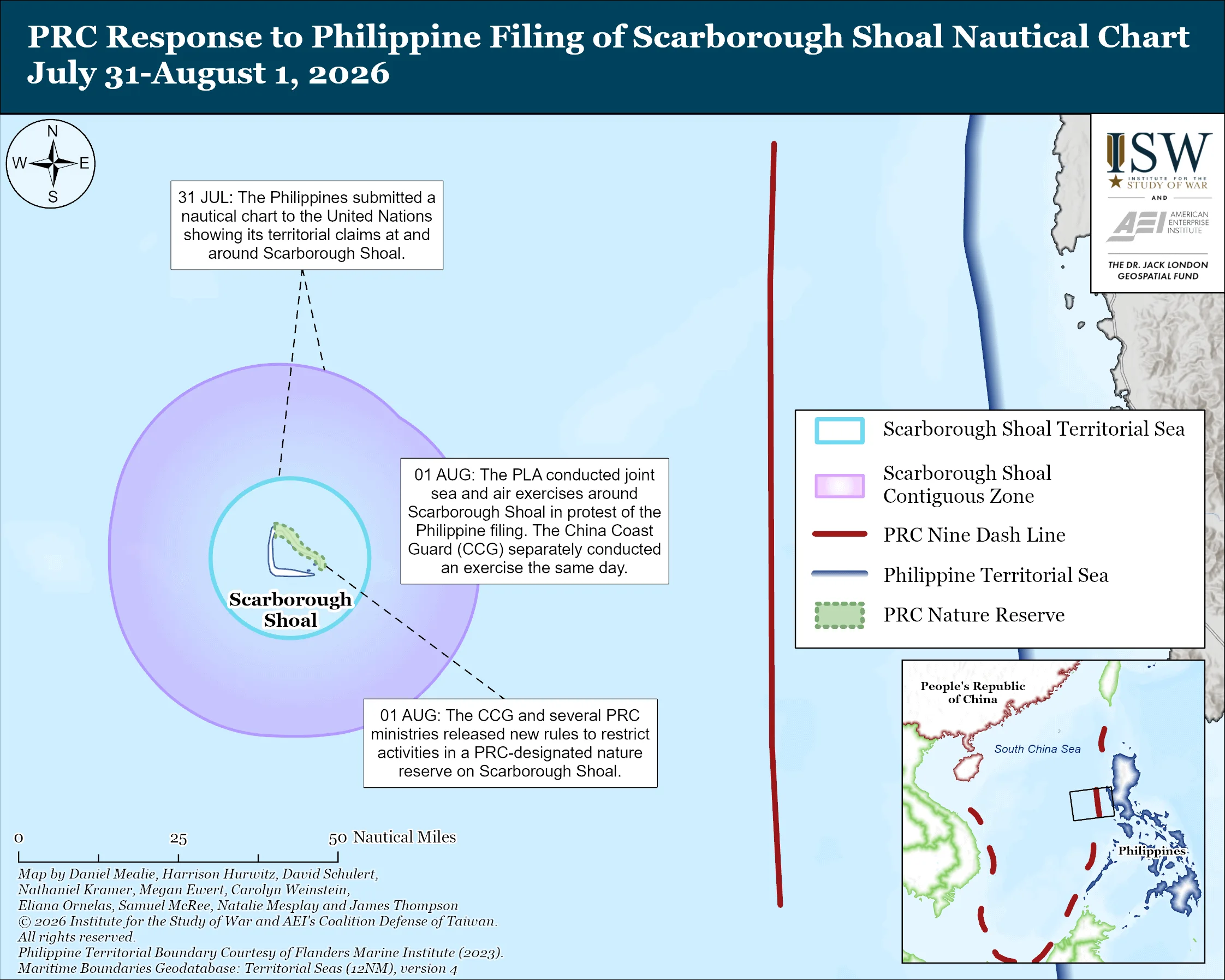
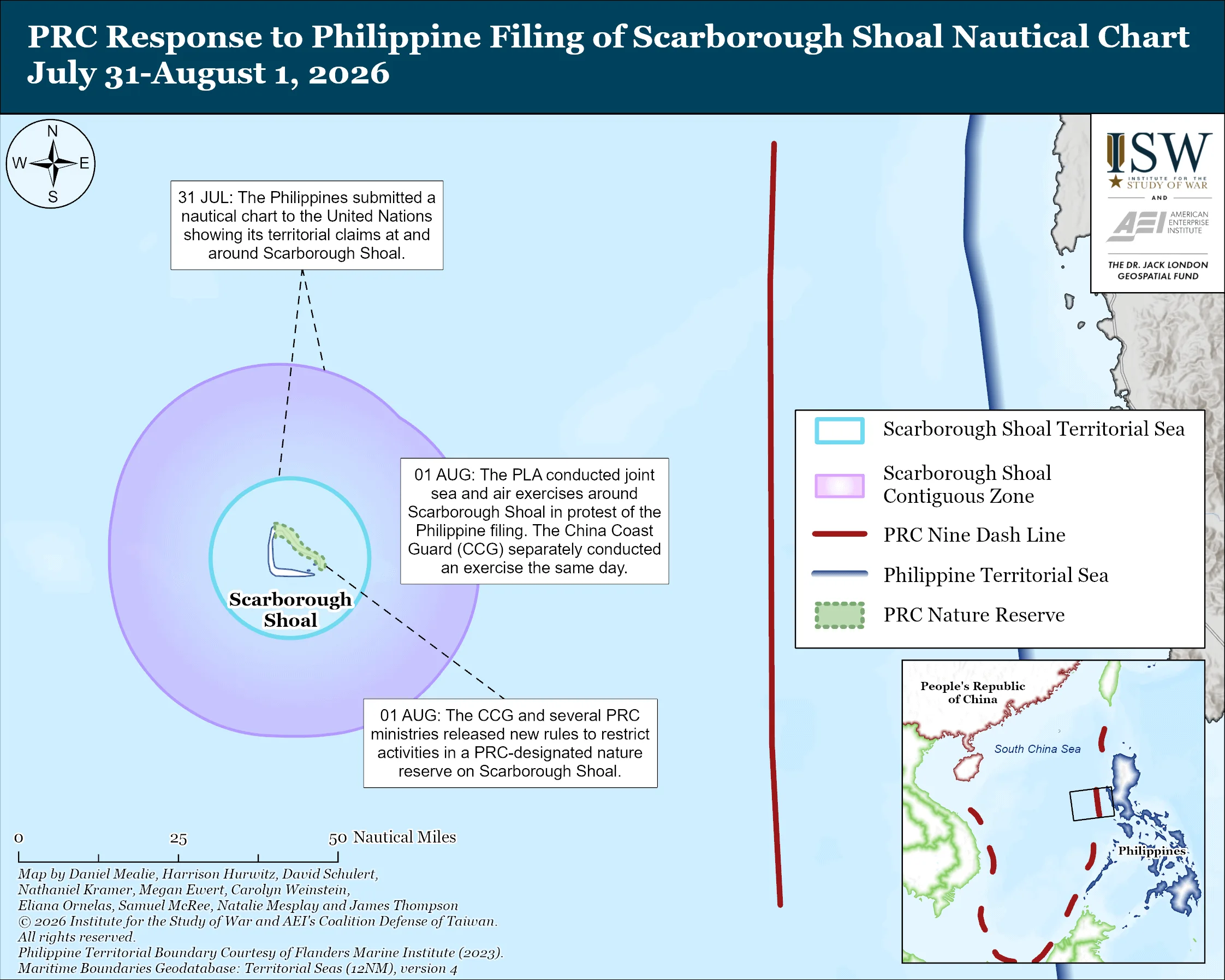
The PRC used a range of military drills, state propaganda, and lawfare as countermeasures after the Philippines filed a nautical chart with the United Nations (UN) detailing Philippine claims around Scarborough Shoal. The Philippine Department of Foreign Affairs (DFA) announced on July 31 that the Philippines deposited an official chart with the UN Secretariat that shows the Philippines’ claimed territorial baseline, territorial sea, and contiguous zone boundaries around Scarborough Shoal.[26] The DFA said that the chart shows Scarborough Shoal generates 12 nautical miles of Philippine territorial waters and a further 12 nautical miles of contiguous zone, pursuant to Philippine domestic law, the UN Convention on the Law of the Sea (UNCLOS), and the 2016 Permanent Court of Arbitration decision to invalidate many of the PRC’s competing territorial claims in the South China Sea. The PRC embassy in Manila warned the Philippines to respect the PRC’s sovereignty and to refrain from “infringement or provocation” around Scarborough Shoal.[27]
The CCG conducted a “law enforcement” drill around Scarborough Shoal on August 1 that practiced boarding and seizure, interception of intruders, and forced towing.[28] The PLA Southern Theater Command held joint air and naval drills around the shoal the same day that involved coordinating air and sea operations, deploying rapid reinforcements, reconnaissance and warning, deterrent patrols, sea and air control, and joint strikes.[29] The PLA exercise featured H-6K bombers with YJ-12 supersonic anti-ship missiles, as well as helicopter operations and air-cushioned landing craft that launched from a Type 071 amphibious assault ship.[30] The exercise also included a Type 052D guided-missile destroyer, a Type 054A guided-missile frigate, and a Type 056A guided-missile corvette.[31] PRC state media defended the PRC’s territorial claim over Scarborough Shoal and portrayed the PLA and CCG drills as examples of the PRC’s “rich and powerful” toolbox of countermeasures against Philippine “violations.”[32] The CCG, PRC Ministry of Natural Resources, PRC National Forestry and Grassland Administration, and the Hainan provincial government jointly issued management rules on August 1 for the “Huangyan Dao National Nature Reserve,” which the PRC established around Scarborough Shoal in September 2025 as an additional legal justification for excluding foreign vessels.[33] The rules include establishing a “routine patrol system” and barring entry to anyone except for those engaged in PRC-approved conservation and management activities.[34]
The PRC claims Scarborough Shoal as its territory and first seized the shoal from the Philippines in 2012 using CCG ships. The PRC has since solidified its control of the shoal by increasing CCG, PLAN, maritime militia, and research ship presence as well as introducing legal measures to block or detain non-PRC vessels that attempt to enter the shoal’s vicinity.
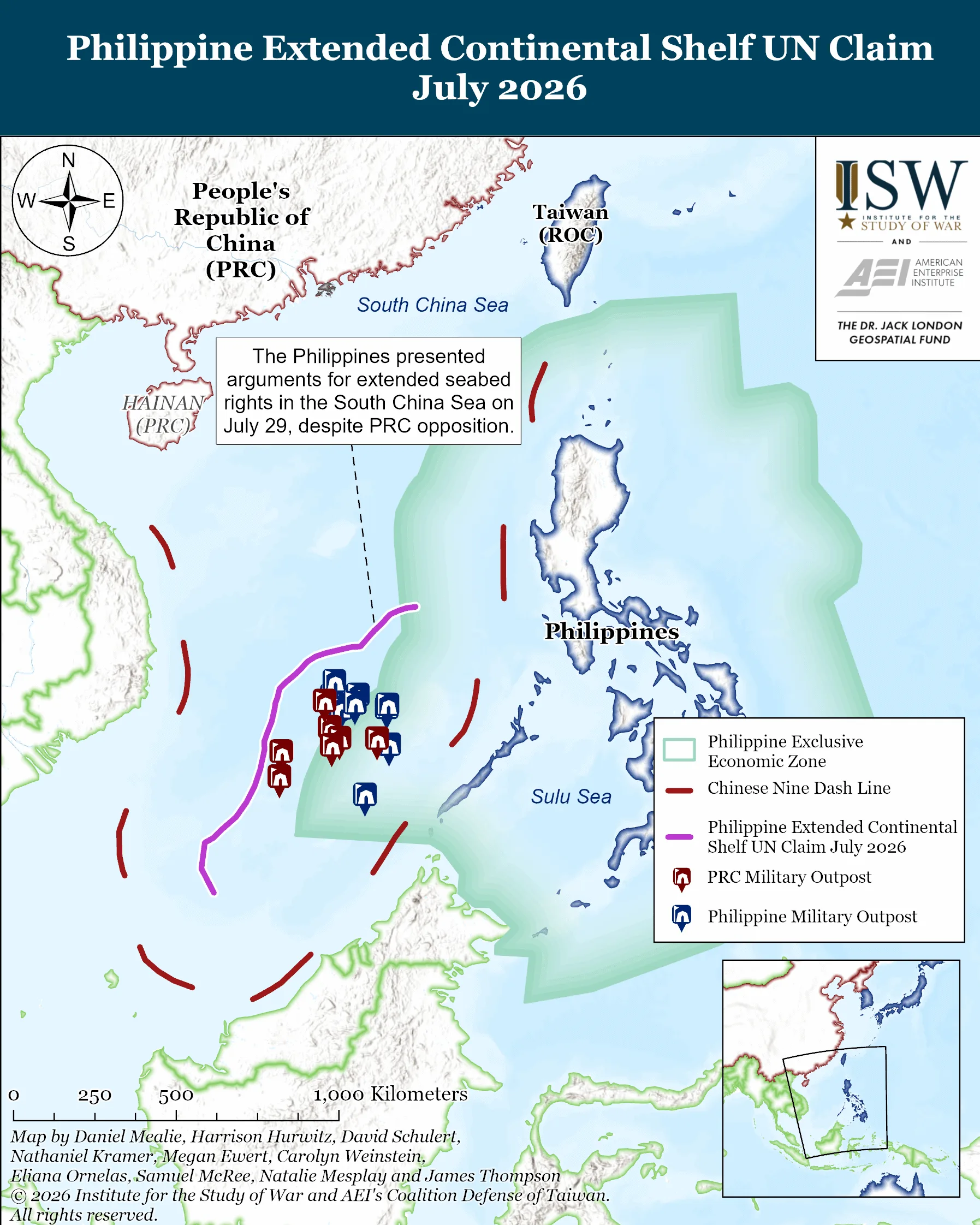
The Philippines separately presented a partial submission to the UN on July 29 for an extended continental shelf (ECS) extending up to 350 nautical miles west and north of Palawan.[35] This is the Philippines’ second ECS filing with the UN since 2009, when it successfully petitioned to extend its seabed jurisdiction to encompass Benham Rise in the Philippine Sea.[36] The proposed new ECS, which the Philippines first announced it would pursue in 2024, would grant the Philippines exclusive seabed resource rights far beyond its existing 200 nautical mile Exclusive Economic Zone (EEZ) and encompass the seabed surrounding most of the entire Spratly Islands archipelago, including around Philippine-occupied and PRC-occupied features in the Spratly Islands.[37] An ECS will not grant the Philippines any new sovereign rights over disputed features, but would further weaken the PRC’s claim to jurisdiction over most of the South China Sea and contest the PRC’s ability to exploit seabed resources in the sea. The PRC, Malaysia, and Vietnam have all filed protest notes to urge the UN to reject the Philippine ECS claim.[38]
Key Takeaways
- Japanese Defense Modernization: Japan test-fired a Tomahawk cruise missile capable of striking PRC territory on July 29 and identified PRC short-of-war coercion as a major threat in its 2026 Defense White Paper. Japan’s continued military modernization and statements decrying PRC coercion indicate that PRC pressure campaigns against Japan are continuing to fail.
- PLA Modernization: The PLAN may use its Type 076 amphibious assault vessel Sichuan in roles similar to its aircraft carriers, allowing the PLAN to supplement its existing limitations in naval aviation. The PLAN will likely experience trade-offs if it uses Sichuan in this way, however.
- PRC-Philippines Territorial Disputes: The Philippines announced on July 31 that it deposited an official chart with the UN Secretariat detailing Philippine territorial claims around Scarborough Shoal. The PRC responded with a range of military drills, propaganda, and lawfare in protest of the Philippines’ actions and to reaffirm PRC territorial claims around Scarborough Shoal.
Cross-Strait Relations
Taiwan
The United States and Taiwan publicized their first confirmed combined Coast Guard patrol in Taiwanese waters. Taiwan and the United States are likely institutionalizing maritime security cooperation amid the PRC’s maritime law enforcement expansions. Taiwan and the United States signed the Memorandum of Understanding (MOU) on Establishing the Coast Guard Working Group (CGWG) in 2021, which aimed to improve communications, cooperation, and information sharing between them.[39]Taiwan’s Coast Guard Administration (CGA) and the US Coast Guard (USCG) have carried out maritime anti-smuggling exercises, search and rescue exercises, and personnel exchanges and training, signaling deepening cooperation since signing the MOU.[40]
Taiwanese commentators amplified news of the patrol as a positive example of US-Taiwan security cooperation against the PRC. The American Institute in Taiwan (AIT) posted a photo on July 28 of a CGA vessel and a USCG vessel patrolling together in waters around Taiwan. Taiwan’s Ocean Affairs Council Minister Kuan Bi-ling responded to the post by stating that it “showed that the United States understands that the CGA is the only law enforcement authority in waters around Taiwan.”[41] Taiwanese experts underscored that this post is a targeted act of deterrence and opposition to the PRC’s efforts to expand its authority in waters around Taiwan, and enhanced Taiwan-US security cooperation.[42] The PRC has expanded CCG patrols in the waters east of Taiwan since June, claiming that it is conducting law enforcement operations in the area.[43] The PRC has also deployed scientific survey vessels to conduct “lawful research and resource surveys in waters east of Taiwan under PRC jurisdiction.”[44]
Taiwanese military recruitment and retention rates increased in 2025 to 117.5 percent of the military’s 2025 recruitment target. The PRC is emphasizing Taiwan’s increased penalties for military volunteers’ early discharge to undermine Taiwanese political support. Taiwanese media reported on figures from Taiwan’s Ministry of National Defense (MND) on July 30 showing that the military recruited 17,113 personnel in 2025, exceeding its target of 14,563 recruits.[45] The Taiwanese military’s retention rate rose from 82 percent in 2024 to 87.2 percent in 2025, exceeding the MND’s 76 percent benchmark, and the number of personnel deemed unsuitable for service fell by 1,652.[46] The MND attributed the improvements to salary increases and expanded benefits, but reported that active personnel filled only 80 percent of authorized positions.[47]
The PRC used Taiwanese military recruitment data in information operations meant to delegitimize Taiwan’s military. PRC MOD spokesperson Jiang Bin responded to the matter of more than 4,000 Taiwanese military volunteers paying early-discharge penalties by 2025 in a July 30 press conference, deeming it a rejection of Taiwanese independence.[48] Taiwan’s increased recruitment and retention rates mark a notable change following longer-term military staffing declines since the 1980s, however.[49] Taiwanese military and government officials have previously speculated that pay increases, as well as improved living conditions and management, are driving factors for increases in military recruitment.[50] Taiwan’s ability to incentivize military recruitment and retention bolsters its defenses amid increasing PRC short-of-war coercion.
Taiwanese media outlet Mirror Media reported that Taiwanese prosecutors detained an Nvidia employee and searched his home and work desk for involvement in illegally exporting Super Micro artificial intelligence (AI) servers containing advanced Nvidia chips to the PRC. This is the third round of searches by Taiwanese authorities in the chip-smuggling probe, following previous rounds in May and June.[51] Major Western news outlets have cited Mirror Media’s reporting, though Nvidia declined to comment when asked to verify if the individual detained was their employee.[52] This individual is the first Nvidia employee implicated in the chip smuggling probe, though the company itself is not accused of wrongdoing.[53] ISW-CDOT covered the previous investigations, during which Taiwanese authorities searched US firm Super Micro, their Taiwanese distributor Albatron, and data center operator Chief Telecom’s Taiwanese offices on June 29.[54] Certain advanced Nvidia chips have been banned under US export controls from being sent to the PRC under national security concerns since 2022.[55]
Taiwan’s Supreme Court formally categorized the CCP and PRC Taiwan Affairs Office (TAO) as “foreign hostile forces” under the Anti-Infiltration Act. This legal precedent was established in a case in which the defendant initially argued that the CCP was a “friendly force” to Taiwan. Former opposition Kuomintang (KMT) Chiayi City council candidate Lin Hsueh-feng was sentenced to four years in prison for accepting CCP funding to influence the 2024 presidential election.[56] Lin used the funding to recruit Chiayi County village and borough wardens for trips to the PRC and promote a particular 2024 Presidential election candidate. The Chiayi District Prosecutor’s Office’s indictment stated that Lin acted on behalf of the Taizhou branch of the PRC TAO.[57] Taiwan’s Supreme Court rejected Lin’s appeal on July 29, affirming the Tainan High Court’s determination that the CCP and TAO are hostile foreign forces, and that Lin is a joint principal offender along with the TAO personnel.[58]
Taiwanese prosecutors similarly convicted two other individuals in November 2024 for recruiting 24 KMT officials and borough wardens for a CCP-funded trip to the PRC, during which they promoted 2024 presidential election candidate Hou Yu-ih.[59] Taiwan Mainland Affairs Council (MAC) spokesperson Liang Wen-chieh stated that the ruling will significantly affect similar cases.[60] The Anti-Infiltration Act states its purpose as preventing “the infiltration and intervention of foreign hostile forces,” which are defined in Article 2 as entities that “endanger the sovereignty of the Republic of China.” The MAC stated in January 2026 that only five of 127 individuals indicted were convicted since the Anti-Infiltration Act was passed in 2020, and those convictions averaged three to six months.[61] Lin’s case eliminates debate on the CCP and TAO’s status as “foreign hostile forces,” making it easier for prosecutors to justify applying the Anti-Infiltration Act since TAO-funded organizations are not consistently classified as such.[62]
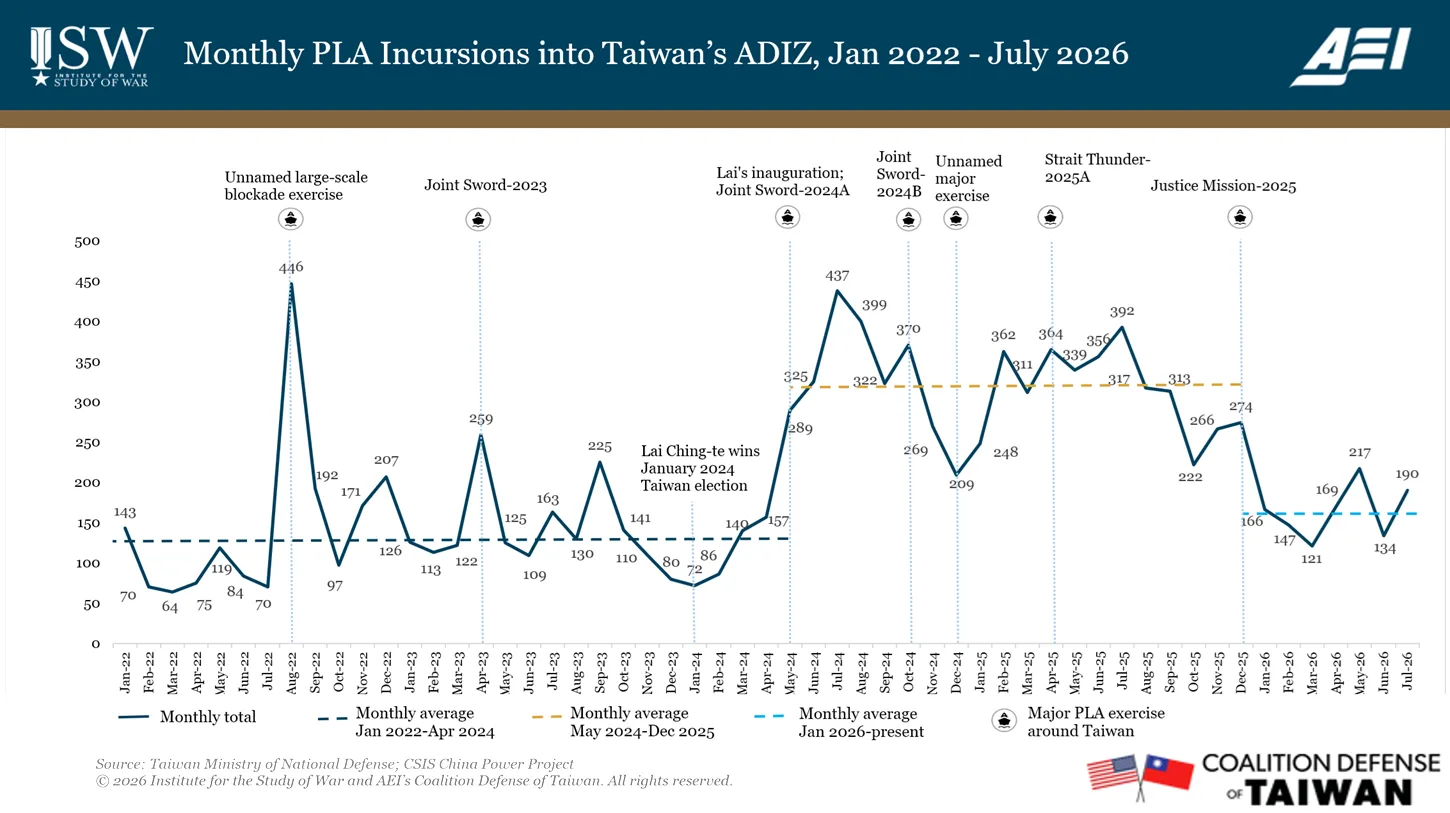
The PLA carried out 190 aerial incursions into Taiwan’s Air Defense Identification Zone (ADIZ) in July, continuing a reduced volume of incursions compared to 2024 and 2025. The monthly incursion total made up less than half the total number of incursions in July 2025 and July 2024, which were the peaks for their respective years.[63] Taiwan’s MND reported six days in July without any ADIZ incursions across the median line of the Taiwan Strait.[64] The PLA doubled its monthly volume of incursions to over 300 per month after President William Lai Ching-te’s inauguration in May 2024 but appears to have reverted to the pre-Lai baseline since the start of 2026. The decline in monthly PLA sorties around Taiwan since the start of 2026 likely reflects an adjustment in the PRC’s coercion strategy targeting Taiwan, rather than seasonal fluctuations or other short-term factors. ISW-CDOT has previously assessed that the reduction in ADIZ incursion volume may free up PLA sorties and resources to focus on other military priorities and reestablish the utility of ADIZ incursions as a means of short-term political signaling.[65] A consistently high volume of ADIZ incursions allows the PRC to degrade Taiwan’s threat awareness by desensitizing it to repeated aerial intrusions.
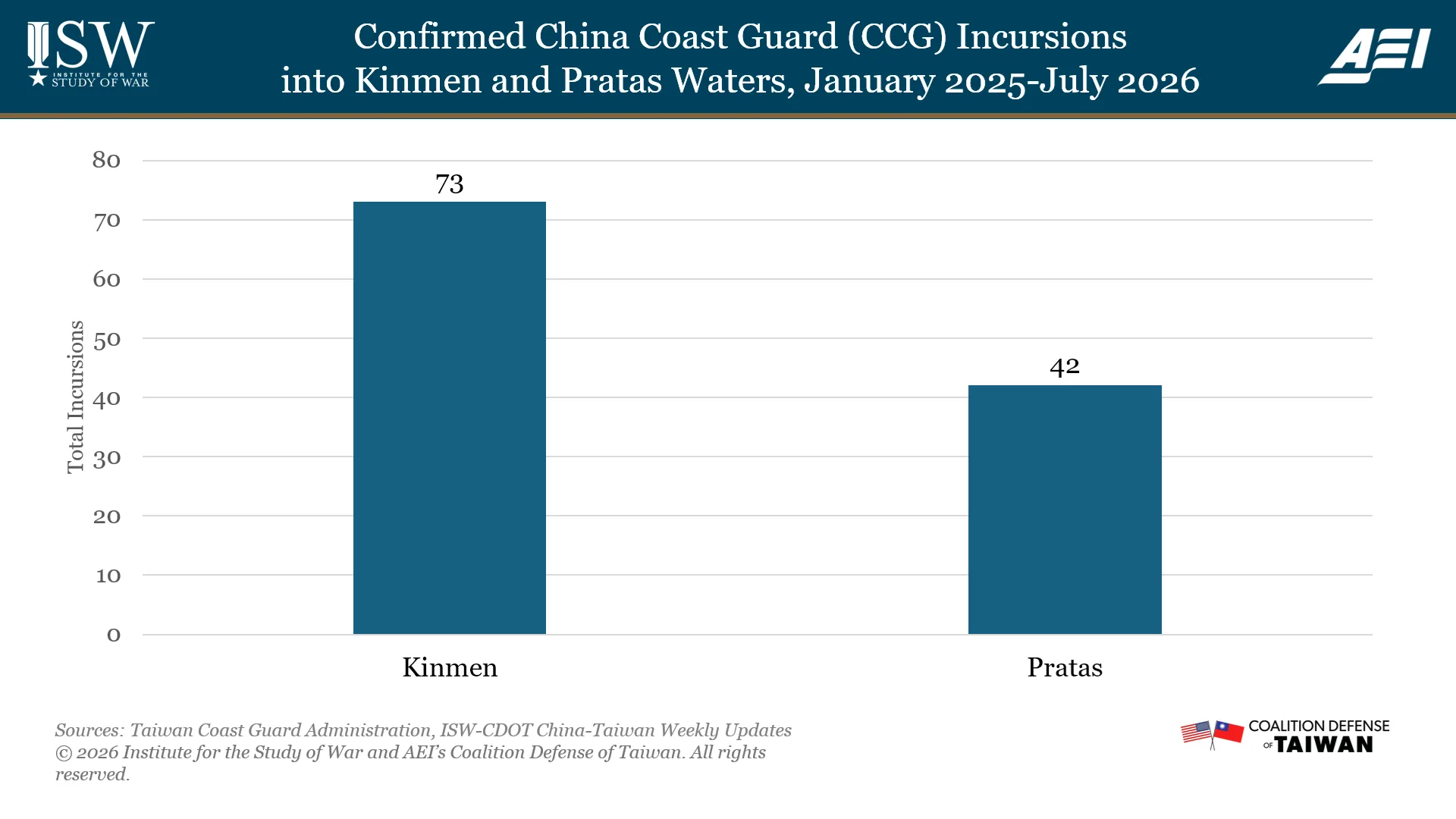
The PRC continued “law enforcement” patrols into Taiwanese restricted waters around the Kinmen islands in July at its usual frequency of four incursions per month. The PRC uses these patrols to weaken Taiwan’s territorial control. Kinmen is a Taiwanese archipelago located less than two miles from the PRC coast and surrounded by PRC internal waters. Taiwan administers concentric zones of “prohibited” and “restricted” waters around Kinmen, which are functionally similar to territorial and contiguous waters. Four CCG ships patrolled in formation in Kinmen’s restricted waters on July 8, July 14, July 21, and July 29.[66]
The PRC normalized such CCG incursions four times per month since February 2024 to erode Taiwan’s territorial control and assert PRC “law enforcement” jurisdiction.[67] Taiwan’s CGA also noted that it tried to drive away a PRC Maritime Safety Administration (MSA) vessel that cut through Taiwanese restricted and prohibited waters around Kinmen on July 16.[68] Ship-tracking data from Starboard Maritime Intelligence shows that civilian law enforcement vessels such as MSA ships sometimes pass through Taiwanese waters around Kinmen without regard for maritime boundaries, but the MSA has rarely directly participated in gray-zone harassment of Taiwan.
Neither the CGA nor ship-tracking software detected any CCG incursions around Taiwan’s Pratas Island in July. CCG ships have carried out an average of one incursion into Pratas’ restricted waters since February 2025, following a similar pattern to the Kinmen incursions. Pratas is an atoll at the northern end of the South China Sea that hosts Taiwanese military and coast guard personnel but has no civilian population.
China
The PLA may be developing operational concepts for deploying unmanned systems during an amphibious landing. These concepts appear to integrate select tactical lessons from the war in Ukraine while eschewing major structural changes to PLA forces and doctrine. PRC state broadcaster CCTV released extensive footage on August 1 of what appears to be a company- or battalion-sized amphibious combined arms formation assaulting a fortified beach.[69] The footage showed integration of unmanned systems alongside armored infantry assaulting the beach, including small first-person-view (FPV) quadcopters and quadrupedal unmanned ground vehicles (UGV).[70] A separate CCTV article on July 31 emphasized the role of the UGVs in the exercises and showed footage of UGVs armed with infantry rifles and grenade launchers performing suppression and clearing tasks ahead of the infantry and armor.[71] The PLA has previously tested using UGVs for beach assaults in a January exercise.[72] CCTV also released footage on August 1 showing an unspecified unit from the PLA Ground Forces (PLAGF) using CH-4 unmanned combat aerial vehicles (UCAV) to target small watercraft that were likely simulating an unmanned surface vessel (USV) attack.[73] These exercises suggest that the PLA is incorporating significant amounts of unmanned systems at the tactical level in its operational concepts for an amphibious landing, including to perform complex tasks to enable armored infantry to advance on the beach.
These exercises align with ISW-CDOT’s observations that the PLA remains hesitant to make significant doctrinal or structural changes to adapt to unmanned systems warfare, however. The unmanned systems operated in the exercises appear to be functioning below the battalion level, likely from dedicated unmanned systems squads or platoons within the amphibious infantry companies, although the presence of a dedicated unmanned systems company within the battalion cannot be ruled out.[74] The PLA’s amphibious armored forces also demonstrated traditional armored tactics for a multi-echeloned armored attack, concentrating a significant number of armored vehicles in a small area.[75] The war in Ukraine has demonstrated how a UAV-saturated battlefield makes such armored concentrations prohibitively costly.[76]
The PLA may currently expect its existing conventional forces supplemented with unmanned systems to avoid the tactical dynamics that have prevented large-scale mechanized maneuver in Ukraine. ISW-CDOT has observed that some discussions of contemporary war within the PLA represent the conflict in Ukraine as a temporary, imperfect phase of modern warfare that advances in AI and other emerging technologies will render largely obsolete.[77] These discussions assume that PLA unmanned systems will be survivable and capable of complex tactical tasks, like the UGVs used during PLA amphibious exercises, in contrast to the colossal use of cheap, attritable unmanned systems in Ukraine.[78] The PLA may rely on more advanced unmanned systems capabilities to create significant tactical advantages for its traditional maneuver formations to remain effective on the modern battlefield.
Reuters reported that PRC military researchers have used outputs from leading US AI models developed by OpenAI and Anthropic to train PRC domestic AI systems, advancing the PLA’s defense capabilities while minimizing data exposure, and providing a compelling model for US government use of AI. Reuters reviewed more than 80 PRC academic papers and patents and found that “model distillation,” using AI outputs from larger AI systems to train smaller AI systems, is widely implemented by researchers linked to the PLA and other PRC military institutions.[79] The PRC is developing specialized systems through model distillation to circumvent US controls on advanced chips and other strategic technologies and employ local AI systems without requiring the same level of computing power as building entirely new frontier AI systems.[80] A PLA military intelligence and cyber-warfare unit, Unit 96941, wrote about using OpenAI’s GPT-3.5 to summarize software code and train a domestic model running entirely within PRC military networks to process sensitive military source code.[81]
Model distillation provides a compelling alternative to unrestricted use of major US AI models for US government and classified purposes, which does not risk classified data being leaked across different AI government models, let alone into publicly available AI models.[82] The US government could further benefit from using model distillation to create secure versions of PRC AI models, including DeepSeek, for US government purposes. The risk of leaks of US government or classified information across US AI models furthermore risks this information becoming available to PRC military researchers who have surpassed US AI export controls.[83]
A PRC-flagged research vessel loitered over undersea communications cables connecting Taiwan, the Philippines, and the United States from approximately July 28 to August 2. The PRC is likely using ostensibly civilian vessels to gather intelligence on and sabotage critical undersea communications cables. Maritime analysis firm Windward reported on August 2 that an unnamed PRC-flagged oceanographic research and survey vessel was loitering at a slow speed over the Pacific Light Cable Network, a system of undersea communications cables connecting Taiwan, the Philippines, and the United States.[84] Data from Starboard Maritime Intelligence indicates that the vessel is likely the Shiyan 1, operated by the state-run Chinese Academy of Sciences.[85] PRC deep-sea research vessels like the Shiyan 1 are likely equipped with instruments and sensors able to locate cables on the seabed. PRC cargo and fishing vessels can damage or cut undersea cables by repeatedly dragging their anchors over them.[86]
Taiwan relies on undersea cables for internet access, rendering it highly vulnerable to short-of-war sabotage. Taiwanese authorities have identified ostensibly civilian PRC-flagged vessels as responsible for several cases of sabotage against undersea communications cables that service Taiwan.[87] PRC fishing and cargo ships severed the undersea cables connecting the main island of Taiwan to the Taiwanese outlying Matsu Islands in February 2023, shutting down internet access on Matsu for two weeks.[88] Two foreign-flagged, PRC-operated ships severed more undersea cables connecting Taiwan to the Taiwanese offshore Penghu Islands and the rest of the world in January and February 2025.[89]
The PRC’s undersea cable sabotage is likely part of its broader efforts to coerce and intimidate Taiwan and erode Taiwanese citizens’ confidence in their government’s ability to protect them, especially in outlying Taiwanese islands like Matsu.[90] Taiwan has strengthened security measures since early 2025 to deter and prevent PRC undersea cable sabotage, including creating a blacklist of suspicious vessels, sharing information about the PRC’s “grey zone” maritime activities with partner countries, and instituting 24-hour CGA patrols around the Taiwan-Penghu undersea cable severed by the PRC.[91] The PRC may also intend to use undersea cable sabotage to coerce the Philippines over territorial disputes in the South China Sea and reduce the Philippines’ support for Taiwan.
Northeast Asia
Nothing significant to report.
Southeast Asia
Philippines
See Toplines.
Oceania
The Solomon Islands and United States signed the Agreement Concerning Counter Illicit Transnational Maritime Activity, a “shiprider” agreement that will permit US patrols in the Solomon Islands’ EEZ. US-Solomon Islands cooperation highlights a US effort to counterbalance PRC presence in the Pacific. The shiprider agreement will permit Solomon Islands security personnel to join and observe USCG patrols. The PRC previously signed a policing agreement with the Solomon Islands, which the United States has sought to counterbalance. The Solomon Islands will maintain the shiprider agreement while remaining in a security pact with the PRC, which has existed since 2022.[92] The Solomon Islands has similarly sought non-military cooperation with the United States. Solomon Islands President Matthew Wale told reporters on July 27 that the US is planning infrastructure investments in Bina Harbour, where the PRC has reportedly sought to invest in the past.[93] Wale has emphasized that he did not seek to side with either the US or PRC but rather hoped to balance between both, avoiding competition.[94]
US officials have expressed concern over agreements between the PRC and Pacific island states, including the Solomon Islands and Cook Islands.[95] US investments and security cooperation offer a means of forestalling PRC presence in Oceania — particularly in the Solomon Islands, where US officials have feared the PRC may attempt to construct a military-capable port.[96] The United States’ deepening ties with the Solomon Islands follow similar efforts by Australia. Lowy Institute research revealed Australia surpassed the PRC as the largest lender in the Pacific region in 2024.[97] Investments and loans offer a means by which larger powers, including the PRC, can deepen leverage and exercise influence over Pacific island nations.
Europe
Belgian authorities arrested a Canadian national on July 24 for allegedly spying on NATO’s military headquarters for the PRC. PRC espionage targets NATO personnel and institutions to acquire sensitive information on NATO strategy, technology, and vulnerabilities. Reuters reported that the suspect worked as an intern in the IT department at NATO’s Supreme Headquarters Allied Powers Europe (SHAPE) from July 2025 until her arrest, citing anonymous sources.[98] The sources also confirmed that Belgian authorities suspect the intern of spying for the PRC.[99] SHAPE’s security services noticed the intern behaving suspiciously and informed Belgian authorities, who searched the intern’s office and home on July 23 and arrested her on charges of espionage and participation in a criminal organization on July 24.[100]
The PRC Ministry of State Security (MSS) and PLA military intelligence aggressively target NATO military personnel and staffers for espionage recruitment.[101] Belgian and NATO authorities have not specified whether they suspect the intern worked for PRC intelligence before she began her work at SHAPE or whether PRC intelligence recruited her during her tenure.
PRC espionage operations explicitly seek sensitive information on NATO’s strategy toward Taiwan, advanced military technologies, and other NATO military secrets.[102] The PRC likely aims to anticipate and deter or effectively repel a NATO intervention in a potential conflict over Taiwan and to improve the PLA’s capabilities by stealing advanced technology.
Iran
Note: A version of this text appeared in the July 29 Iran Update Special Report.
The PRC may be helping Iran bolster its air defense capabilities by selling Iran man-portable air defense systems (MANPADS). The PRC likely views MANPADS sales as a low-cost means of complicating the US war effort in Iran. Three sources told Reuters on July 28 that Iran reportedly signed a deal through a Hong Kong-based company to buy between 300 and 400 PRC-made MANPADS.[103] A European source separately told Reuters that the deal could include a shipment of PRC QW-12, QW-18, and QW-19 MANPADS. A second unspecified source added that it is unclear whether Iran and the PRC have completed the deal.[104] Reuters listed the value of Iran’s reported purchase at $60-70 million.[105] The PRC denied the sale in a July 30 press conference, however.[106]
MANPADS enable ground-based strikes on aircraft from a range of several miles away.[107] Iranian forces may have previously used PRC-made MANPADS to shoot down a US F-15E fighter jet in April 2026.[108] Sources also told Reuters that China would deliver the MANPADS via aircraft to Pakistan, which would then be transferred to Iran by land.[109] The Pakistani military denied the source’s claim.[110] This Reuters report follows an April 2026 New York Times report that China may have sent a shipment of Chinese MANPADS to Iran.[111]
The PRC likely aims to bolster Iran’s capabilities against the United States and demonstrate the PRC’s value as a partner without involving itself too deeply in the conflict. ISW-CDOT previously assessed that the PRC aims to avoid appearing to outright side with Iran, weighing its support for Iran against possible reputational damage with its other Middle Eastern partners.[112] The PRC may be more willing to provide material aid to Iran than ISW-CDOT previously assessed, however. The PRC sold Iran chemical precursors for missile fuel before and during the war, aided Iran’s targeting accuracy, defended Iran against sanctions, and continued to buy the vast majority of Iranian oil exports — enabled by Iran allowing PRC ships to pass through the Strait of Hormuz on several occasions.[113] Beijing may view sales of “defensive” weapons or components such as MANPADS as a useful enough contribution to its Iranian partner that nonetheless does not risk involving the PRC as a co-belligerent. The PRC very likely hopes for Iranian regime survival but also benefits from the Iran war degrading US military capabilities that the United States could use in the Western Pacific.

[1] https://news.usni.org/2026/07/30/japanese-destroyer-launches-tomahawk-for-the-first-time-in-drill-with-u-s-navy
[2] https://understandingwar.org/research/china-taiwan/china-taiwan-update-may-29-2026/
[3] https://news.usni.org/2026/07/30/japanese-destroyer-launches-tomahawk-for-the-first-time-in-drill-with-u-s-navy; https://www.reuters.com/world/asia-pacific/japans-order-tomahawk-missiles-delayed-by-us-use-iran-bloomberg-news-says-2026-04-03/; https://understandingwar.org/research/china-taiwan/china-taiwan-update-may-29-2026/
[4] https://news.usni.org/2026/08/04/japans-2026-defense-white-paper-digest
[5] https://news.usni.org/2026/08/04/japans-2026-defense-white-paper-digest; https://asia.nikkei.com/politics/defense/japan-warns-russia-north-korea-axis-raises-regional-security-threat
[6] https://www.mod.go.jp/j/press/wp/wp2026/pdf/DOJ2026_Digest_EN.pdf
[7] https://www.mod.go.jp/j/press/wp/wp2026/pdf/DOJ2026_Digest_EN.pdf
[8] https://news.usni.org/2026/08/05/japan-plans-to-transform-military-capabilities-with-drones-boost-domestic-defense-industry
[9] https://www.mod.go.jp/j/press/wp/wp2026/pdf/DOJ2026_Digest_EN.pdf
[10] http://www.mod.gov dot cn/gfbw/xwfyr/fyrthhdjzw/16477732.html
[11] https://www.reuters.com/world/china/china-complains-japan-over-defence-white-paper-foreign-ministry-says-2026-08-05/
[12] https://www.gmfus.org/news/japans-takaichi-stands-firm-taiwan
[13] https://military.cctv dot cn/2026/08/02/ARTIv5fL3rYuew4DFWG1HxKe260802.shtml
[14] https://military.cctv dot cn/2026/08/02/ARTIv5fL3rYuew4DFWG1HxKe260802.shtml
[15] https://military.cctv dot cn/2026/08/01/ARTI0KyzSmMJDcb8CZK7QWL9260801.shtml
[16] https://understandingwar.org/research/china-taiwan/china-taiwan-update-november-21-2025/
[17] https://www.navalnews.com/naval-news/2025/11/chinese-type-076-amphibious-carrier-sichuan-starts-sea-trials/
[18] https://understandingwar.org/research/china-taiwan/china-taiwan-update-february-13-2026/
[19] https://understandingwar.org/research/china-taiwan/china-taiwan-update-november-21-2025/; https://understandingwar.org/research/china-taiwan/china-taiwan-update-february-13-2026/
[20] https://understandingwar.org/research/china-taiwan/china-taiwan-update-november-21-2025/
[21] https://thedefensepost.com/2026/05/29/gerald-ford-class-aircraft-carrier-guide/; https://www.globalsecurity.org/military/systems/ship/cvn-68-design.htm
[22] https://www.19fortyfive.com/2026/01/the-u-s-navys-new-ford-class-supercarrier-has-a-secret-weapon/; https://defencesecurityasia.com/en/china-liaoning-carrier-170-sorties-western-pacific-plan-blue-water-power-projection/; https://gssr.georgetown.edu/the-forum/topics/technology/the-fujian-class-aircraft-carrier-the-prcs-challenge-to-the-indo-pacific-order/
[23] https://www.admiraltytrilogy.com/mcmf.php
[24] https://www.navalnews.com/naval-news/2025/11/chinese-type-076-amphibious-carrier-sichuan-starts-sea-trials/
[25] https://media.defense.gov/2025/Dec/23/2003849070/-1/-1/1/ANNUAL-REPORT-TO-CONGRESS-MILITARY-AND-SECURITY-DEVELOPMENTS-INVOLVING-THE-PEOPLES-REPUBLIC-OF-CHINA-2025.PDF
[26] https://www.pna.gov dot ph/articles/1280837
[27] https://mb.com dot ph/2026/08/02/china-warns-of-resolute-response-over-philippine-baselines-around-bajo-de-masinloc
[28] http://www.mod.gov dot cn/gfbw/qwfb/yw_214049/16477222.html
[29] https://www.scmp dot com/news/china/military/article/3362628/pla-stages-south-china-sea-drills-days-after-illegal-philippine-territorial-bid?module=top_story&pgtype=subsection
[30] https://www.scmp dot com/news/china/military/article/3362628/pla-stages-south-china-sea-drills-days-after-illegal-philippine-territorial-bid?module=top_story&pgtype=subsection
[31] https://news.usni.org/2026/08/03/chinese-warships-bombers-surge-to-scarborough-shoal-for-drills
[32] https://english.news dot cn/20260803/aad349f9df644cf98c931551eebb4534/c.html ; http://www.81 dot cn/yw_208727/16477375.html
[33] http://english.scio.gov dot cn/chinavoices/2026-08/02/content_118629662.html ; https://understandingwar.org/research/china-taiwan/china-taiwan-weekly-update-september-15-2025/
[34] http://english.scio.gov dot cn/chinavoices/2026-08/02/content_118629662.html
[35] https://www.pna dot gov.ph/articles/1280620
[36] https://newsinfo.inquirer dot net/183779/un-approves-ph-territorial-claim-to-benham-rise
[37] https://understandingwar.org/research/china-taiwan/china-taiwan-weekly-update-june-21-2024/
[38] https://www.philstar dot com/headlines/2026/07/30/2545664/ph-makes-case-west-philippine-sea-extended-continental-shelf-claim-un
[39] https://www.ait.org dot tw/ait-tecro-mou-to-establish-coast-guard-working-group/
[40] https://news.ltn dot com.tw/news/politics/paper/1764480
[41] https://www.cna dot com.tw/news/aipl/202607280260.aspx; https://www.cga dot gov.tw/GipOpen/wSite/ct?xItem=168576&ctNode=650&mp=999;https://udn dot com/news/story/10930/9656324?from=udn-ch1_breaknews-1-cate1-news
[42] https://www.cna dot com.tw/news/aipl/202607280304.aspx; https://www.cna dot com.tw/news/aipl/202607280347.aspx
[43] https://www.reuters.com/world/china/taiwan-says-chinese-vessel-activity-jumps-raising-fears-pacific-supply-routes-2026-07-20/ DNGTS: https://www.cna dot com.tw/news/aipl/202607200127.aspx; https://www.taipeitimes dot com/News/taiwan/archives/2026/07/20/2003861070; https://www.cga dot gov.tw/GipOpen/wSite/ct?xItem=168306&ctNode=650&mp=999
[44] https://www.globaltimes dot cn/page/202607/1366630.shtml ; https://www.news dot cn/tw/20260729/b9b219b07c4f4a1da0aa5952d197b922/c.html; https://www.gwytb dot gov.cn/xwdt/xwfb/wyly/202607/t20260729_12779603.htm
[45] https://www.cna dot com.tw/news/aipl/202607300108.aspx
[46] https://www.cna dot com.tw/news/aipl/202607300108.aspx
[47] https://www.cna dot com.tw/news/aipl/202607300108.aspx
[48] http://www.mod dot gov.cn/gfbw/xwfyr/lxjzh_246940/16476763.html
[49] https://talk.ltn dot com.tw/article/breakingnews/5353575 ; https://www.taipeitimes dot com/News/front/archives/2025/11/13/2003847118; https://www.voanews.com/a/taiwan-faces-decline-in-troop-numbers-report-reveals-/7940882.html
[50] https://tw.news.yahoo dot com/%E7%82%BA%E4%BD%95%E5%9C%8B%E8%BB%8D%E7%95%99%E4%B8%8D%E4%BD%8F%E4%BA%BA-%E5%BF%97%E9%A1%98%E5%BD%B9%E5%AF%A7%E8%B3%A02000%E8%90%AC%E4%B9%9F%E8%A6%81-%E6%8F%90%E5%89%8D%E9%80%80%E4%BC%8D-%E9%80%80%E5%B0%87%E6%8F%AD%E6%83%A1%E6%80%A7%E5%BE%AA%E7%92%B0-%E4%B8%8D%E5%A6%82%E8%B7%91%E5%A4%96%E9%80%81-035244516.html ; https://udn dot com/news/story/10930/9636574 ; https://talk.ltn dot com.tw/article/breakingnews/5353575; https://www.scmp dot com/news/china/politics/article/3360122/taiwan-military-gains-5000-volunteers-real-problem-retention; https://www.voanews.com/a/taiwan-faces-decline-in-troop-numbers-report-reveals-/7940882.html
[51] https://www.bloomberg.com/news/articles/2026-07-28/taiwan-detains-nvidia-employee-in-china-chip-smuggling-probe
[52] https://www.reuters.com/world/asia-pacific/taiwan-detains-nvidia-employee-super-micro-probe-taiwan-media-says-2026-07-28/;
https://asia.nikkei.com/spotlight/society/crime/taiwan-detains-nvidia-employee-in-super-micro-probe-taiwan-media-says
[53] https://www.bloomberg.com/news/articles/2026-07-28/taiwan-detains-nvidia-employee-in-china-chip-smuggling-probe
[54] https://understandingwar.org/research/china-taiwan/china-taiwan-update-july-10-2026/
[55] https://www.reuters.com/technology/nvidia-says-us-has-imposed-new-license-requirement-future-exports-china-2022-08-31/
[56] https://www.taipeitimes dot com/News/taiwan/archives/2026/07/29/2003861597; https://udn dot com/news/story/7321/9658995?from=udn-ch1_breaknews-1-cate2-news
[57] https://www.taipeitimes dot com/News/taiwan/archives/2026/07/29/2003861597
[58] https://www.taipeitimes dot com/News/taiwan/archives/2026/07/29/2003861597
[59] https://www.taipeitimes dot com/News/taiwan/archives/2024/11/06/2003826467
[60] https://www.cna dot com.tw/news/acn/202607300367.aspx
[61] https://www.taipeitimes dot com/News/front/archives/2026/01/13/2003850502
[62] https://jamestown.org/taiwan-exposes-more-prc-military-infiltration-cases/; https://www.techtimes.com/articles/322354/20260730/taiwan-court-locks-hostile-force-tag-ccp-infiltration-ruling.htm
[63] https://x.com/MoNDefense?lang=en ; https://docs.google.com/spreadsheets/d/1qbfYF0VgDBJoFZN5elpZwNTiKZ4nvCUcs5a7oYwm52g/edit?gid=1177684118#gid=1177684118
[64] https://x.com/MoNDefense?lang=en ; https://docs.google.com/spreadsheets/d/1qbfYF0VgDBJoFZN5elpZwNTiKZ4nvCUcs5a7oYwm52g/edit?gid=1177684118#gid=1177684118
[65] https://understandingwar.org/research/china-taiwan/china-taiwan-update-march-20-2026/
[66] https://www.cga.gov dot tw/GipOpen/wSite/ct?xItem=168345&ctNode=650&mp=999 ; https://www.cga.gov dot tw/GipOpen/wSite/ct?xItem=168424&ctNode=650&mp=999 ; https://www.cga.gov dot tw/GipOpen/wSite/ct?xItem=168489&ctNode=650&mp=999 ; https://www.cga.gov dot tw/GipOpen/wSite/ct?xItem=168581&ctNode=650&mp=999
[67] https://understandingwar.org/research/china-taiwan/china-taiwan-weekly-update-september-8-2025/
[68] https://www.cga.gov dot tw/GipOpen/wSite/ct?xItem=168445&ctNode=650&mp=999
[69] https://military.cctv dot cn/2026/08/01/ARTIfPNOHt29JGpIVk7JIBwH260801.shtml
[70] https://military.cctv dot cn/2026/08/01/ARTIfPNOHt29JGpIVk7JIBwH260801.shtml
[71] https://military.cctv dot cn/2026/07/31/ARTIOYaF6uxz8qdJY4D9bDVb260731.shtml
[72] https://x.com/ChinaMilBugle/status/2012459870881276035?s=20
[73] https://military.cctv dot cn/2026/08/01/ARTIfPNOHt29JGpIVk7JIBwH260801.shtml
[74] https://military.cctv dot cn/2026/07/31/ARTIOYaF6uxz8qdJY4D9bDVb260731.shtml; https://military.cctv dot cn/2026/08/01/ARTIfPNOHt29JGpIVk7JIBwH260801.shtml
[75] https://military.cctv dot cn/2026/08/01/ARTIfPNOHt29JGpIVk7JIBwH260801.shtml
[76] https://understandingwar.org/research/future-of-war/ukraine-and-the-problem-of-restoring-maneuver-in-contemporary-war/
[77] https://understandingwar.org/research/china-taiwan/lessons-learned-with-chinese-characteristics-understanding-the-limits-of-pla-efforts-to-adapt-to-contemporary-warfare/
[78] https://understandingwar.org/research/china-taiwan/lessons-learned-with-chinese-characteristics-understanding-the-limits-of-pla-efforts-to-adapt-to-contemporary-warfare/
[79] https://www.reuters.com/world/asia-pacific/chinese-military-researchers-tap-us-ai-models-train-defence-systems-2026-07-31/
[80] https://www.reuters.com/world/asia-pacific/chinese-military-researchers-tap-us-ai-models-train-defence-systems-2026-07-31/
[81] https://www.reuters.com/world/asia-pacific/chinese-military-researchers-tap-us-ai-models-train-defence-systems-2026-07-31/
[82] https://www.technologyreview.com/2026/03/17/1134351/the-pentagon-is-planning-for-ai-companies-to-train-on-classified-data-defense-official-says/; https://www.reuters.com/technology/us-blocks-foreign-access-anthropics-most-advanced-ai-models-axios-reports-2026-06-13/
[83] https://www.technologyreview.com/2026/03/17/1134351/the-pentagon-is-planning-for-ai-companies-to-train-on-classified-data-defense-official-says/
[84] https://www.newsweek.com/china-ship-spotted-lurking-over-us-taiwan-undersea-cable-12276477; https://x.com/WindwardAI/status/2083848816155856928/photo/1; https://www.submarinecablemap.com/submarine-cable/pacific-light-cable-network-plcn
[85] https://english.cas dot cn/research/platforms/large-research-infrastructures/earth-ystem-and-nvironment/srv/; https://lssf.cas dot cn/en/facilities/ese/srv/
[86] https://globaltaiwan.org/2025/06/taiwans-digital-vulnerabilities/; https://thediplomat.com/2026/05/what-actually-caused-the-latest-submarine-cut-near-taiwan/
[87] https://www.aei.org/commentary/china-taiwan-update-july-31-2026/; https://understandingwar.org/research/china-taiwan/china-taiwan-update-july-31-2026/; https://globaltaiwan.org/2025/06/taiwans-digital-vulnerabilities/
[88] https://globaltaiwan.org/2025/06/taiwans-digital-vulnerabilities/; https://thediplomat.com/2023/04/after-chinese-vessels-cut-matsu-internet-cables-taiwan-shows-its-communications-resilience/
[89] https://globaltaiwan.org/2025/03/countering-chinas-subsea-cable-sabotage/; https://www.taipeitimes dot com/News/taiwan/archives/2025/12/28/2003849642
[90] https://www.aei.org/commentary/china-taiwan-update-april-10-2026/; https://understandingwar.org/research/china-taiwan/china-taiwan-update-april-10-2026/; https://www.aei.org/commentary/exploring-a-prc-short-of-war-coercion-campaign-to-seize-taiwans-kinmen-islands-and-possible-responses/; https://understandingwar.org/research/china-taiwan/exploring-a-prc-short-of-war-coercion-campaign-to-seize-taiwans-kinmen-islands-and-possible-responses-2/
[91] https://www.aei.org/commentary/china-taiwan-weekly-update-september-22-2025/; https://understandingwar.org/research/china-taiwan/china-taiwan-weekly-update-september-22-2025/; https://www.reuters.com/world/asia-pacific/taiwan-navy-protect-sea-cables-if-needed-defence-minister-says-2025-01-16/; https://globaltaiwan.org/2025/06/taiwans-digital-vulnerabilities/
[92] https://www.rfa.org/english/pacific/2026/08/01/solomon-islands-security-agreement-usa/
[93] https://www.taipeitimes dot com/News/world/archives/2026/07/30/2003861647; https://www.scmp dot com/week-asia/politics/article/3362924/solomon-port-plans-mark-us-reset-anaemic-pacific-ties?module=top_story&pgtype=section
[94] https://www.rfa.org/english/pacific/2026/08/01/solomon-islands-security-agreement-usa/
[95] https://www.reuters.com/world/china/us-envoy-says-cook-islands-minerals-are-top-priority-2026-07-03/
[96] https://www.taipeitimes dot com/News/world/archives/2026/07/30/2003861647
[97] https://pacificaidmap.lowyinstitute.org/; https://www.abc.net.au/news/2026-07-28/new-lowy-pacific-aid-map-australia-lending-investor/106967764
[98] https://www.reuters.com/world/china/arrested-canadian-nato-intern-suspected-spying-china-sources-say-2026-07-30/; https://www.cbc.ca/news/canada/canadian-nato-intern-espionage-arrest-biwei-zhang-9.7290088
[99] https://www.reuters.com/world/china/arrested-canadian-nato-intern-suspected-spying-china-sources-say-2026-07-30/
[100] https://www.bbc.com/news/articles/cwymk20n0v7o; https://www.cbc.ca/news/canada/canadian-nato-intern-espionage-arrest-biwei-zhang-9.7290088
[101] https://www.aei.org/commentary/china-taiwan-update-april-3-2026/; https://understandingwar.org/research/china-taiwan/china-taiwan-update-april-3-2026/; https://www.aei.org/commentary/china-taiwan-update-february-13-2026/; https://understandingwar.org/research/china-taiwan/china-taiwan-update-february-13-2026/
[102] https://www.aei.org/commentary/china-taiwan-update-april-3-2026/; https://understandingwar.org/research/china-taiwan/china-taiwan-update-april-3-2026/; https://www.aei.org/commentary/china-taiwan-update-february-13-2026/; https://understandingwar.org/research/china-taiwan/china-taiwan-update-february-13-2026/; https://news.err dot ee/1608148489/court-sentences-estonian-marine-scientist-to-prison-for-spying-for-china; https://www.usafe.af.mil/News/Article-Display/Article/3670096/chinese-attempts-to-recruit-us-nato-service-members-as-advisors-prompts-ramstei/
[103] https://www.reuters.com/world/china/iran-get-chinese-shoulder-launched-missile-systems-weeks-sources-say-2026-07-29/
[104] https://www.reuters.com/world/china/iran-get-chinese-shoulder-launched-missile-systems-weeks-sources-say-2026-07-29/
[105] https://www.reuters.com/world/china/iran-get-chinese-shoulder-launched-missile-systems-weeks-sources-say-2026-07-29/
[106] https://www.mfa dot gov.cn/web/wjdt_674879/fyrbt_674889/202607/t20260730_11995594.shtml
[107] https://www.armscontrol.org/factsheets/manpads
[108] https://www.nbcnews.com/politics/national-security/iran-may-used-chinese-missile-shoot-us-fighter-jet-sources-say-rcna347555 ; https://www.nbcnews.com/news/military/us-fighter-jet-went-iran-search-rescue-mission-underway-officials-say-rcna266523
[109] https://www.reuters.com/world/china/iran-get-chinese-shoulder-launched-missile-systems-weeks-sources-say-2026-07-29/
[110] https://www.reuters.com/world/china/iran-get-chinese-shoulder-launched-missile-systems-weeks-sources-say-2026-07-29/; https://t.me/mehrnews/400709; https://www.dawn dot com/news/2018909
[111] https://www.nytimes.com/2026/04/11/us/politics/china-iran-war-missiles-supplies.html#commentsContainer
[112] https://understandingwar.org/research/middle-east/china-taiwan-weekly-update-july-3-2025/
[113] https://understandingwar.org/research/china-taiwan/china-taiwan-update-april-10-2026/ ; https://www.abc.net.au/news/2026-04-06/chinese-satellite-intelligence-helping-iran-target-us-forces/106535420 ; https://www.reuters.com/business/energy/china-invokes-anti-sanctions-law-counter-us-blacklisting-refiners-2026-05-04/ ; https://understandingwar.org/research/china-taiwan/china-taiwan-update-june-18-2026/ ; https://www.wsj.com/world/middle-east/how-china-helped-iran-cushion-the-blow-of-sanctions-and-fund-its-war-machine-6fa2847d ; https://www.dw.com/en/iran-says-chinese-ships-passed-through-hormuz-overnight/a-77163709