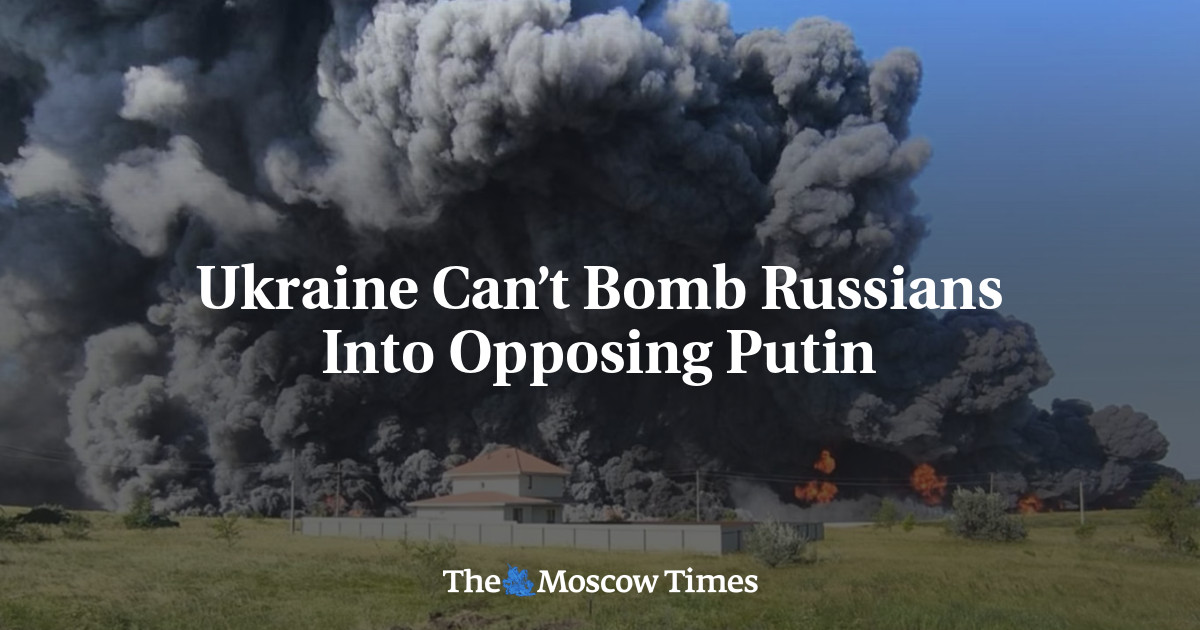
For more than two weeks, Ukrainian forces have been carrying out near-daily attacks on warehouses operated by Wildberries, Russia’s largest online marketplace.
At least eight people have been killed and dozens have been injured. Preliminary estimates put sellers’ losses at 280 billion rubles ($3.5 billion), Forbes Russia reported on Sunday. Since then, more warehouses have been attacked and given the resulting business closures and logistical disruptions, the cost is likely to rise substantially.
The attacks appear to be part of Ukrainian President Volodymyr Zelensky’s 40-day campaign to pressure Russia to make peace. Targeting Wildberries warehouses, alongside strikes on oil refineries and ports, are intended not only to weaken Russia’s economic capacity, bolster Ukrainian morale and generate international publicity, but also to provoke public discontent inside Russia over the war and declining living standards.
The campaign is bringing the war directly into the lives of Russians who have tried to ignore it — from makers of handmade candles and owners of family-run bakeries to residents of major cities accustomed to having almost anything delivered quickly and cheaply to pickup points near their homes.
In the second quarter of 2025, the analytics firm Sensor Tower estimated that the Wildberries app had between 67.6 million and 69.5 million weekly active users in Russia.
The platform also served hundreds of thousands of small and medium-sized sellers.
If you search Instagram in Russian for phrases such as “my goods burned in the warehouse,” you will find hundreds, perhaps even thousands, of videos posted by these business owners. Many are desperate, having lost overnight what they had spent years building. Some say they have no choice but to file for bankruptcy.
The attacks have also produced other, less visible consequences. Animal shelters in several Russian cities, for example, have turned to social media for help after warehouse fires destroyed supplies of pet food intended for animals in their care.
It’s striking, but you’ll hardly find any complaints directed at the government among these hundreds of mass appeals. The very government whose function is to ensure the safety of its citizens. That’s a truism. But isn’t that what taxes are for?
Instead, the sellers’ complaints are directed primarily at Wildberries. Yet the company itself is also a victim of the attacks.
Possibly anticipating that its warehouses might become targets, Wildberries amended its terms of service in early July to limit or exclude the company’s liability for losses caused by drone attacks.
The company’s founder, Tatyana Kim, nevertheless promised to reimburse sellers for at least part of their losses. So far, only a small number have received compensation. But these payments have often been significantly lower than the losses incurred, in some cases amounting to little more than a token gesture.
At the same time, the Russian authorities have distanced themselves from this issue, as if the damage to civilian infrastructure were none of their concern.
Perhaps these entrepreneurs are acting rationally by directing their anger at Wildberries rather than at the authorities or the war itself. Venting at a marketplace is relatively safe; publicly criticizing Putin or the war is not. Why, while already facing a crisis, would they do something that would only create more problems without solving the ones they already have?
Many of them, particularly since the onset of the Covid-19 pandemic, have stopped expecting meaningful help from the authorities and have grown accustomed to relying on themselves. Few appear to believe that Putin will see their complaints on social media and bring the war to an end. Their only realistic option, as they see it, is to adapt and wait for better times.
This also reflects my own experience of speaking with Russian businesspeople.
In private conversations, some of them — even those who work with state-owned companies — may curse the government and express hope for Putin’s swift death. Yet very few would have the courage to say the same thing publicly.
The attacks on warehouses may have another, less obvious effect: they could push the prospect of peace even further away.
Research suggests that bombing enemy territory often provokes hatred toward the attacker rather than protest against the population’s own government.
Journalist Vladislav Gorin pointed out that Robert Pape’s research into numerous 20th-century conflicts shows that in nearly all wars involving extensive aerial bombardment, attacks on enemy cities often failed to trigger uprisings behind enemy lines. Instead, they often strengthened social cohesion behind the government or the broader war effort.
Just recently, the U.S. and Israeli airstrikes had this galvanizing effect on Iranian society despite the fact that, shortly before the war, protests involving tens of thousands of people were raging in the Islamic Republic. But now the regime seems even more stable than before.
What’s more, such attacks turn not only apolitical citizens against Ukraine. They also cause disillusionment among someanti-war Russians.
The other day, a journalist I know — who lives in Russia and writes secretly for independent media — said: “It’s interesting that in the fifth year of the war … It’s not as if the score has evened out between the sides. But there is a trend in that direction.”
The score has not, in fact, evened out. Russia started the war, not Ukraine. These strikes do not erase the distinction between the state that launched the invasion and the state responding to it. They may, however, make that distinction less emotionally compelling to Russians who feel Ukrainian attacks are indiscriminate or unjustified. In their eyes, the original question of responsibility for the war may gradually be overshadowed by a more immediate one: who is destroying their businesses, threatening their cities and disrupting their daily lives today?
By portraying Wildberries warehouses and oil refineries as legitimate military targets, Kyiv is using arguments structurally similar to those used by the Kremlin when it strikes Ukrainian postal depots and power plants: a civilian or dual-use facility is described as part of military logistics or the defense industry, after which the attack is presented as being directed not against the population, but against the enemy’s ability to wage war.
The fact that Wildberries sold first-aid kits, helmets, or electronics purchased by the military does not imply that the company was integrated into the Defense Ministry’s logistics system. Furthermore, the volume of such purchases is negligible compared to the rest of its sales.
Undoubtedly, many Russians find the loss of this victim-and-aggressor dichotomy appealing. It frees those who define themselves through their connection to Russia — the aggressor state — of the discomfort associated with that identity.
Even those who did not support the invasion from the start are beginning to feel that Kyiv has lost its moral authority. And for those who didn’t have a clear position and tried to ignore the war, the Ukrainian strikes may well reinforce the conviction that there are no longer “right and wrong sides” in this war, even if they quietly oppose the invasion itself.
Bringing the war home, therefore, may not bring peace any closer. Instead, it may deepen moral and political cynicism toward both sides of the conflict. Russians are growing tired and angry, but they are also acutely aware of their powerlessness. All they can do is endure and adapt, quietly cursing both “Grandpa Putin” and “clown Zelensky.”
The views expressed in opinion pieces do not necessarily reflect the position of The Moscow Times.
A Message from The Moscow Times:
Dear readers,
We are facing unprecedented challenges. Russia’s Prosecutor General’s Office has designated The Moscow Times as an “undesirable” organization, criminalizing our work and putting our staff at risk of prosecution. This follows our earlier unjust labeling as a “foreign agent.”
These actions are direct attempts to silence independent journalism in Russia. The authorities claim our work “discredits the decisions of the Russian leadership.” We see things differently: we strive to provide accurate, unbiased reporting on Russia.
We, the journalists of The Moscow Times, refuse to be silenced. But to continue our work, we need your help.
Your support, no matter how small, makes a world of difference. If you can, please support us monthly starting from just $2. It’s quick to set up, and every contribution makes a significant impact.
By supporting The Moscow Times, you’re defending open, independent journalism in the face of repression. Thank you for standing with us.
Continue

Not ready to support today?
Remind me later.
×
Remind me next month
Thank you! Your reminder is set.