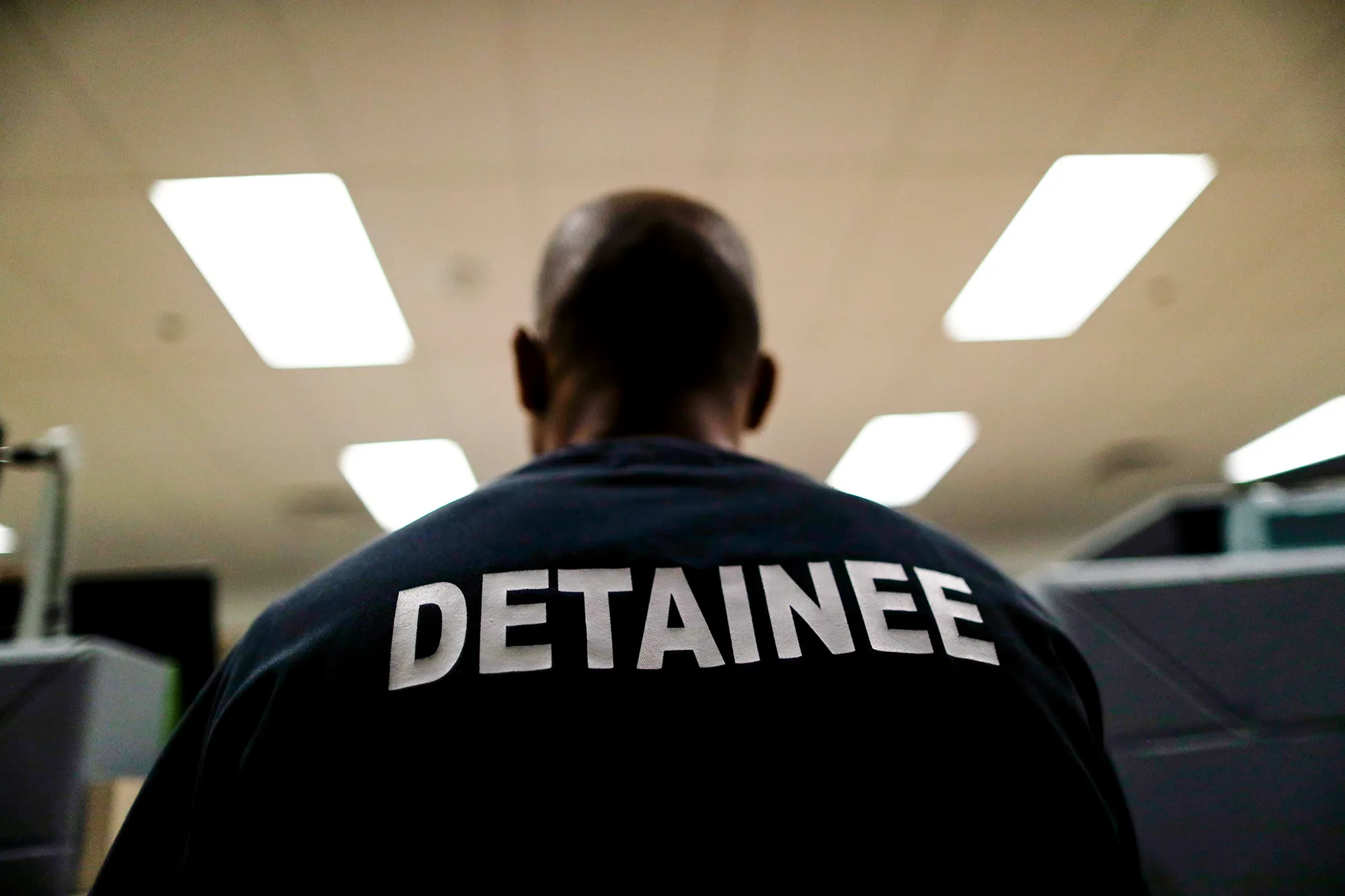

A federal court dealt a blow to the Trump administration’s mass detention of unauthorized immigrants in a new ruling that held many of them should have had opportunities to be released while awaiting deportation decisions.
The 9th Circuit Court of Appeals determined that the federal government for more than 30 years has treated people detained inside the U.S. differently than immigrants apprehended at the border.
At the border, immigrants can be detained and deported almost immediately without a court hearing. Further inside the country, unauthorized immigrants are given a chance to post bond and return to their families while proceedings unfold.
The Trump administration, by contrast, does not distinguish between the two groups — a practice that has filled detention centers and clogged federal courts with thousands of petitions for release. “Some of these detained aliens have resided in the United States for lengthy periods,” wrote 9th Circuit Judge Daniel Bress, who was nominated to the court by President Donald Trump.
Bress acknowledged conflicting language in federal laws, but he pointed to the long record of how different presidents have interpreted the law.
- Bress: “We have 30 years of action — the government actively treating unadmitted aliens present in the interior of the country as entitled to bond hearings.”
The case turned on immigrants held in the Seattle area, but it covers the entire West, including California.
The appeal court’s 2-1 split ruling mirrors the divide among the lower courts on this issue. Because the lower courts have issued different rulings, it is almost certain that the U.S. Supreme Court will take up the case.
CalMatters events: Join us Aug. 5 in Riverside for a free conversation about how California will educate its future workforce. CalMatters’ Adam Echelman will moderate a discussion with health, education and workforce leaders. Register here.
CalMatters and inewsource are also hosting a conversation on Aug. 13 in San Ysidro about the Tijuana River contamination crisis, an environmental emergency affecting millions on both sides of the U.S.-Mexico border. Register.
Other Stories You Should Know
He lost in the 2018 anti-Trump wave. Can he hold on this time?

Republican Rep. David Valadao may have a fundraising advantage over his Democratic opponent, but the incumbent for one of the state’s most competitive districts still has a tough fight ahead of him in his bid to stay in Congress, reports CalMatters’ Maya C. Miller.
Valadao faces progressive newcomer Randy Villegas in the race to represent California’s 22nd congressional district in the Central Valley. Valadao has branded himself as a bipartisan leader and his background as a dairy farmer has helped him win reelection. He is also the last remaining Republican who voted to impeach Trump after the Jan. 6, 2021 Capitol riots.
But since being elected to Congress in 2012, Valadao has lost an election too — during the “blue wave” of 2018 with Trump’s first midterm. Democrats seek to oust Valadao again by riding this midterm’s anti-Trump sentiment, driven by voters’ frustration over tariffs and inflation. Valadao was also the decisive vote to pass Trump’s budget bill, which slashed $28.4 billion from California’s Medicaid program.
UC San Diego severs ties with Border Patrol

UC San Diego has parted ways with a federal grant program that provides millions of dollars for campus police to aid Border Patrol, after CalMatters reporting revealed the university’s decade-long partnership with the federal agency.
As Phoebe Huss of CalMatters’ College Journalism Network explains, students emailed complaints, threatened to hold a public rally and publicly criticized the university’s relationship with the U.S. Department of Homeland Security at a February anti-ICE walkout following the report.
A university spokesperson declined to confirm whether campus police left the program. But internal emails from a university vice chancellor sent in March confirmed that the college intended to stop using the grant and had no plans to reapply. The San Diego County Sheriff’s Office, which manages operations funded by the program, also told CalMatters in May that UC San Diego will not participate in future grant operations.
And lastly: New director at CA consumer agency

Gov. Gavin Newsom has appointed a new head of the state’s Professional Fiduciaries Bureau, months after a CalMatters investigation revealed how the agency has failed to stop conflicts of interest and curb abuse in the industry. Before Newsom’s appointment of Nicole Dragoo, who served as the agency’s licensing chief, the position remained unfulfilled for two years since it had opened. Read more from CalMatters’ Byrhonda Lyons.
California Voices
Two views on Proposition 45, a ballot measure to expedite environmental reviews for housing and infrastructure:
The measure would modernize California’s broken project approval process, maintain the state’s environmental, worker and tribal protections and bring greater accountability, writes Jenna Abbott, executive director of the California Council for Affordable Housing.
Prop. 45 would be disastrous for communities living near industrial pollution because it would weaken environmental protections, reduce community input and allow corporations to shift costs onto taxpayers, writes Mabel Tsang, political director for the California Environmental Justice Alliance.
Other things worth your time:
Two cities burned in LA fires settle YIMBY lawsuit // CalMatters (free)
DHS agent testifies that Border Patrol raid outside Newsom event was ‘purely political’ // San Francisco Chronicle (gift link)
CA farmworkers cut back on medical care, shopping after ICE enforcement // The Sacramento Bee (gift link)
AI transparency rule from Bay Area lawmakers kicks in Saturday // San José Spotlight (free)
Life after the Bay Area: New report finds what happens to people who leave high cost CA // SFGATE (free)
Boyle Heights schools set to reopen with rotting food, fly swarms and rats // Los Angeles Times (paywall)
Silicon Valley donors just poured $194M into CA politics // The Mercury News (gift link)
Sales are so low, CA wineries are burning their vineyards // The New York Times (gift link)