Riyaz ul Khaliq
16 July 2026•Update: 16 July 2026
- Beijing announces launch of Shanghai-based World Artificial Intelligence Cooperation Organization with backing of 29 nations
Humanoid robots, AI-powered smartphones and next-generation foundation models are expected to draw attention at the World Artificial Intelligence Conference (WAIC) in Shanghai, which begins Friday.
The ninth edition of WAIC comes as Beijing intensifies efforts to become a global leader in artificial intelligence amid growing competition with the US over advanced technologies, computing power and AI infrastructure.
A key development on the eve of the summit is the establishment of the World Artificial Intelligence Cooperation Organization (WAICO), a China-proposed multilateral platform aimed at promoting international cooperation on AI innovation, development and governance.
On Thursday, 29 countries signed an agreement establishing the organization, which will be headquartered in Shanghai, according to state-run Xinhua News.
Chinese President Xi Jinping is scheduled to outline Beijing’s approach to AI development and governance during the conference.
UN Secretary-General Antonio Guterres and several foreign leaders, including Kazakh President Kassym-Jomart Tokayev, the prime ministers of Thailand and Cambodia, and Pakistan’s Foreign Minister Ishaq Dar, are among those expected to attend.
World Artificial Intelligence Cooperation Organization
WAICO was first proposed by China in July last year.
According to a Baidu blog, the organization “aims to deepen international cooperation in the field of artificial intelligence, break down barriers to the flow of production factors by creating a supply-demand matching platform, and promote practical AI cooperation among countries.”
Its work will focus on three main goals: deepening innovation cooperation, promoting inclusive development and strengthening collaborative governance.
Xi to unveil China’s vision of AI development
China has hosted WAIC annually since 2018.
Xi, who is attending the conference for the first time, will “systemically elaborate on China’s policies, position, visions and propositions on AI development and governance,” according to China’s Foreign Ministry.
The ministry said AI technological innovation is undergoing broad-based breakthroughs and demonstrating unprecedented dynamism, creating both opportunities and challenges for the international community and making AI governance a “profound topic of our times.”
Xi has long urged the ruling party and the government to develop “new quality productive forces,” shifting the growth model of the world’s second-largest economy from traditional, labor-intensive manufacturing toward high-tech, innovation-led and sustainable development.
‘Intelligent Partners, Co-create the Future’
WAIC will feature more than 140 forums, bringing together more than 1,400 participants from China and abroad.
Running from Friday to Monday, the summit will feature conferences, exhibitions, application experiences, innovation incubation and talent attraction, according to Chinese state media.
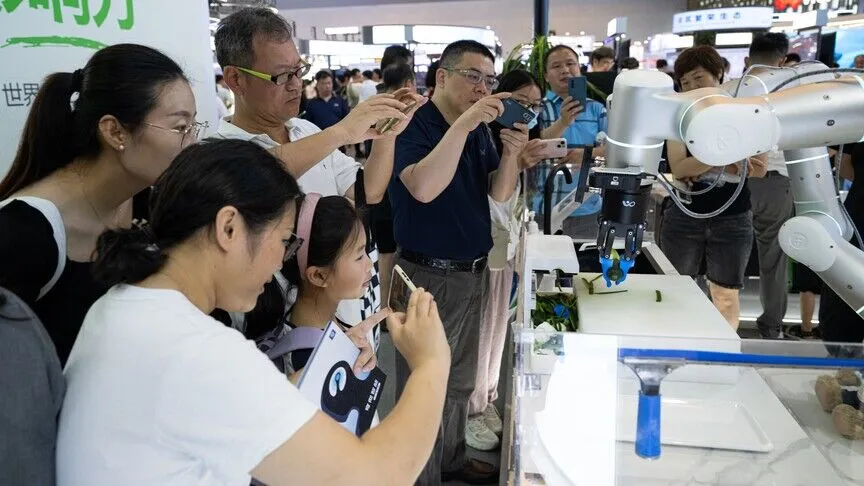
More than 1,100 enterprises will showcase over 3,000 products and technologies, with more than 300 products making their global debut, according to Xinhua News.
The main attractions are expected to include Huawei’s Atlas 950 AI computing super node, MiniMax’s M3 multimodal foundation model and the world’s first agentic AI phone.
A variety of humanoid robots and AI-powered dexterous hands will also be on display.
Reflecting Xi’s push for new quality productive forces, six Chinese central government ministries and commissions are participating in the summit.
Highlighting Shanghai’s role in China’s AI ambitions, Deputy Mayor Chen Jie said: “The city has built a full-fledged development ecosystem integrating independent innovation, application-driven growth, opening-up and cooperation, coordinated industrial ecosystem development, and security governance.”
Last year, Shanghai was home to 394 major AI enterprises, whose combined industrial scale exceeded 637 billion yuan ($93.7 billion), up 39.5% year-on-year.