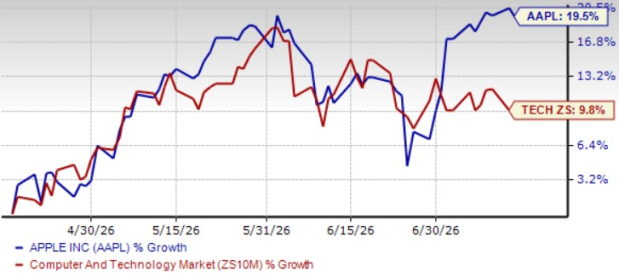
Apple AAPL shares have jumped 19.6% in the past three months, outperforming the broader Zacks Computer and Technology sector’s return of 9.8%. The outperformance can be attributed to strong second-quarter fiscal 2026 results (reported on April 30), improving visibility into AI-enabled product strategy, resilient iPhone demand and expanding Services business. However, further upside will likely depend on Apple’s ability to sustain iPhone sales momentum while navigating component cost inflation and macroeconomic uncertainties. So, what should investors do with the AAPL stock? Let’s dig deep to find out.
Apple Stock’s 3-Month Price Performance
Image Source: Zacks Investment Research
Apple’s Prospects Ride on Strong iPhone Sales
iPhone revenues surged 22% year over year to $57 billion in the second quarter of fiscal 2026, driven by exceptional demand for the iPhone 17 lineup. Apple highlighted record March-quarter iPhone sales and record upgrader activity. Apple also called out iPhone Air as its slimmest and lightest smartphone, while iPhone 17 was positioned as a strong-value upgrade.
The iPhone 17 momentum continues per the latest Counterpoint Research report. Apple increased global iPhone shipments 3% year over year during the second quarter of calendar 2026, while the broader smartphone market declined sharply. Apple’s global smartphone market share reached a record 20%, supported by strong iPhone 17 demand and stable pricing even as competitors struggled with higher memory costs. Although Apple has raised prices for Macs and iPads, the iPhone has been left untouched.
Per Counterpoint Research report, Samsung reclaimed its #1 position with 24% market share, trailed by Apple, Xiaomi (12% market share), OPPO (11% market share) and vivo (8% market share). Alphabet’s GOOGL Google saw strong shipment growth, up 16% year over year, driven by strong demand for Pixel 10 and 10a in key mature markets.
AI Push to Boost AAPL’s Top-Line Growth
Apple is increasingly positioning its devices as the best platform for on-device AI. Apple Intelligence is deeply integrated across iPhone, Mac and AirPods, while newer Apple Silicon chips provide meaningful AI performance gains. The company also noted growing enterprise adoption of Macs for AI development, with Mac Mini, Mac Studio and MacBook Neo experiencing demand well above expectations because of AI workloads.
Apple’s new version of Siri AI, announced at this year’s annual Worldwide Developers Conference, is designed to be more conversational, context-aware and capable across the company’s devices. The update introduces enhanced reasoning, personalized assistance, visual intelligence, writing tools and deeper integration with apps and system functions.
Apple announced AI-powered improvements across iOS 27, iPadOS 27, macOS 27, watchOS 27, visionOS 27 and tvOS 27, while emphasizing privacy through its on-device processing and Private Cloud Compute architecture. The company included updates such as stronger parental controls, improved Visual Intelligence features, developer AI tools and deeper integration of AI into apps such as Photos, Safari, Messages, Mail and Shortcuts, making everyday tasks more personalized and efficient.
Strong Services Momentum to Boost Apple’s Prospects
Apple’s Services segment benefits from an expanding games portfolio and the growing popularity of Apple TV+. In the second quarter of fiscal 2026, Services contributed 27.9% of total net sales, with revenues rising 16.3% year over year to $30.98 billion, which was a record in Apple’s history. Apple continues to benefit from its installed base of more than 2.5 billion active devices, supporting higher paid accounts, transaction volumes and recurring revenues. This expanding ecosystem provides investors with greater earnings visibility and margin stability.
Apple TV+ recently received a record 89 Emmy Award nominations, reinforcing Apple’s position as a premium content provider. Continued success in original programming strengthens the Services ecosystem, improves customer engagement and supports subscription growth over the long term.
Apple’s Prospects Suffer From Multiple Challenges
Although robust iPhone demand and an expanding installed base of devices are expected to boost the Services business, stiff competition from Chinese OEM smartphone vendors, as well as Alphabet, HP HPQ, Dell Technologies DELL and Microsoft in the PC and AI domain are major headwinds. Apple’s prospects have suffered from issues with its AI initiatives due to the postponement of several features, which has been a concern for investors. In the past three months, Apple has underperformed Dell and HP, shares of which have surged 137% and 24.9%, respectively, but outperformed Alphabet, shares of which have returned 7%.
Meanwhile, Apple has acknowledged that memory prices continue to rise because AI infrastructure demand is tightening semiconductor supply. Apple expects significantly higher memory costs during the June quarter and indicated these pressures could intensify beyond June. Supply constraints for advanced chips and certain Mac products are expected to limit near-term revenue growth.
Apple shares are also overvalued, as suggested by a Value Score of F. The stock is trading at a forward 12-month price/earnings (P/E) of 33.51X compared with the broader sector’s 24.27X, Alphabet’s 24.61X, HP’s 8.37X and Dell’s 22.30X.
Apple Stock’s Valuation
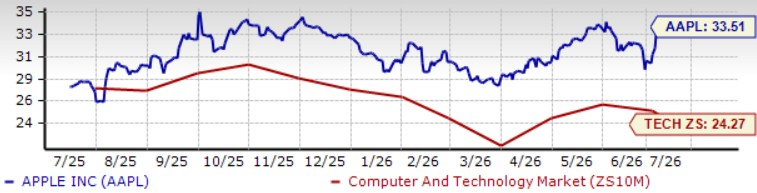
Image Source: Zacks Investment Research
AAPL’s FY26 Earnings Estimate Revision Shows Declining Trend
The Zacks Consensus Estimate for Apple’s fiscal 2026 earnings has declined by a penny to $8.74 per share over the past 30 days, indicating 17.2% growth from the figure reported in fiscal 2025.
Apple Inc. Price and Consensus

Apple Inc. price-consensus-chart | Apple Inc. Quote
The Zacks Consensus Estimate for Apple’s fiscal 2026 revenues is pegged at $478.19 billion, indicating 14.9% growth over the figure reported in fiscal 2025.
Conclusion
Apple remains well positioned for long-term growth, supported by strong iPhone 17 demand, an expanding Services ecosystem and its growing focus on on-device AI. AAPL’s massive installed base and recurring revenue model provide resilience, while Apple Intelligence could unlock new upgrade opportunities over time. However, a premium valuation, rising component costs, AI execution risks and intense competition may limit near-term upside.
AAPL currently has a Zacks Rank #3 (Hold), which implies that investors may prefer to wait for a more attractive entry point or clearer evidence that its AI strategy is translating into faster revenue and earnings growth. You can see the complete list of today’s Zacks #1 Rank (Strong Buy) stocks here.
Radical New Technology Could Hand Investors Huge Gains
Quantum Computing is the next technological revolution, and it could be even more advanced than AI.
While some believed the technology was years away, it is already present and moving fast. Large hyperscalers, such as Microsoft, Google, Amazon, Oracle, and even Meta and Tesla, are scrambling to integrate quantum computing into their infrastructure.
Senior Stock Strategist Kevin Cook reveals 7 carefully selected stocks poised to dominate the quantum computing landscape in his report, Beyond AI: The Quantum Leap in Computing Power.
Kevin was among the early experts who recognized NVIDIA’s enormous potential back in 2016. Now, he has keyed in on what could be “the next big thing” in quantum computing supremacy. Today, you have a rare chance to position your portfolio at the forefront of this opportunity.
Apple Inc. (AAPL) : Free Stock Analysis Report
HP Inc. (HPQ) : Free Stock Analysis Report
Dell Technologies Inc. (DELL) : Free Stock Analysis Report
Alphabet Inc. (GOOGL) : Free Stock Analysis Report
This article originally published on Zacks Investment Research (zacks.com).
The views and opinions expressed herein are the views and opinions of the author and do not necessarily reflect those of Nasdaq, Inc.