Published on
July 14, 2026
By: Antara Mitra

Image generated with Ai
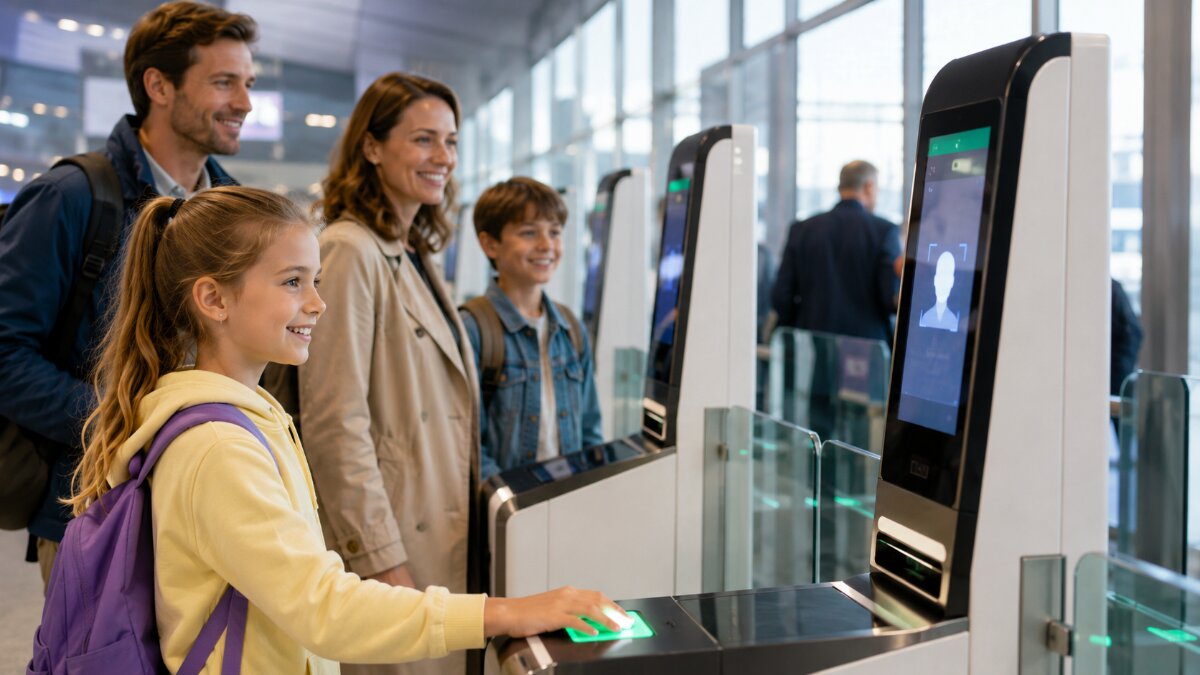
The United Kingdom has lowered the minimum age for accompanied children using automated passport gates from ten to eight, creating a major operational shift during the summer family travel peak. The change, effective since 8 July 2026, could make 1.5 million more children eligible over the next year. Children must be at least 120 centimetres tall, hold an eligible biometric passport and travel with an adult. More than 290 eGates operate across 15 UK air and rail ports, including juxtaposed border-control locations in continental Europe.
United Kingdom Extends Automated Border Entry to Younger Children
Children aged eight and nine can now use United Kingdom eGates when entering the country, provided that they meet all passport, immigration, height and supervision requirements.
The revised age rule became operational on 8 July 2026. It represents the latest expansion of automated passenger processing at the UK border and has been introduced as school holidays increase family traffic through airports and international rail terminals.
Before the change, children generally needed to be at least ten years old to use the gates. The new system places accompanied eight- and nine-year-olds inside the eligible passenger group for the first time.
Advertisement
Advertisement
Children between eight and 17 must travel with an adult when using an eGate. Every user must also be at least 120 centimetres tall. The height requirement allows travellers to stand correctly within the gate and complete the facial-recognition process.
The Home Office estimate of 1.5 million additional eligible children is based on 2025 United Kingdom arrival figures. This number represents potential eligibility over the next year. It does not mean that 1.5 million children have already used the gates or that every newly eligible child will pass through automated control successfully.
Advertisement
Advertisement
Key United Kingdom eGate Rules for Families
| Operational requirement | Current rule from 8 July 2026 | Practical effect for passengers |
|---|---|---|
| Minimum age | Eight years | Eight- and nine-year-olds join the automated-entry cohort |
| Adult supervision | Required for travellers aged eight to 17 | Children cannot pass through the eGate area independently |
| Minimum height | 120 centimetres | Shorter children must use a staffed immigration desk |
| Passport type | Eligible biometric passport | The passport must carry the biometric chip symbol |
| Immigration permission | Valid status, ETA, eVisa or exemption where applicable | eGate eligibility does not replace permission to travel |
| Facial check | Live facial image compared with the passport photograph | A failed identity match leads to an officer referral |
| National identity cards | Not accepted at eGates | Eligible travellers should use passports instead |
| Network coverage | More than 290 eGates at 15 air and rail ports | Benefits are concentrated at major international gateways |
| Additional eligible children | Estimated 1.5 million over one year | Potentially reduces demand on staffed family queues |
The gates can normally be used by British citizens and nationals of European Union countries, Iceland, Liechtenstein, Norway and Switzerland. Eligible passport holders from Australia, Canada, Japan, New Zealand, Singapore, South Korea and the United States can also use them when they hold the required immigration permission. Members of the Registered Traveller Service may qualify under separate provisions.
Why the eGate Age Reduction Matters During the Summer Peak
The most important industry impact is not simply that more children can use automated gates. The larger consequence is the possible redistribution of family groups between automated channels and staffed passport-control desks.
Advertisement
Advertisement
Families often move through border control as a single travelling unit. Under the previous arrangement, the presence of an eight- or nine-year-old could require the entire household to join a staffed queue, even when parents and older children were eligible for eGates.
The new rule may allow more complete family groups to enter the automated processing area. That could reduce pressure on officer-operated desks at periods when several international flights or trains arrive within a narrow time window.
United Kingdom border guidance states that popular travel periods, including school and Christmas holidays, bring increased numbers of travellers. The 8 July implementation therefore places the expanded eligibility system in operation before the main school-holiday peak across much of England and Wales.
The change could be especially important at large airports where long-haul and European arrivals overlap. It may also influence international rail terminals, where passengers can arrive in concentrated groups following the departure and arrival pattern of each train.
Advertisement
Advertisement
UK Passenger Arrivals Reveal the Scale of the Processing Challenge
The latest complete Home Office statistics recorded 136.8 million passenger arrivals in the year ending March 2026. This was 3 per cent higher than the previous year and 11 per cent above the pre-pandemic level.
Air travel accounted for 88 per cent of all recorded arrivals. Rail represented 7 per cent and sea travel accounted for the remaining 5 per cent. British nationals generated 57 per cent of the total.
| Arrival measure | Official share or total | Approximate passenger volume | Border-processing relevance |
| Total UK arrivals | 100% | 136.8 million | Overall annual demand handled through legitimate routes |
| Air arrivals | 88% | 120.4 million | Main exposure for airport eGate infrastructure |
| Rail arrivals | 7% | 9.6 million | Important for international rail and juxtaposed controls |
| Sea arrivals | 5% | 6.8 million | Many passengers continue to require port-specific processes |
| British nationals | 57% | 78.0 million | Large core group potentially eligible for automated entry |
| Non-British nationals | 43% | 58.8 million | Eligibility depends on nationality and immigration status |
Approximate volumes in the table have been calculated from official Home Office percentages and rounded to one decimal place. They illustrate scale rather than representing separately published totals.
Against annual arrivals of 136.8 million, the estimated 1.5 million newly eligible children are equivalent to approximately 1.1 per cent of the latest annual arrival volume.
That percentage may appear limited at national level. However, its operational value can be greater during specific holiday weeks because family travel is highly seasonal. A concentrated movement of newly eligible children during July, August, Christmas and half-term periods could create a more noticeable change in queue composition than the annual percentage suggests.
More Than 290 eGates Support the United Kingdom Border Network
More than 290 eGates are installed across 15 air and rail ports. The network includes major United Kingdom gateways and juxtaposed controls where UK immigration checks take place in continental Europe before passengers travel to Britain.
Advertisement
Advertisement
Juxtaposed controls are particularly relevant to cross-Channel rail operations. They allow UK entry checks to be completed before departure from selected European terminals, rather than after the passenger reaches Britain.
The infrastructure forms part of a wider transition towards digital passenger permission and automated identity processing. The eGate does not independently decide whether a traveller has the right to enter. It checks the traveller’s biometric passport, facial identity and connected digital records before allowing passage or directing the passenger to an officer.
Facial-recognition technology compares the person standing inside the gate with the digital photograph stored in the passport chip. Successful automated clearance therefore depends on both readable travel documentation and a reliable identity match.
The Family Processing Sequence Is Operationally Important
Border guidance recommends that a single adult travelling with children should enter the eGate first. Where two or more adults are travelling together, the recommended sequence is the first adult, followed by the child or children, and then the final adult.
This sequence provides adult supervision on both sides of the automated control point. It also reduces the possibility of a child becoming separated from the travelling group during processing.
Airports, rail operators, travel agents and tour leaders should communicate this procedure before passengers reach immigration. Clear pre-arrival information could reduce hesitation at the gate entrance, incorrect queue selection and last-minute movement between automated and staffed channels.
Advertisement
Advertisement
Families should remain together even when some members are not eligible. A child below 120 centimetres, a traveller using an identity card or a family member without the necessary digital permission may still require a staffed desk.
eGate Access Does Not Guarantee Automated Clearance
Eligibility only allows a traveller to attempt automated entry. It does not guarantee that the gate will open.
Passengers may be referred to a Border Force officer when further checks are needed to verify identity, nationality, travel documents or immigration status. An eGate may also reject a user because of a damaged passport chip, worn travel document, equipment fault or unsuccessful facial comparison.
Changes in appearance can affect the identity check. Hats, headphones, face coverings and glasses can also interfere with image capture. Passengers must look directly at the screen and follow the instructions displayed by the equipment.
Digital-record problems represent another risk. An ETA, eVisa or digital exemption may be missing, expired or connected to an old passport. Travellers holding UK immigration status should ensure that the passport being used for travel is correctly linked to their UK Visas and Immigration account.
Safeguarding checks remain part of the system. Border Force may refer a family to an officer to establish the relationship between a child and accompanying adults.
Advertisement
Advertisement
Different Surnames Can Still Trigger Additional Family Checks
Adults travelling with children who have different surnames may face further questions. Similar checks may occur when the accompanying adult is not the child’s parent or when the family relationship is not immediately clear.
Useful supporting documents can include birth or adoption certificates, marriage or divorce documents and parental-authority letters. A consent letter should include the contact information of the parent or guardian who authorised the journey.
These documents are not substitutes for passports or immigration permission. However, carrying them can support a faster safeguarding assessment when an officer needs to confirm the relationship or reason for travel.
Historical Expansion Shows a Progressive Automation Strategy
| Year | United Kingdom eGate development | Strategic significance |
| 2019 | Automated access expanded to eligible travellers from Australia, Canada, Japan, New Zealand, Singapore, South Korea and the United States | Increased the international visitor population able to use eGates |
| 2023 | Minimum age reduced to ten for accompanied children; 293 gates operated across 15 air and rail ports | Allowed more family groups to enter the automated channel |
| 2026 | Minimum age reduced again to eight, subject to a 120-centimetre height requirement | Adds an estimated 1.5 million eligible children over the following year |
In 2019, 264 eGates were operating across 15 air and rail terminals and juxtaposed controls. During the year ending September 2018, the gates processed 51.9 million passengers.
The 2023 expansion covered children aged ten and 11 following trials at major airports. At that time, approximately 400,000 children in those age groups were expected to use eGates during the year. The national estate then included 293 gates across 15 air and rail ports.
The 2026 change is broader in scale. Its estimate of 1.5 million additional eligible children is nearly four times the 2023 projection for ten- and 11-year-olds, although the figures were prepared for different age groups and reporting periods.
Advertisement
Advertisement
Industry Analysis: Why Family Queue Redistribution Is the Real Story
The immediate traveller benefit is a potentially shorter and more predictable passport-control experience. The larger commercial impact lies in how airports and rail terminals manage arrival surges.
Border queues can influence baggage-hall congestion, passenger meeting times, coach departures, private transfers, rail connections and airport parking operations. Moving more complete family groups into automated lanes may create a steadier flow from immigration into baggage reclaim and landside transport areas.
The change may also allow staffed desks to concentrate more heavily on passengers who require document examination, visa verification, safeguarding interviews or passport stamps. This does not automatically reduce Border Force staffing requirements. eGates still require officer oversight, passenger guidance, exception management and intervention when automated checks fail.
The real performance test will be whether ports align gate availability, staff deployment and queue signage with flight and rail arrival patterns. An expanded eligible population produces limited benefit when too few gates are open, families do not understand the rules, or passengers enter the wrong queue.
Travel companies therefore have a direct role in converting legal eligibility into operational efficiency. Clear information supplied before departure can prevent families from assuming that age alone guarantees eGate use.
Operational Takeaways for Travel Agents and Tour Operators
- Confirm that children aged eight and above are also at least 120 centimetres tall before presenting automated entry as an option.
- Explain that travellers aged eight to 17 must be accompanied by an adult throughout the eGate process.
- Check that every traveller holds an eligible biometric passport carrying the chip symbol.
- Remind visa-exempt international clients that an ETA may still be required before departure.
- Advise eVisa holders to link their current passport to the correct UK Visas and Immigration account.
- Do not guarantee shorter queues, since gate availability, arrival peaks and officer referrals can affect processing times.
- Build transfer schedules with sufficient contingency for families carrying damaged passports or facing unsuccessful facial checks.
- Encourage adults travelling with children of a different surname to carry relationship and consent documents.
- Inform travellers using national identity cards that they cannot use the automated gates.
- Brief groups on the recommended order of adult, children and final adult when passing through the eGate area.
United Kingdom Border Automation Enters a New Family-Travel Phase
The reduction of the minimum eGate age from ten to eight represents a targeted but strategically important extension of the United Kingdom’s automated border infrastructure.
Advertisement
Advertisement
It creates no new right to enter the country and removes none of the existing immigration, security or safeguarding checks. Its value comes from allowing a larger number of already eligible travellers to complete those checks through an automated channel.
With 136.8 million annual arrivals, more than 290 gates and a growing system of ETAs, eVisas and biometric passports, the United Kingdom border is increasingly dependent on the interaction between pre-travel digital permission and physical automated processing.
The next stage will be operational measurement. Queue performance, family adoption rates, referral volumes and gate availability will determine whether the additional eligibility produces sustained improvements beyond the 2026 summer peak.
For airlines, airports, international rail operators and travel intermediaries, the change strengthens the case for treating border preparation as part of the passenger journey rather than a process beginning only after arrival. Accurate information delivered before departure could become as important as the infrastructure itself in turning the expanded eGate network into a measurable improvement for international family travel.
Advertisement
Advertisement