The sound of a ringing telephone startled Santiago Escobar. It was July 2, 1994 at 2 a.m. in Las Vegas, Nevada, where Santiago, the older brother of Colombia national team defender Andrés Escobar, was on vacation with a sizable contingent of immediate family.
The Escobars had planned to tour the United States while they followed Andrés and World Cup favorites Colombia deep into the knockout round of the tournament. When Colombia were eliminated in the group stage, their summer family plans changed on a whim.
Santiago, an accomplished midfielder who had recently retired after a 13-year professional career, was joined in Las Vegas by his father Dario, along with several siblings and extended family.
Andrés was supposed to be there, too, but instead traveled back to his hometown of Medellín, despite Santiago’s insistence he stay with his family. Pamela Cascardo, Andrés’ then-fiancée, was finishing dental school in Medellín, which was a factor in his decision to return.
After starting every game for Colombia at the 1990 World Cup, in which Colombia advanced from the group stage for the first time, a transfer to European football became a real possibility.
Before the 1994 World Cup, European champions Milan targeted Andrés as a potential successor to their legendary center back Franco Baresi. The Italian is considered one of football’s greatest-ever defenders. But the World Cup that followed was a forgettable tournament for Colombia.
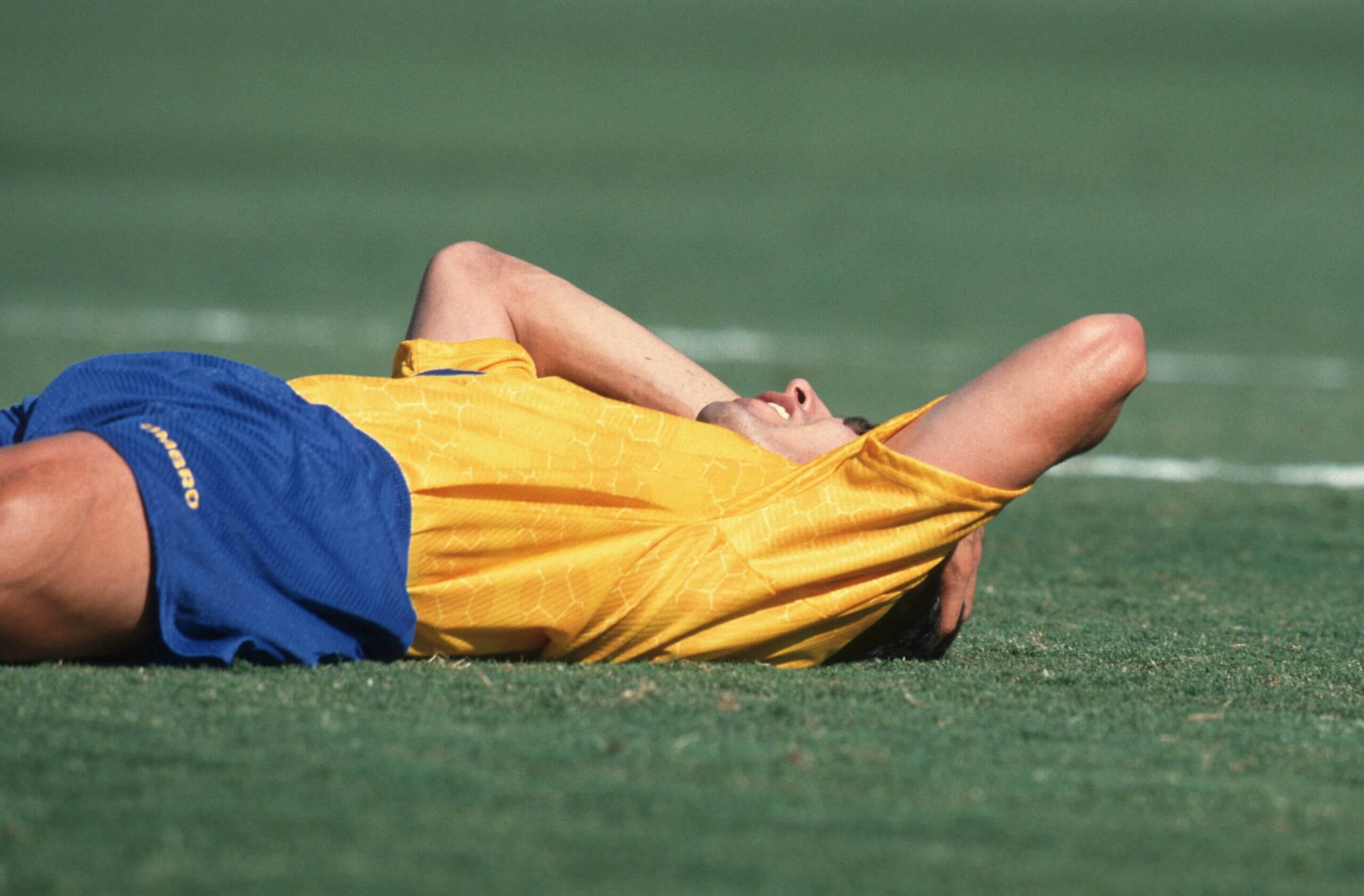
Andrés scored an own goal against the U.S. on June 22 in Colombia’s second game that contributed to an embarrassing 2-1 loss. The result came after a 3-1 defeat to Romania.
“It was really hard for us as a family,” Santiago tells The Athletic from his home in Medellín, “because we were there in the stadium, and it was just so painful to see Andrés on the ground like that, holding his head.”
Andrés Escobar reacts after his own goal against the United States. Michael Kunkel / Bongarts / Getty Images
The own goal did more than dash Colombia’s hopes at the World Cup. Because of the magnitude of the occasion, Andrés felt his expected move to Italy’s top side would fall through. Immediately after the loss, Andrés spoke to Santiago at Colombia’s team hotel.
“He wanted to have a great World Cup because he was going to be Franco Baresi’s replacement at Milan,” Santiago says. “When he scored that own goal, he said to me: ‘Never in my life had I scored an own goal and I had to go and do it in the middle of a World Cup’. That destroyed him. He was devastated.”
“I told him: ‘Forget about that. Milan have been watching you for a year or two now. They don’t sign you based on one or two games’. And Andrés said to me: ‘They’re not going to sign me anymore’.”
Santiago and the Escobar family were at the Rose Bowl that June day. It was a must-win game for Colombia. Yet no one outside the team’s camp knew about the added stress that the Colombian players were under.
Midfielder Gabriel Gómez and head coach Francisco Maturana had received death threats hours before the match. Those threats then appeared on the television sets inside the hotel room of every member of the squad. And a day before, the older brother of starting right-back Luis Herrera was killed in a car accident in Colombia.
The country had spent the last decade grappling with a war between the state and the myriad narco-terrorist cartels. The most powerful and violent group was led by Pablo Escobar, leader of the Medellín Cartel. The drug lord had wreaked havoc across Colombia via calculated political assassinations, international drug trafficking and kidnappings and extortion. And, despite Pablo Escobar’s death in December of 1993 — killed by a specialized unit of the Colombian police — the national team, a symbol of hope, could not escape the darkness he inflicted.
“Before and after the game against the United States, Andrés didn’t say anything to me about those things,” Santiago says regarding the threats.
A 2-0 win against Switzerland to close out their World Cup ended what was supposed to be a historic tournament. Call it intuition or a gut feeling, but Santiago felt it was best to avoid, albeit temporarily, the public and media scrutiny that was awaiting the Colombian players back home.
No one could have foretold the tragedy that followed.
“I told Andrés, ‘Don’t go back to Colombia’,” Santiago says. “Stay here with all of us and have Pamela meet you here. And he told me, ‘No, I have to go to Colombia to face things head-on and tell Pamela that we should travel together’. He never imagined they were going to do something like that to him.”
The phone call at 2 a.m. was the beginning of what Santiago describes as the worst day of his life. Gómez was part of a small inner circle who knew the Escobars were in Las Vegas. He contacted their hotel.
“He told us: ‘They killed Andrés’,” says Santiago. “As you can imagine, it was chaos.”
Santiago and his family, in a state of shock, boarded a flight from Las Vegas to Houston at 6 a.m. From there, they took another flight to Miami and then another to Medellín, as misinformation regarding the motive behind the murder spread throughout Colombia and the world. It was an agonizing journey back to the scene of an unimaginable crime.
“Those images in Las Vegas have never left me,” Santiago says. “It was the hardest moment of my life because of everything I lived through with Andrés and because of the way they killed him. He just didn’t deserve to die like that.”
Santiago has not spoken publicly about his brother’s murder in such detail until now. It’s been 32 painful years since that moment, one that shocked the world and shone a spotlight on the darkest part of Colombian society.

Fans at a 1994 World Cup game unfurl a banner in support of Andrés Escobar. Richard Sellers / Sportsphoto / Allstar via Getty Images
The World Cup has returned to the U.S. this summer, and once again, Colombia entered the tournament expected to impress.
Santiago admits he has mixed feelings about that reality. It’s strange, he says, to compartmentalize the excitement of a World Cup with the sense of grief with which he continues to grapple. Andrés would have turned 59 on March 13 of this year. He was 27 the day he was killed.
“At that World Cup in 1994, Andrés scored an own goal then came back to Medellín and lost his life,” says Santiago. “For me, this is a time of remembrance.”
Six shots from a handgun at point-blank range killed Andrés as he sat in the driver’s seat of his blue Honda Civic. He had been back in Colombia for just four days.
Eyewitness accounts told Colombian outlet El Tiempo at the time that Andrés was in good spirits throughout the night. Before entering the local nightclub Pádova, Andrés was greeted affectionately by passers-by, many of whom were fans of his club team, Atlético Nacional.
He signed autographs for staff at one of his stops and spoke casually with other patrons about the World Cup. He was accompanied by close friends Eduardo Rojo and Juan Jairo Galeano, along with their respective partners. His fiancée Pamela opted to stay in that night.
In hindsight, Santiago remembers one clear red flag that preceded his brother’s murder.
“The afternoon of July 2 at 4:00 p.m. Andrés called Galeano, he called Eduardo Rojo, and he called Juan Carlos Villegas — three friends of Andrés and friends of mine,” remembers Santiago. “And it struck them as strange that Andrés was calling them and wanted to be with them that day, because he almost never called his friends. He didn’t have much free time because of football.”
Santiago continues.
“Andrés was very professional. He lived for the profession. He dignified the profession,” the 62-year-old says. “He took care of himself because he knew that the life of a football player was different from that of any other person.
“Andrés was not one for going out. Unfortunately, the day he lost his life, he was in a place where he didn’t need to be. But he was on vacation. When he was in season with Atlético Nacional or the Colombia national team, Andrés didn’t go out. Andrés didn’t have a drink, didn’t go to a nightclub.”

Santiago Escobar says his brother, pictured, ‘lived for the profession’ (Courtesy of Escobar family)
The neighborhood in Medellín where he grew up would serve as a refuge before rejoining his family back in the U.S. – tragically, that setting led Andrés into a false sense of security.
The camaraderie at Pádova continued until the early morning hours. Andrés never felt threatened until someone shouted, “Congratulations for scoring that great own goal!” as he left the nightclub.
Andrés left the establishment with Rojo and his wife and headed towards his vehicle. He was approached by Santiago Gallón Henao and Pedro Gallón Henao, brothers who were known drug traffickers in Medellín. They ridiculed him, called him a homophobic slur and, according to Rojo, grabbed Andrés’ backside, as detailed in the 2010 award-winning ESPN documentary The Two Escobars.
Typically stoic and unfazed, a furious Andrés walked to his car intending to leave, but he drove back towards the group who had confronted him. From the driver’s seat of his car, Andrés asked them for respect. Seemingly out of nowhere, six shots rang out.
Humberto Muñoz Castro, the Gallón’s personal bodyguard, confessed to the killing. He was sentenced to 43 years in prison but only served 11. The Gallón brothers served 15 months in prison as accessories to murder.
“As he was leaving that nightclub, that’s when the verbal abuse started. Then, sitting in his car, he was shot,” says Santiago. “Given how much the people loved Andrés, he could never have imagined that he would suffer such a vile attack like the one they committed against him.”
This February, Santiago Gallón was shot and killed at a restaurant in Mexico.
“It doesn’t move me,” Santiago Escobar says. “Because if that brought Andrés back, fine, but it doesn’t bring Andrés back. The only thing that matters to me is Andrés and how much we miss him, the harm that was done to him. No death is going to bring Andrés back. None of it makes me happy.”
In 1985, Santiago Escobar was enjoying the height of his own professional career in Colombia. He was a technical box-to-box midfielder who was playing for Atlético Nacional, a South American powerhouse in the 1980s. At the time, Andrés was a wiry teenager with dreams of following in his brother’s footsteps.
One afternoon, Santiago invited several teammates to the Escobar home for lunch. As the players conversed and enjoyed their afternoon off, a curious Andrés, then 18 years old, peered through the kitchen window, too shy to join the conversation.
Santiago remembers that moment vividly.
“Come in, come in, I told him. I’ll introduce you to my teammates,” Santiago says. “So I introduced them, and once we had lunch and they left, Andrés asked me, ‘Hey, Shanti’ — he used to call me Shanti — ‘Will I ever be able to be a professional player?’ I told him, ‘The day you have discipline, commitment, change your diet, and start hitting the gym’. I gave him a few guidelines, and he told me, ‘That’s what I’m going to do’.”
Just a year later, that timid teenager made his professional debut with Nacional. Three years later, he earned his first senior-level cap for Colombia and won the 1988 Copa Libertadores, South America’s equivalent of the Champions League/European Cup, the first time a Colombian club had lifted it. His rapid rise was unprecedented.
“He started going to the gym, eating well, asking our mother to change his diet,” says Santiago. “He spoke to a nutritionist, and in two or three more years, Andrés became a breakout player, and everyone would ask me, ‘Where did Andrés come from? Who is that player?’.”
Santiago laughs when he remembers how people would see Andrés and refer to him as the brother of a professional footballer. That quickly changed once Andrés started his own career.
“Once Andrés got famous, it became ‘There goes Sachi, Andrés’s brother’,” says Santiago. “I started getting recognized more for that than for myself, you know? We used to joke about it all the time.”

The Escobar brothers (Courtesy of the Escobar family)
The Escobar brothers faced each other on opposite teams in Colombia’s first division for the first time in 1991. Santiago had signed with Bogotá-based Millonarios and came up against Andrés’ Nacional in Medellín.
Santiago’s head coach warned him that if he let his little brother score on him on set piece, he’d be benched. Knowing his brother’s competitive nature, Santiago egged on Andrés throughout the match.
“I told him, ‘Don’t score on me on corners. The coach will bench me’,” says Santiago. “And he’d reply, ‘I’m playing for real! I’m going to score on you’.
On each set piece, especially corners in favor of Nacional, Andrés seemed to increase his intensity.
“He’d run all over the box trying to score on me. There are photos of me grabbing him by the shirt inside the penalty area,” Santiago adds. “I never let him score on me. Never. But if it had been up to him, he would’ve scored every goal in the book on me because I was defending what was mine, and he was defending what was his.”
Santiago describes his brother as a beloved sibling, uncle and student of the game. He was also a skilled writer who was intrigued by journalism. During the 1994 World Cup, Andrés was a guest columnist for Colombia’s most prominent newspaper, El Tiempo. His final column was published on June 29, three days before his death. His chilling sign-off still resonates today.
“After so many twists and turns, the reasons behind this World Cup failure are gradually becoming clear. We lacked grit and drive. It is a matter of honor to admit that we didn’t have the necessary push during the difficult moments that the tournament threw at us.
“It was a very painful experience that is simply a call for common sense, for reflection, and to not casually throw around opinions trying to analyze an entire seven-year process based on a single moment of defeat.
“But please, let’s stay respectful. Sending a big hug to everyone. It was a phenomenal, rare opportunity and experience, the likes of which I had never felt in my life. See you soon, because life doesn’t end here.”
“His death hit me really hard,” says Santiago. “I loved him. I wanted him here for longer. He left us too soon. After 32 years, I still cry for my brother and I don’t understand the death of a person who only did what he loved most, which was play football, entertain people, give joy to his fans, and give everything for his country, for his city.”
Santiago is a prostate cancer survivor, but the disease has prematurely ended his coaching career. He managed first-division teams in Venezuela, Bolivia, Ecuador, Chile and Colombia, including two stints with Nacional. He is currently undergoing chemotherapy after a rare cancerous tumor was removed from his appendix.
Cancer ended the lives of Santiago and Andrés’ mother Beatriz in 1985. Last year, their older sister Maria Esther passed away from cancer aged 64. She was the family spokesperson after Andrés’s murder.
“Her death has really been very, very hard because she died young, too,” Santiago says. “Including Andrés, I’ve lost three more siblings. I had five siblings and I have one brother left. There were seven of us including my parents and now there’s two of us left. And I don’t know who’s next, whether it’s my brother or me. That’s up to God.”

Fans attend a memorial service for Andrés Escobar in Medellín in 2014 (Raul Arboleda/AFP via Getty Images)
Santiago’s oldest son Martín bears a striking resemblance to his famous uncle, a living reminder of the inseparable bond the Escobar brothers had. It’s important, Santiago says, that Andrés is remembered for his charisma and professionalism rather than what occurred on the night of July 2, 1994.
There are murals that honor Andrés throughout Medellín. Nacional ultras sport tattoos of Escobar’s face on their arms, chest and calves. There’s a makeshift museum with several of Escobar’s match-worn jerseys, at the home of one of Nacional’s most ardent supporters.
And, in the Medellín neighborhood of Belén, local children play football on two full-sized pitches overlooked by a statue of Andrés. They never saw him play but his name and likeness are why the Unidad Deportiva de Belén Andrés Escobar, a sports and recreation center, exists for aspiring athletes.
“The greatest legacy he could have left,” Santiago says, “is the legacy of being an impeccable human being first. The etiquette, the values, the principles. That’s the biggest legacy Andrés left us. Being a good person. Andrés is still alive in our hearts. Andrés hasn’t gone, we haven’t let him go.”