On September 3, 2025, Xi Jinping held a military parade in Tiananmen Square to mark the 80th anniversary of China’s victory over Japan in World War II. The display was deliberate in every detail, from the advanced weapons systems to the leaders of multiple authoritarian states in attendance, Russia and North Korea among them. The scale of the parade was rare, even for Xi. It was a signal of authority to the military, a performance of legitimacy for the public. But it was not his only weapon.
A week after the parade, the Standing Committee of the National People’s Congress began deliberating the “Law of the People’s Republic of China [PRC] on the Promotion of Ethnic Unity.” The law treats Taiwanese people as citizens of the PRC. Article 21 mandates that the Chinese Communist Party work to “strengthen the sense of belonging, identification, and honor of Taiwan compatriots toward the Chinese nation,” to “promote the joint inheritance and promotion of Chinese culture by compatriots on both sides of the strait,” and to deepen the recognition that both sides “belong to Chinese culture” and are both “Chinese people.”
The law includes a reporting mechanism: any individual can be reported and prosecuted. Any Taiwanese person who does not identify as Chinese is, under its terms, committing a crime subject to criminal liability.
The law passed in March 2026 and takes effect on July 1. Starting tomorrow, it will be one of Xi’s weapons against Taiwan.
In Taiwan, what was once a matter of personal national identity will become the target of public prosecution. And the vast majority of Taiwanese are guilty of this “thought crime.” According to polling conducted across multiple firms, roughly two-thirds of Taiwan’s population identify primarily as Taiwanese. Fewer than 3 percent primarily see themselves as Chinese. Among younger Taiwanese, those aged 18-34, the gap is even wider: over 80 percent identify as primarily Taiwanese; just one percent as primarily Chinese.
This is not a surprise. Among Taiwan’s 23 million people, roughly 600,000 are indigenous, Polynesian peoples entirely distinct from China’s Han majority in language, culture, society, and belief. More than a million are new residents, originally from Vietnam, Indonesia, Japan, Hong Kong, Macau, and parts of mainland China; they and their descendants constitute what many regard as a new cultural wave in Taiwan. There are those who came to Taiwan with Chiang Kai-shek after 1949, some of whom retain deep feelings for China.
Taiwan’s largest population group consists of people whose ancestors migrated from coastal southeastern China roughly 400 years ago, who have long since developed distinct cultures, and identities. Their ancestors came from China. That does not mean they still identify as Chinese, any more than Americans whose ancestors came from England, Germany, or the Netherlands still call themselves British, German, or Dutch.
This diversity is what makes Taiwan distinct from China, and it is the strongest argument for Taiwan’s right to self-determination. It is precisely what blocks the CCP’s goal of unification, and precisely what the CCP fears most.
The law set to take effect on July 1 establishes something like a thought-police system, an invisible identity camp. Its definition of “undermining ethnic unity” is deliberately vague, widening the aperture of criminality. If you have publicly denied being Chinese, you cannot know what will happen the next time you travel to China for business. You will now have to worry about being detained or extradited during a layover abroad. You cannot know whether you have already, unknowingly, violated the law. You will live under the shadow of potential retaliation.
By asserting that this law applies to Taiwanese people, the CCP can place Taiwan’s citizens under a form of ideological house arrest, prompting journalists, businesses, and public figures to self-censor, seeding doubt about the legitimacy of Taiwan’s government, and manufacturing internal fracture. That has long been China’s playbook for forcing Taiwan to accede to Beijing’s rule.
Taiwan has been governed separately from China’s since the civil war ended in 1949. Although Taiwan’s governance was initially in the hands of a Chinese nationalist dictatorship, direct presidential elections began in 1996. Taiwan’s democracy is young and it is fragile. In every presidential race, the most contested issue is identity vis-à-vis China – and the results show that the more a candidate leans toward China, the harder it becomes to win.
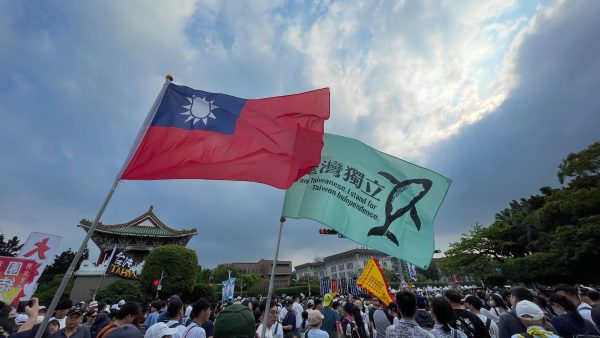
Taiwan today is a free country. Since the lifting of martial law in 1987, nearly 40 years of open public discourse have accumulated. There are hundreds of television channels. Prime time, every night, features political commentary programs that criticize the government openly and argue about China. The fiercest arguments are almost always about identity. Taiwan’s independence is expressed through its plurality. It is what the CCP is now trying to erase.
Years of CCP intimidation, combined with the spread of AI and algorithmic amplification, have pushed Taiwanese public opinion toward the extreme ends of the spectrum. The specter of populism hangs over the country. Taiwan has, for 10 consecutive years, been the nation most targeted by foreign disinformation, according to international observers. It has struggled to resist the CCP’s pressure campaign. Research shows that 95 percent of Taiwanese people have received disinformation. Distrust of politicians has risen to 68 percent. The share of people reporting decreased trust in media stands at 70.5 percent. All these numbers are climbing.
The CCP is using law to formalize its political objectives, exploiting existing distrust to spread both hatred and Chinese identity narratives from within. Taiwan’s freedom of expression is being used as a weapon against itself.
This is not hyperbole; it is a serious matter. If Beijing gets it wish, Taiwan will become the next Hong Kong, or Tibet, or Xinjiang. That would not bring stability to the Indo-Pacific, nor would it help a global economy that depends on advanced semiconductors. Yet since his summit with Xi, U.S. President Donald Trump has repeatedly criticized Taiwan and questioned the rationale for defending it militarily. The language of democratic values no longer figures prominently in how the United States addresses Taiwan.
On July 1, Taiwanese will start fighting a new battle. We face this challenge increasingly alone, with our democracy on the line.