The opening image of Pressure tells you almost everything you need to know before a single line of dialogue is spoken: blood diffusing into dark, restless water, soldiers lying in the ocean—an omen hanging heavy in the air. It’s an arresting, almost ghostly visual that frames the film as a meditation on the fragile, terrifying calculus behind it. From there, we arrive 72 hours before D-Day, into a world where the fate of thousands hinges not on bullets or bombs, but on clouds, wind, and the stubborn interpretations of men.
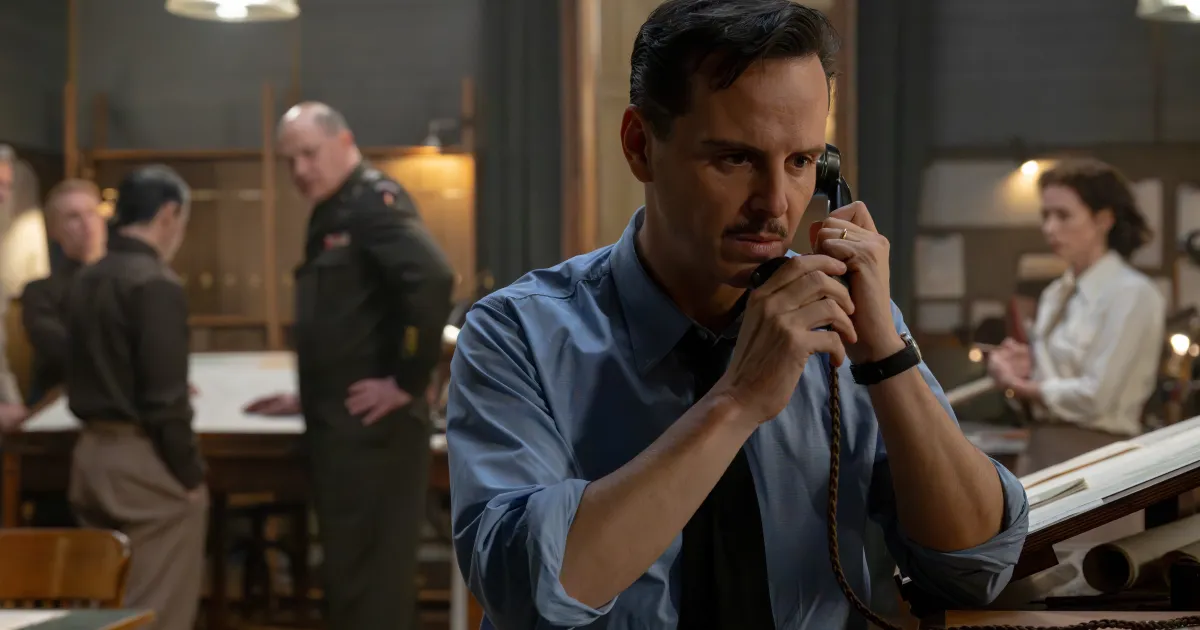
At the center of this storm, both literal and metaphorical, is James Stagg, played with quiet intensity by Andrew Scott. The film introduces him in familiar fashion: a dutiful man pulled away from his pregnant wife, summoned to serve a higher purpose. It’s a setup that could feel overly conventional in another film, but here it works precisely because it’s so foundational. Pressure understands that in a story driven heavily by technical debate and historical inevitability, we need an emotional tether, and Stagg’s personal life provides that anchor. You don’t realize how much you miss these grounding details in modern films until one reminds you how effective they can be.
Stagg himself is not an easy protagonist. He’s rigid, deeply focused, and often humorless to a fault. Social niceties seem like an afterthought compared to the burden he carries: the responsibility of being right. Scott leans into this severity without making the character inaccessible. There’s a subtle vulnerability beneath his stoicism—a sense that his bluntness and isolation aren’t just personality traits, but defense mechanisms against the enormity of what’s at stake. Every forecast he delivers isn’t just data; it’s a life-or-death assertion.
Opposing him is Irving P. Krick, played with confident ease by Chris Messina. Where Stagg is cautious and methodical, Krick is charismatic and assured, advocating that conditions will be favorable for the invasion. Their dynamic becomes the film’s central tension—not a battle of fists or weapons, but of intellect, ego, and interpretation. Pressure smartly resists turning this into a simplistic good-versus-bad dichotomy. Instead, it highlights a more unsettling truth: both men believe they are right, and both can marshal evidence to support their claims.
Hovering above them is Dwight D. Eisenhower, portrayed by Brendan Fraser with a commanding but human presence. Fraser’s Eisenhower is not the distant, mythologized leader we often see in war films. He’s impatient at times, prone to flashes of temper, yet ultimately grounded by the crushing weight of decision-making. This interpretation creates a compelling contrast with Stagg’s quiet restraint. Eisenhower must absorb the clashing certainties of his advisors and still arrive at a single, irreversible choice. The film understands that leadership, especially in moments like this, is less about confidence and more about making the decision that feels right.
What makes Pressure stand out in the crowded landscape of WWII cinema is its refusal to rely on spectacle. There are brief glimpses of the machinery of war, but they remain peripheral. The real action unfolds in cramped rooms filled with maps, chalkboards, and exhausted men running on little sleep. The film is driven almost entirely by dialogue, yet it rarely feels static.
In that sense, Pressure feels spiritually aligned with films like The Imitation Game or Darkest Hour. It’s less concerned with the execution of history than with the agonizing process that precedes it. The ticking-clock structure, with those crucial 72 hours, adds a layer of urgency that keeps the film propulsive, even when characters are simply debating weather patterns. You feel the time slipping away, the margin for error shrinking with each passing hour.
The film also taps into a theme that feels strikingly contemporary: the danger of cherry-picking data. In an era where information can be selectively interpreted to support almost any conclusion, Pressure serves as a sobering reminder of the stakes involved when truth becomes malleable. Krick’s confidence isn’t villainized outright, but the film carefully illustrates how certainty, when built on selective evidence, can be as dangerous as ignorance. Stagg’s insistence on caution, meanwhile, underscores the value of humility in the face of incomplete knowledge.
There’s also an undercurrent of exhaustion that permeates the film. These men aren’t just debating; they’re unraveling under pressure. Sleepless nights blur together, tempers fray, and the weight of impending catastrophe becomes almost unbearable. The film does an excellent job of conveying how high-stakes decision-making erodes even the most disciplined minds. It’s in these quieter, more human moments that Pressure finds its emotional core.
Performance-wise, the ensemble is uniformly strong. Scott anchors the film with a performance that is both restrained and quietly devastating. Messina provides a necessary counterbalance, injecting energy into scenes that might otherwise become too heavy. Fraser, meanwhile, delivers one of his more understated performances in recent years, grounding the film in gravitas without tipping into caricature.
Perhaps most refreshing is the film’s scale. Pressure feels like the kind of mid-budget adult drama that has become increasingly rare in today’s blockbuster-dominated landscape. It doesn’t rely on visual excess or franchise recognition to capture attention. Instead, it trusts its audience to engage with ideas, characters, and moral dilemmas. There’s something almost radical about that simplicity.
Ultimately, Pressure is a film about decisions—how they’re made, who makes them, and what they cost. It reminds us that history is not just shaped by grand actions, but by quiet, uncertain moments where the right choice is anything but clear. In stripping away the spectacle of war and focusing instead on the minds behind it, Pressure offers a perspective that feels both intimate and immense. It may not have the explosive set pieces of more conventional war films, but it offers something arguably more compelling: an emotional, thrilling, thoughtful examination of responsibility, truth, and the unbearable weight of being right.
SCORE: 8/10
As ComingSoon’s review policy explains, a score of 8 equates to “Great.” While there are a few minor issues, this score means that the art succeeds at its goal and leaves a memorable impact.
Disclosure: ComingSoon attended the world premiere for our Pressure review.