From Taiwan to Tehran, the summit between President Donald Trump and China’s President Xi Jinping addressed some of the most pressing global security issues—including AI. In an interview, Treasury Secretary Scott Bessent indicated that Washington and Beijing “are going to start talking” about a threat neither country can manage alone: the misuse of AI by terrorists.
Biosecurity should be a focus of that discussion. As global leaders in the AI and biotechnology fields, the United States and China have the power to reduce AI-bio risk—but only if they act together. Despite tensions, both countries share a critical interest in addressing this challenge.
Biosecurity measures are often wrongly framed as “constraints” on competition. Strong security enables faster, more confident innovation and bioterrorist threats cannot be managed unilaterally—gaps on either side create openings for misuse. If Washington and Beijing take biosecurity seriously, working together is essential.
Greater alignment between U.S. and Chinese biosecurity governance would help reinforce responsible practices globally—closing gaps that malicious actors could exploit, while supporting continued biotechnology leadership in both countries.

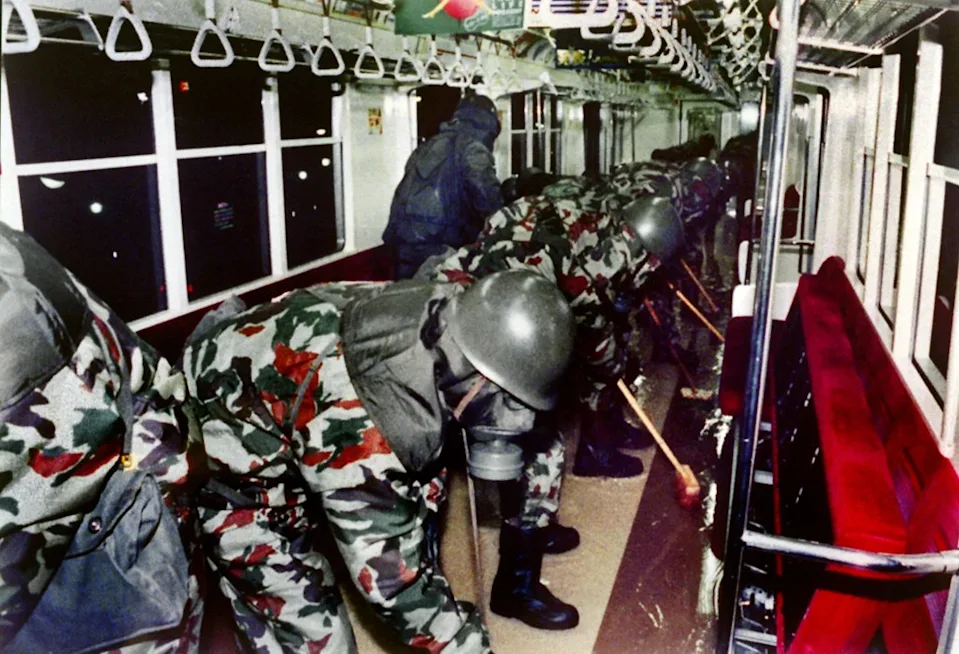
Members of the Japan Ground Self-Defense Forces clean up subway cars on March 20, 1995, in Tokyo after Aum Shinrikyo’s sarin nerve gas attack.
The good news is that U.S.-China biosecurity talks would not be starting from scratch. Recent bilateral conversations in Beijing among U.S. and Chinese biosecurity experts produced a joint call for stronger safeguards, signaling momentum and pointing to a clear next step for aligning governance: mandatory DNA synthesis screening.
DNA synthesis screening is one of the most practical and high-impact steps both countries can take. It is a critical safeguard to ensure companies do not inadvertently supply genetic material that could be used to engineer dangerous pathogens. The U.S. and China together account for a majority share of global DNA synthesis capacity, but neither country currently mandates screening. That gap is a shared vulnerability that serves neither side’s interests.
Mandating DNA synthesis screening in both countries would directly advance their shared national security goal of preventing providers from supplying the building blocks for dangerous pathogens to terrorist groups. Common screening standards would also establish market incentives for responsible providers across the global biotechnology market.
Senators Tom Cotton (R-AR) and Amy Klobuchar (D-MN) recently introduced bipartisan legislation requiring U.S. gene synthesis providers to screen both orders and customers. As proposed, it would strengthen American oversight of DNA synthesis—a development that makes this a timely moment for China to make parallel commitments.
AI-enabled biology raises similar security concerns, albeit earlier in the research process—before a DNA synthesis order is placed. Evaluating frontier AI models for biological misuse risk assesses whether an AI system could help a user design, modify or deploy a biological agent. Effective biosecurity will require AI safeguards that complement DNA synthesis screening and help ensure that AI tools do not allow users to evade responsible provider practices.
AI does not create harmful intent, but it makes advanced biological knowledge more accessible—raising the need for strong safeguards. There have always been actors willing to cause harm. What has often limited them is the knowledge and operational ability needed to turn written know-how into a working capability—a capability that is now easier to acquire with AI.
Before its 1995 Tokyo subway sarin attack, Aum Shinrikyo attempted biological attacks with botulinum toxin and anthrax but failed to overcome the technical hurdles. Frontier AI labs have acknowledged this biosecurity challenge. Several, including OpenAI, Anthropic and Google DeepMind, have warned publicly that AI could assist in the creation and release of biological weapons, and many are building controls to reduce the risk of misuse.
Policymakers are beginning to follow. The U.S. Center for AI Standards and Innovation has signed agreements with Google DeepMind, Microsoft and xAI to support pre-deployment evaluations and related research, building on earlier work with OpenAI and Anthropic. Its mandate covers cybersecurity, biosecurity and chemical weapons risks. Much of the recent attention has focused on cyber-capable models, including Anthropic’s Mythos. Models that can assist in dangerous biological work should face comparable scrutiny before release.
However, unilateral action by the U.S. will be ineffective without international participation, especially from China, whose AI sector is expanding rapidly and whose models are increasingly accessible globally. Safeguards applied consistently across markets provide dual benefit: fair competition and global risk reduction.
Forthcoming exchanges between the U.S. and China on AI present an opportunity to elevate both issues. The leaders should commit to mandatory DNA synthesis screening and direct their governments to jointly advance AIxBio safeguards, building on existing Track II Biosecurity Dialogue discussions.
The U.S. and China will continue to compete in AI and biotechnology. The opportunity is to ensure that competition continues to reward responsible innovation and scientific leadership. Parallel commitments would help prevent a race to the bottom on biosecurity and keep competition focused on scientific progress and industrial leadership—not on which side is prepared to accept greater biological risk.
This is not idealism. It is clear economic and national security necessity: support innovation while reducing deliberate misuse or risk losing control of advancing technologies.
Christine Wormuth, former U.S. secretary of the army, is president and CEO of the Nuclear Threat Initiative—a nonprofit, nonpartisan global security organization focused on reducing nuclear, biological and emerging technology threats imperiling humanity. Emily Leproust is CEO of Twist Bioscience, a U.S.-based synthetic biology company.
The views expressed in this article are the writers’ own.
Related Articles