Every day, the Ukraine Battlefield update newsletter offers a clear look at how the war is unfolding on the ground, highlighting key developments along the frontline and the shifting dynamics of the conflict. This offers readers regular and detailed information to better understand the implications of the war for the country and the whole continent.
- “We have lost everything and we are still the poorest.”
- Donetsk is no longer a safe city for Russians – Ukrainian drones fly freely over it.
- Russian forces moved closer to Rai-Oleksandrivka on the Sloviansk axis.
- The Moscow defence ministry published a map of European cities where components of Ukrainian drones are manufactured.
- Russia is now using drones even to drop leaflets – their content will not change the course of the war.
- Maps of the day – Sloviansk axis
- Videos of the day – a Czech helicopter is still fighting and bears dozens of symbols of downed drones; drones again hunted air-defence assets; the value of drone operators – a MiG-29 with a bomb was sent after a single one; a Ukrainian F-16 takes off from a Belgian airfield.
“We have lost everything and we are still the poorest.” No, Russia is not going to collapse economically tomorrow or next month, and you should not pin your hopes on the regime falling any time soon. But something is happening in Russian society and it can no longer be ignored. If Russian president Vladimir Putin does ignore it, it may come back to haunt him.
“More and more often, responsibility for the state of Russia’s collapsing economy is being assigned to Putin. This was something that would have been unthinkable a year ago, and at the same time easy to predict,” Christo Grozev from Bellingcat wrote on Thursday shortly before midnight.
At the same time, the BBC’s Moscow correspondent Steve Rosenberg, in his regular review of the Russian press on Friday morning, quoted the following sentences from various Moscow newspapers:
“Controlled slowdown has turned into an accelerating decline”; “The economic situation is worse than expected”; “In a few months, the IT industry could be in ruins.”
The greatest attention this week, however, was drawn by the remarks of Russian economist Roman Nigmatulin, delivered at a conference in Moscow.
Professor of political science Branislav Slantchev from the university in San Diego in the United States said that they showed “cracks in Putin’s regime are becoming more evident by the day”.
Nigmatulin really launched into an unusually frank speech. He warned that the Russian economy was beginning to show the same signs as the state that led to economic collapse at the beginning of the 1990s.
The list of his objections is long:
-
Per capita income in Russia is the lowest in Europe. The Russian economist said that even the poorest Chinese regions have a higher per capita income than the poorest regions of Russia.
-
While average GDP growth over the past 11 years reached 1.5 percent, average annual inflation was around 7 percent.
-
At the same time, Russian demographics are in a catastrophic state – the Russian population is shrinking by 600,000 people a year.
-
None of what Putin presented in 2012 as his economic programme has been achieved – money is not being channelled into growth but swallowed up by inflation.
-
Productivity has slumped, the number of skilled jobs in the engineering sector has fallen tenfold, while the number of low-skilled jobs has risen sharply.
-
In Russia there are 54 researchers per 10,000 inhabitants, while in developed economies the average is 174.
You can watch part of Nigmatulin’s speech with English subtitles here:
In an interview after his speech, he said that the first signs of collapse were already real, and although only very indirectly, he clearly criticised the way Russia was governed under Putin:
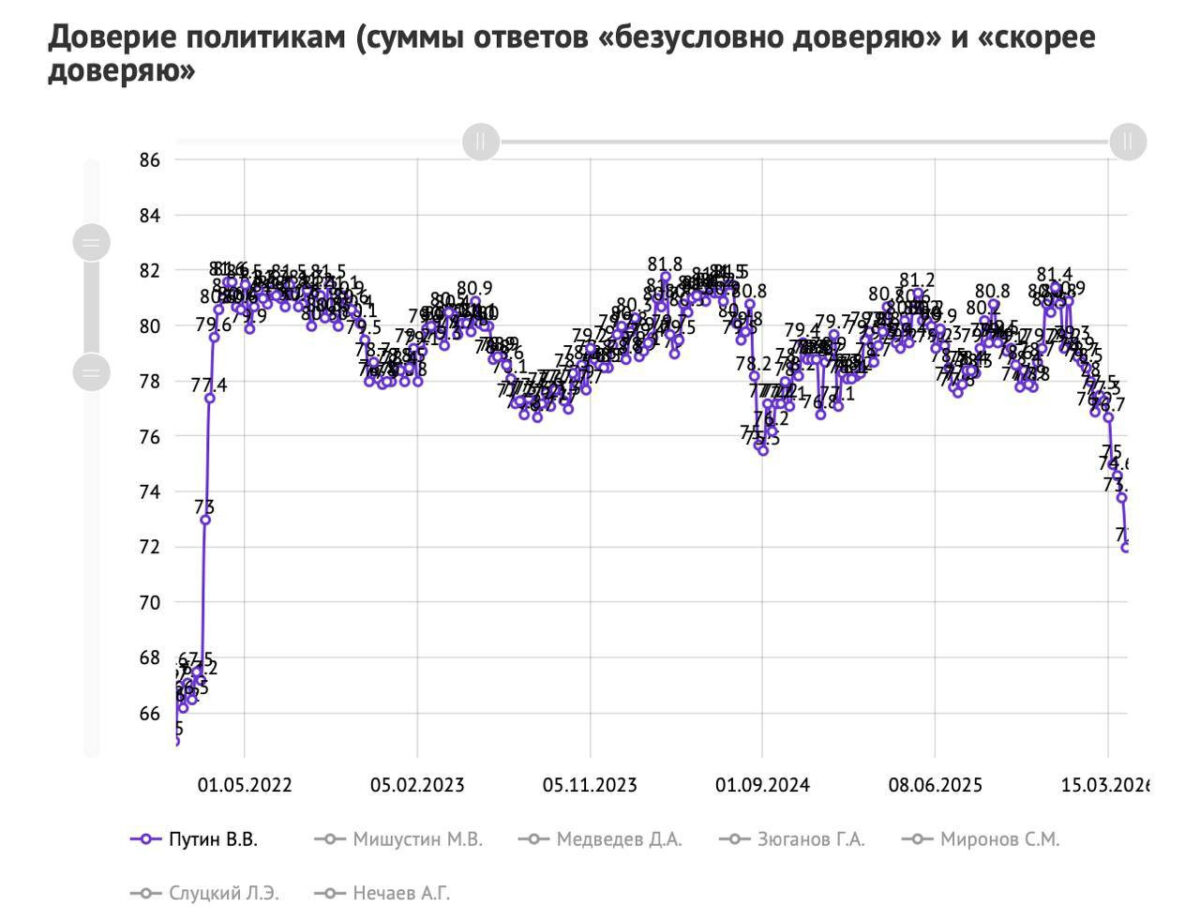
Of course, all the problems are caused by the war and its enormous costs, as well as by the sanctions imposed on Russia. After a long time, this is also beginning to be reflected in the trend of Putin’s personal ratings, which have been falling for six weeks in a row.
Although they are still at levels most politicians in Slovakia can only dream of, the downward trend is unmistakable. Moreover, it is virtually certain that even these figures are distorted by fear of expressing an opinion in a repressive regime, and Putin’s real support is even lower.
Note that the following graph is manipulative, because the vertical axis does not start at zero, as it should, but below 66 percent. Its author wanted Putin’s numbers to look worse than they actually are according to the poll. What can be read from it, however, is the fact that they are starting to return to the level they were at before the invasion of Ukraine began.
Donetsk is no longer a safe city for Russians – Ukrainian drones fly freely over it. The war is currently in a phase in which far more developments are taking place in the rear than directly on the front line.
Whereas at the beginning of the year there was a critical situation in the Ukrainian rear, with Russian drones equipped with Starlink attacking the defenders’ supply routes at distances of more than 50 km, the situation has now completely reversed and it is the Russians who have a very serious problem.
It is perfectly symbolised by a video published on Thursday by the 1st Azov Corps. It is a montage showing several types of situations: in addition to the traditional strikes on Russian army trucks, we can see Ukrainian drones freely flying over the city and the famous Shakhtar Donetsk stadium, which hosted the 2012 European Football Championship.
Thanks to a flight over such a landmark, it is possible to pinpoint very precisely how far from the front Ukrainian drones are already operating. The stadium lies 65 km in a straight line from the northern edge of the village of Hryshyne near Pokrovsk, where the leading Russian units are currently positioned, 54 km from the southern outskirts of Kostiantynivka, and 59 km from the village of Shakhove in the Dobropillia sector.
It is not known exactly where the drones that recorded the videos took off from, but in every case it means they are already able to control the Russian rear to a depth of 60 km and more.
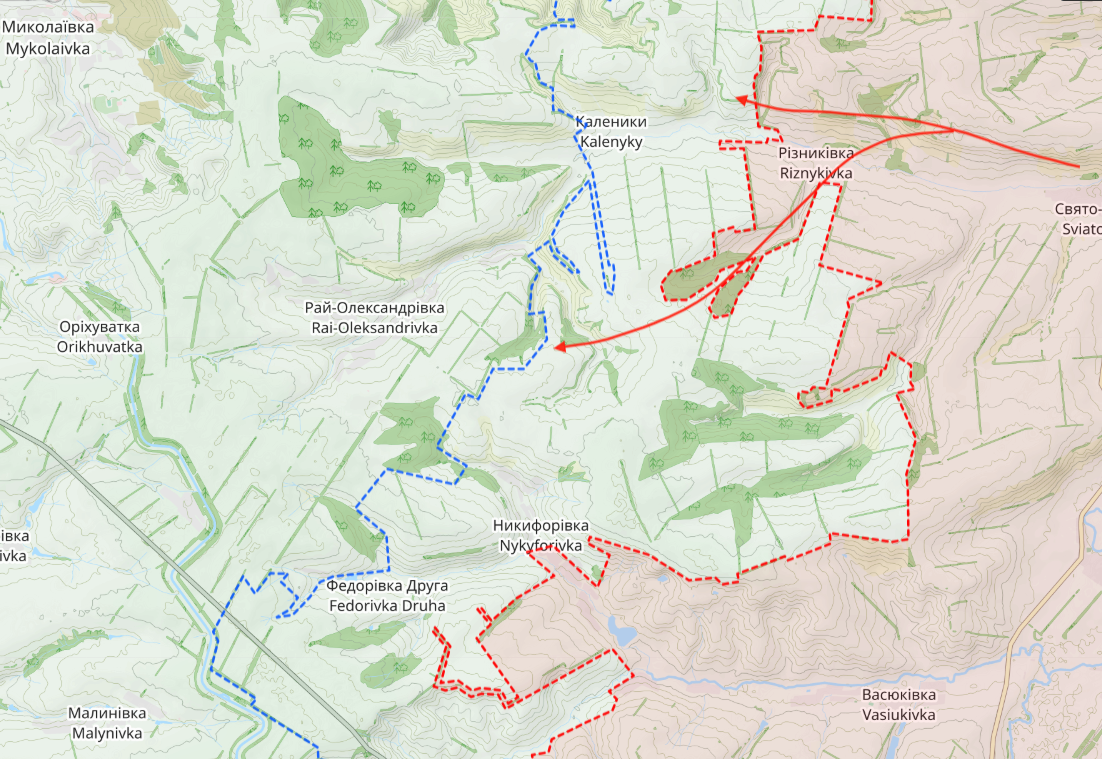
Russian forces moved closer to Rai-Oleksandrivka on the Sloviansk axis. The Russian attack towards Sloviansk is continuing with limited results, but the situation is nevertheless slowly deteriorating.
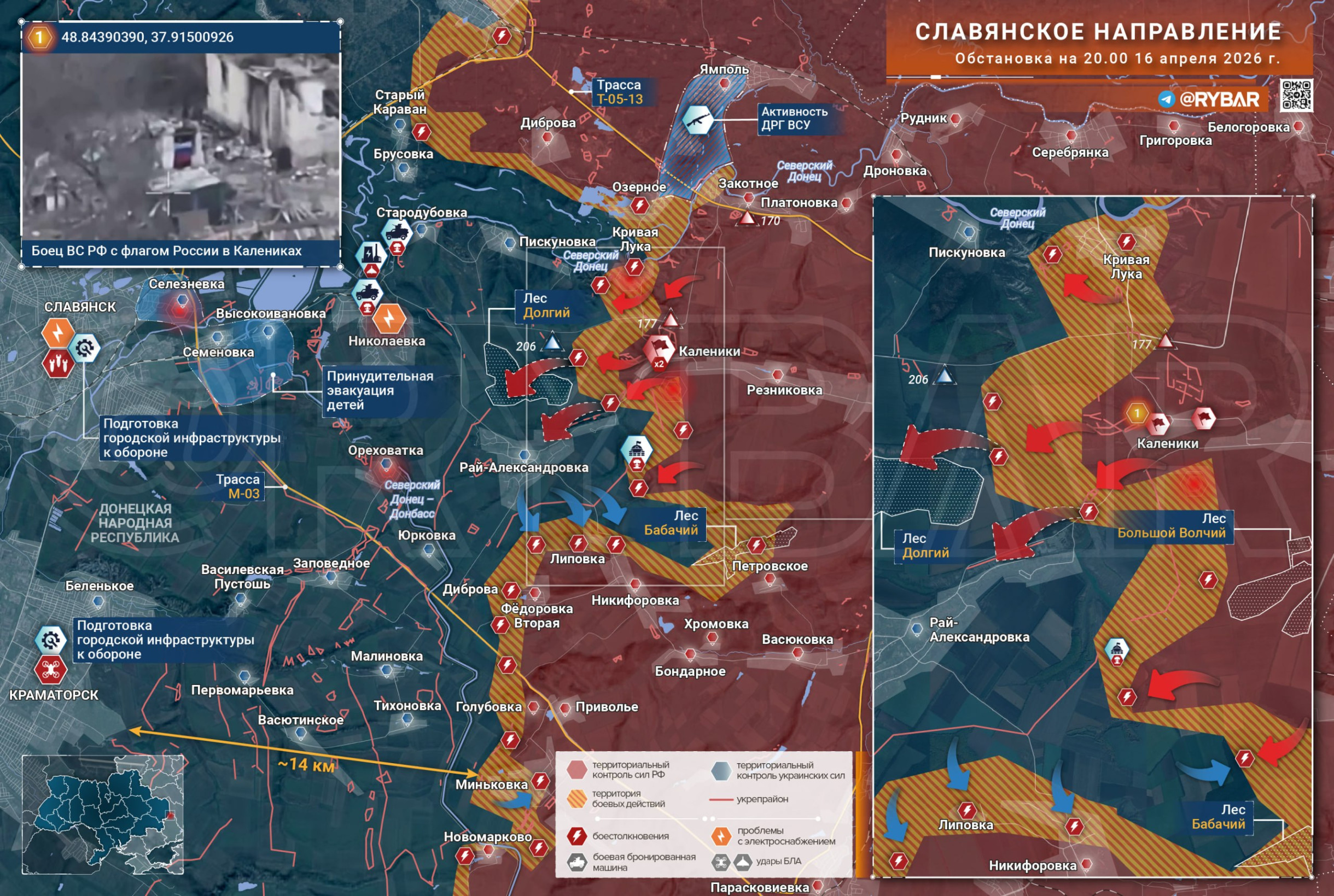
“On the Sloviansk axis, Russian troops are fighting along the Kryva Luka–Kalenyky line. Judging by recently published footage showing members of the 6th Cossack Brigade raising Russian flags in Kalenyky, units of the Southern Group of Forces have gained a firm foothold in this village.
This means the definitive creation of a bridgehead for a future offensive aimed at encircling the village of Rai-Oleksandrivka. This village is the last important transport hub of the enemy on this bank of the Siverskyi Donets–Donbas canal,” the Russian outlet Rybar wrote.
The raising of the Russian flag in Kalenyky has also been confirmed by independent sources. For example, the OSINT account Ukraine Control Map published its map with the precise geolocation of where this happened:
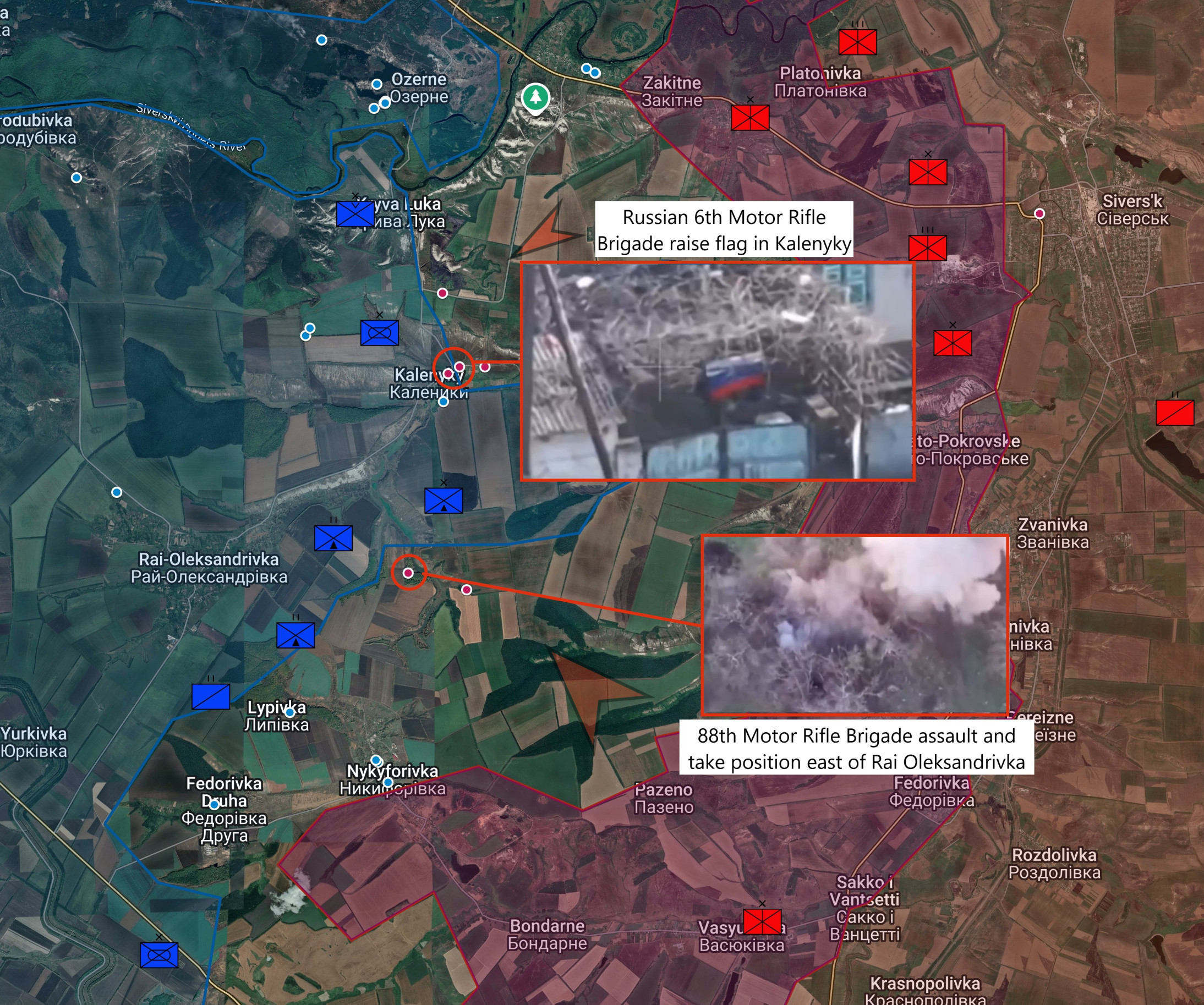
As is usually the case with flag-raising, one has to be cautious about drawing conclusions. The Russians routinely create the impression that they have captured a village when in reality they are still far from it. Even now, on Rybar’s map above, you can see that Kalenyky is already marked as occupied and the author has shifted the front line significantly to the west. As a result, it really looks as if Rai-Oleksandrivka has already been cut off from three sides.
However, the map by the Finns from the Black Bird Group, updated on Thursday shortly before midnight, shows nothing of the sort.
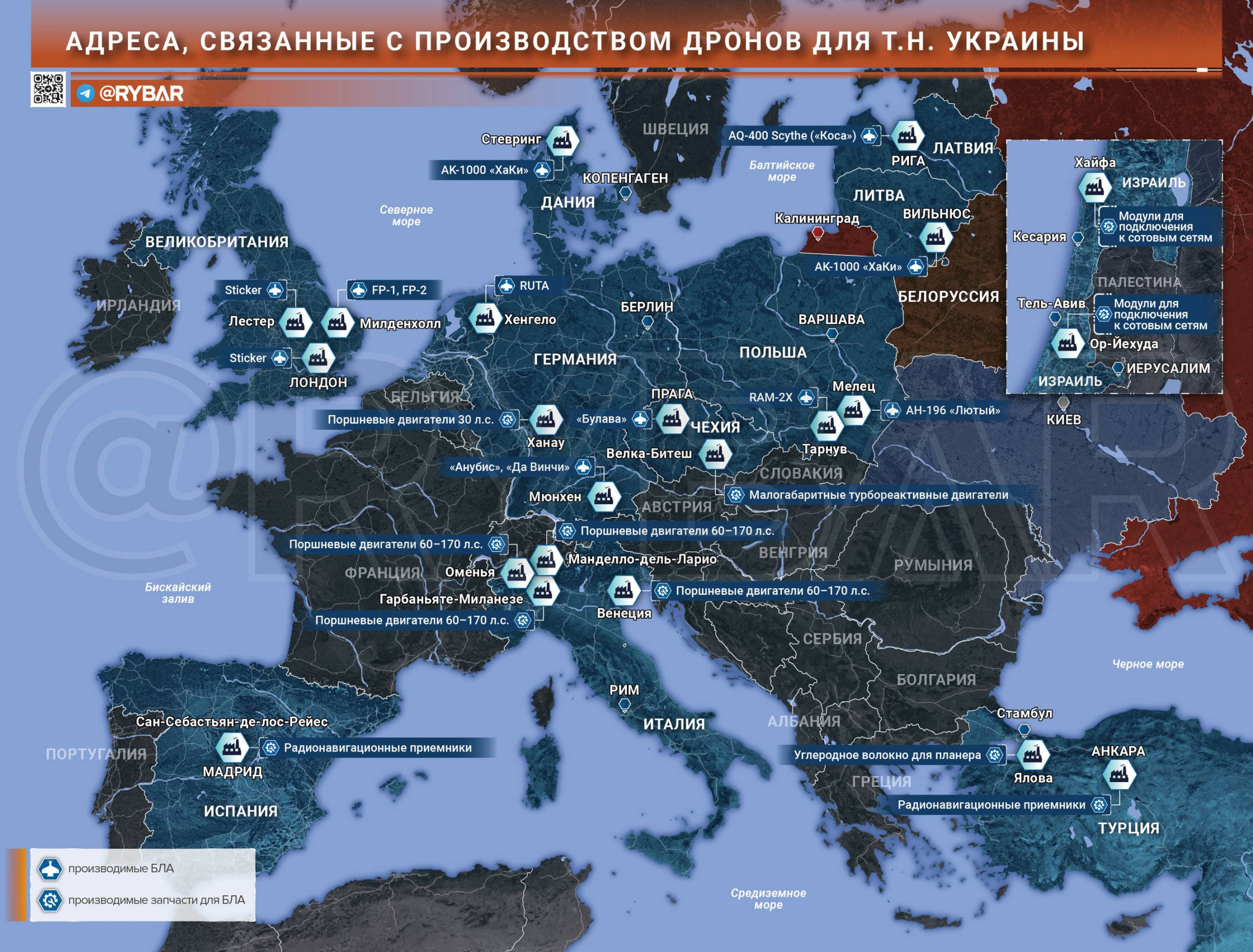
The Moscow defence ministry published a map of European cities where components of Ukrainian drones are manufactured. This was accompanied by more or less explicit hints that they were legitimate targets for Russian weapons, as well as open complaints from the so‑called Z‑channels – influential pro-war bloggers – that nothing would come of it anyway, even though it should.
There is no Slovak city on the map, even though Slovakia is among the key suppliers of artillery ammunition, but Prague (Bulava drones) and Velká Bíteš (small jet engines) are included.
Russia is now using drones even to drop leaflets – their content will not change the war. There are so many unmanned aircraft that they are now being assigned side tasks that were not originally envisaged. This one dropped paper leaflets somewhere over Ukraine.
This is a traditional form of wartime propaganda, for which various means are used. At the beginning of the invasion, it was quite common for both armies to use special rockets fired from Grad multiple rocket launchers to distribute leaflets; instead of explosives, these carried bundles of paper in dedicated compartments.
Various Ukrainian accounts on Thursday published the image of a propaganda leaflet that soldiers found in the Sumy region. It bears the slogan “Aid to Ukraine is a thing of the past” and shows a crying Volodymyr Zelensky, with Donald Trump pointing at Iran.
The visual side is crude, and the content is no better. With the important exception of air-defence missiles, the problem for the Ukrainian army is not a lack of resources but a lack of people.
Moreover, the United States has not donated anything to Ukraine for more than a year; all assistance is being paid for by its European allies, who will continue to do so. Soldiers at the front know this very well.

Videos of the day
An Mi-24 in the typical Czech camouflage, donated to Ukraine, has become an “ace”. Dozens of symbols for downed unmanned aircraft and other missions are clear proof that donated weapons are helping to defend Ukraine and its inhabitants.
It is becoming standard by now – drones once again destroyed elements of Russian air defence.
Few things say more about the importance of drone operators than such videos. The Ukrainian air force sent an aircraft with guided munitions against a building where reconnaissance had identified their base.
A Ukrainian F-16 takes off from a Belgian airfield. According to available information, it is an aircraft that has undergone repairs.
What are the losses
As of Friday morning, without an update.
-
By Monday morning, Russia had demonstrably lost 24,440 pieces of heavy equipment (24,383 on Monday 30 March). Of these, 19,079 (19,028) pieces were destroyed by the Ukrainians, 975 (971) were damaged, 1,205 (1,204) were abandoned by their crews and 3,181 (3,180) were captured by the Ukrainian army. This includes 4,381 (4,371) tanks, of which 3,284 (3,276) were destroyed in combat.
-
Ukraine has lost 11,923 (11,697) pieces of equipment, of which 9,175 (9,027) were destroyed, 668 (656) damaged, 666 (661) abandoned and 1,414 (1,404) captured. This includes 1,412 (1,401) tanks, of which 1,078 (1,071) were destroyed in combat.
Note: Neither side regularly reports on its dead or its destroyed equipment. Ukraine publishes daily figures for Russian casualties and destroyed equipment, which cannot be independently verified. In this overview we use data from the Oryx project which, since the beginning of the war, has compiled a list of equipment losses that are documented exclusively by photographs.