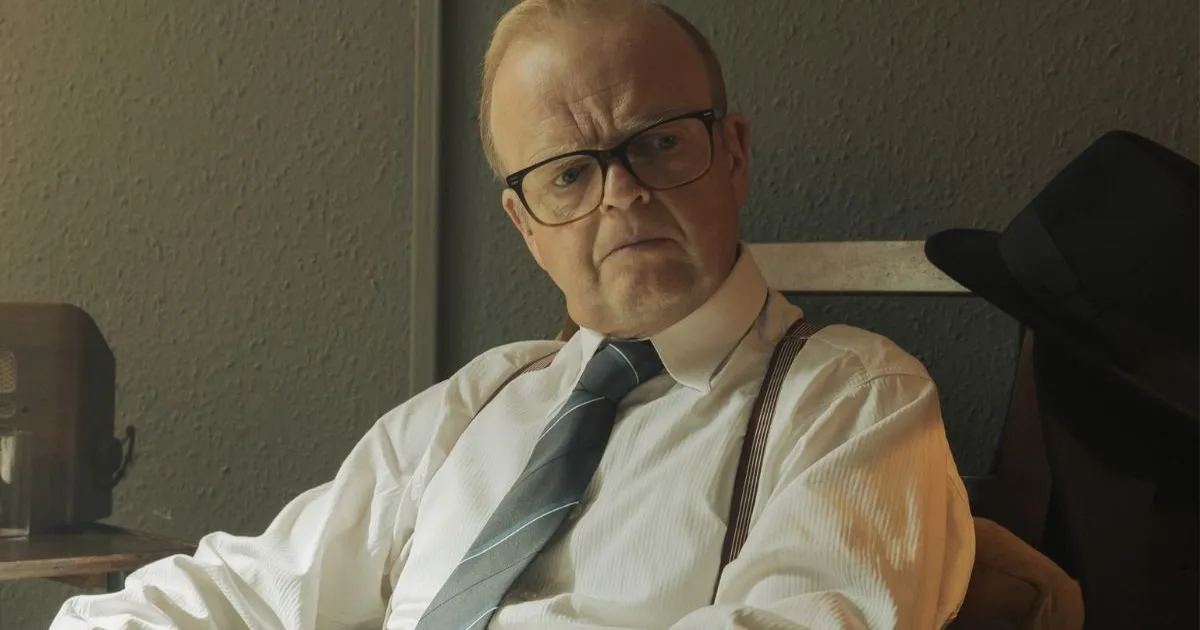
ComingSoon Senior Editor Brandon Schreur spoke to Mr. Burton actor Toby Jones about the new dramatic biopic movie. Jones discussed what he learned about iconic actor Richard Burton while making the movie, why it’s exciting that the movie got released in the United States at this time, and more.
“The true story of how Port Talbot schoolmaster Philip Burton inspired his young pupil Richard Jenkins – setting him on a path to becoming the greatest star Wales has ever produced,” the official synopsis reads.
Mr. Burton is now available to watch on various digital platforms.
Brandon Schreur: Before I ask you anything, I just wanted to say congratulations on this movie, Mr. Burton. I watched it about a week ago, and I loved it. It’s really stuck with me since then.
Toby Jones: Thank you! It’s a surprisingly dark film, isn’t it? You think it’s going to be kind of a benign, ‘teach a pupil’ story. And it has something much darker going on, I think, underneath it. I think that takes people by surprise in the film, a bit.
Oh, totally. I mean, I knew a little bit about Richard Burton before watching this, but I love the act of learning about him through this movie while exploring where the actual script takes the audience — I thought it was really well done how it presents all the information in here.
Excellent.
I’d love to start just by asking how it was that you got involved with this project. What’s the story of how you got cast in Mr. Burton, and what was it that really made you want to be part of this movie?
So Marc Evans, the director, approached me maybe six years ago, and he said we’ve got a very Welsh movie. He spent his life directing specifically Welsh stories. And he approached me to play the part. I think, at that point, he didn’t realize that I wasn’t Welsh, even though my name is Jones. I read the script, and I really liked it, but my fingers were crossed as to whether it could be made. It’s such a delicate, small story. Which doesn’t mean it doesn’t have big implications, but it’s the kind of biopic where you hope they’ll find a way to get it made.
Over six years, they did, and I stuck with it. Yeah, what can I say? There was a hunt for who was going to play Richard Jenkins — a lot of the time in waiting was about trying to find a young actor, or an actor who could seem that young, to play that part. Which is not obvious. Obviously, for people of that generation, they don’t really know who Richard Jenkins Burton was. I grew up with Burton as a massive part of my life; not because I’d seen him on stage, but just because I’d seen him on screen. But also, because of celebrity pages of things. He was such a sort of overwhelming figure. Nowadays, people just haven’t even heard of him. It’s an extraordinary thing.
To find a young actor who could then get into that persona and understand the power of that voice. And understand the impact of that personality. That’s what took the time. So, as the years went by, I was hoping — certain actors got too old. It’s just that usual thing of trying to hunt down the right person at the right time.
That makes total sense. You touched on something that I wanted to ask you about, too. A movie like this, Mr. Burton, can feel like such a gift. I mean, don’t get me wrong, I love the big blockbusters and I love the superhero movies, but I’m also well aware that a smaller budget biopic like this can be hard to get made in a world where IP dominates everything. And the fact that it’s coming out now is pretty awesome, too; I feel like movies like this tend to be released from October through January for awards season, and then there’s a dry spell for eight months where we don’t get these kinds of movies. How exciting is it for you to be part of a project like this that’s coming out now, and what do you ultimately hope people get out of watching Mr. Burton?
Well, here’s the thing, Brandon. As an actor, I’m interested in acting in the best material that I can find. Or the best material that gets offered to me. Really, I’m kind of selfish in that way. Of course, you want it to go out and find an audience. But, in a way, my enjoyment comes from just making the film. I think, at times, with these smaller movies, they can sometimes just disappear. As you said, the noise created by bigger marketing budgets means things get swamped. It becomes very important when and how you release these things.
It was released here to coincide with Richard Burton’s 100th birthday. So, it was part of a series of things that were celebrating that. So that was fortuitous — well, it wasn’t fortuitous, it was deliberately done.
I think it’s a shame, personally, that films all get bunched up in a way. It didn’t used to be like that, but everything has become about awards. Because awards, in a way, are another sort of way of marketing a film. So they all bunch up like that. Yeah, it’s great that it’s getting released in America. I hope it finds its audience. If not immediately, I hope it gradually gets discovered as people hear about it and word of mouth spreads. That’s my hope.
Yeah, for sure. Like I said, I watched it about a week ago, and I’ve been telling people I know that this is one they’re going to want to check out. This is a good one.
Good, good, I’m glad.
So you’re obviously playing Mr. Philip Burton in this movie. He’s such an interesting, inspiring character. Obviously, this is all based on real life; both Philip and Richard Burton were real people. But what excited you the most about getting to portray this character? When you read the script for the first time, was there an aspect of him that really jumped out to you and made you excited to explore in your performance?
I think it’s easy to think, when one has seen the film and the events of this film — and, indeed, when one watches the film from start to end — that you’re dealing with a character, or a man, who lives a slightly — there’s a pathos about him because he lives a solitary life. And his sexuality seems unfulfilled. He seems like, in some way, by the end of the film — spoiler alert — but his adoption of Richard Jenkins. And Richard Jenkins subsequent ascendancy. [There’s an assumption] that he might be left behind. What’s extraordinary is that, when one reads about Philip Burton, he went on to form a drama school in the States, in New York, which is still there. He set that up.
And then, he accompanied Burton throughout the rest of his life; he was friends with Burton and [Elizabeth] Taylor. Also, he was sort of a counselor and advisor; he was also in rehearsals throughout Burton’s career. Then, he obviously outlived Richard Burton, who died tragically young.
Also, he came out successfully in Florida. He lived in Florida and had a very happy, fulfilled, and long life. That, I think, is kind of — I found that very intriguing. So, when I came to play the part, I wanted to suggest there was nothing pathetic about this man. That his love of literature, his love of acting, and his love of teaching — these three passions that he had nourished and fueled his view of the world at large. I think that’s what I loved about the film, in a way. It’s easy to write him off as a tragic character to begin with, because he’s an apparently lonely man living in a boarding house. But, actually, he has this huge emotional landscape within him that we discover throughout the film. That happened in his subsequent biography, as well. So, in many ways, what happened to him later fueled my understanding of him at the beginning of this film.
That makes total sense. It jumps into my next question, too, because, while talking to you, it sounds like you know a lot about Richard Burton and Philip Burton in regard to who they were. But was there anything you felt like you learned during the process of making this movie about Richard Burton? Whether it’s something factual or just a perspective of his life that you didn’t fully realize, did you come away from this experience feeling like you knew more about who Richard Burton was?
Oh, absolutely. I think there’s something about what happens in this film — it’s sort of unimaginable, nowadays, in terms of what happens or what Philip Burton does for Richard Burton. Yes, he’s an inspirational teacher, and some of us are lucky enough to have inspirational teachers. But, again, spoiler alert, the relationship they have, and how it develops, you can’t quite believe that this was the origin story of Richard Burton. It’s like out of a novel, this relationship, or this exchange and bargain that happens between the two fathers that Richard Jenkins has. It feels like this must belong to a 19th-century Thomas Hardy novel or something. It feels incredible. I certainly didn’t know anything about that.
But, also, that he had so many brothers and sisters that his sister, effectively, became his mother. I didn’t know anything about that. The sheer contrast of what we now know about Burton and the astronomical wealth he earned in his lifetime, compared to the abject poverty — by which I don’t mean sadness, because I think he had a very happy childhood. But the poverty that he lived in, that contrast, I didn’t really understand the sheer scale of that. That feels very much of its time.
And it’s very close to my heart. My father was an actor, and he came from a mining town in the 1950s and became an actor. Those stories, those sort of very British stories of social mobility through acting, you don’t hear about them quite as much as you used to. I think it’s of interest to people to see how acting and the arts used to be a passage out of economic instability.
Thanks to Toby Jones for taking the time to discuss Mr. Burton.