Key Points
-
Over the last year, Nvidia has used its record profits to make a number of strategic investments.
-
In late 2025, Nvidia invested $1 billion into Nokia — bringing AI out of data centers and toward edge devices.
-
While Marvell stands to benefit greatly from its ties to Nvidia, Nokia might be the real winner from this new deal.
- 10 stocks we like better than Nvidia ›
Most investors chasing the artificial intelligence (AI) theme have made Nvidia (NASDAQ: NVDA) a cornerstone of their portfolio. The savviest investors have complemented mainstream big tech players with Marvell Technology (NASDAQ: MRVL) given the company’s role in high-speed data center fabrics.
While market-beating gains have already been generated from the Nvidia-Marvell combination, a quieter beneficiary is emerging at the edge of the AI network. Enter Nokia (NYSE: NOK), a long-dismissed telecom equipment manufacturer whose stock barely twitched until recently.
Will AI create the world’s first trillionaire? Our team just released a report on the one little-known company, called an “Indispensable Monopoly” providing the critical technology Nvidia and Intel both need. Continue »
Below, I’ll break down why Nokia stands to capture outsized gains from the same AI infrastructure supercycle supporting Nvidia and Marvell.
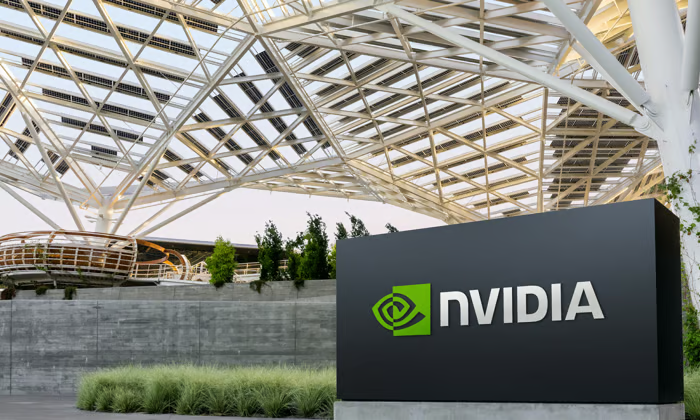
Image source: Nvidia.
NVLink Fusion powers the AI core that Nokia serves at the edge
A few weeks ago, Nvidia announced that it was investing $2 billion into Marvell as part of a broader strategic partnership. The relationship with Marvell highlights Nvidia’s commitment to bringing ultralow-latency, high-bandwidth interconnects inside AI clusters featuring its graphics processing units (GPUs).
The company’s NVLink Fusion ecosystem allows data centers to move workloads faster and more efficiently across hundreds of thousands of GPUs — accelerating the training and inference demands that support generative and agentic AI applications.
This infrastructure is vital for scaling models like ChatGPT and Claude, both of which experience heavy utilization from mobile devices. As models become faster and cheaper, growth in downstream AI demand from mobile devices is poised to explode. While Marvell and Nokia win the core architecture, the spillover traffic flows outward.
Nokia’s AI-RAN platform turns mobile traffic into monetizable 6G intelligence
In late 2025, Nvidia announced that it was investing $1 billion into Nokia in an effort to embed its Aerial RAN Computer (ARC) Pro platform into Nokia’s RAN portfolio. The vision is to create a software-defined, AI-native radio access network that bridges connectivity, accelerated computing, and sensing at the base layer.
Per the terms of the partnership, T-Mobile is scheduled to begin field trials this year, while Dell Technologies supplies PowerEdge servers. This architecture is designed for Nokia’s stack to seamlessly upgrade from 5G-Advanced to full 6G. The idea is that by leveraging Nvidia’s ecosystem, Nokia turns from an AI traffic carrier into a more comprehensive grid at the edge where latency, data sovereignty, and physical-world sensing matter most.
Nokia is strongly positioned for AI’s next frontier.
Tucking Nvidia’s NVLink Fusion ecosystem into Marvell’s underlying architecture adds a new pillar supporting the acceleration of data center factory build-outs. Meanwhile, Nokia’s AI-RAN unlocks the factory doors to billions of devices, including smartphones, satellites, drones, robots, and autonomous systems.
The proliferation of physical AI is why the AI RAN market is estimated to reach $200 billion by 2030. Nokia should no longer be viewed as a commoditized telecom provider. Instead, the company’s next upgrade cycle will be fueled by last-mile monetization layers for the AI economy.
While Wall Street continues to hone in on the visible GPU and networking winners, Nokia’s stock will likely remain unnoticed precisely because its transformation is viewed through the lens of a low-margin telecom operation rather than a direct beneficiary of the ongoing AI infrastructure boom.
Investors who already own Nvidia and Marvell for the data center narrative can easily complement their portfolio with adjacent players such as Nokia to better own the full AI value chain — from model training all the way down to the pockets of consumers.
Indeed, investing in Nokia looks boring on the surface. But in an AI realm that is expanding beyond data centers and heading toward edge devices, it is the stealth pick-and-shovel plays that will turn Nvidia and Marvell’s gains into real-world scale elsewhere.
Should you buy stock in Nvidia right now?
Before you buy stock in Nvidia, consider this:
The Motley Fool Stock Advisor analyst team just identified what they believe are the 10 best stocks for investors to buy now… and Nvidia wasn’t one of them. The 10 stocks that made the cut could produce monster returns in the coming years.
Consider when Netflix made this list on December 17, 2004… if you invested $1,000 at the time of our recommendation, you’d have $573,160!* Or when Nvidia made this list on April 15, 2005… if you invested $1,000 at the time of our recommendation, you’d have $1,204,712!*
Now, it’s worth noting Stock Advisor’s total average return is 1,002% — a market-crushing outperformance compared to 195% for the S&P 500. Don’t miss the latest top 10 list, available with Stock Advisor, and join an investing community built by individual investors for individual investors.
*Stock Advisor returns as of April 15, 2026.
Adam Spatacco has positions in Nvidia. The Motley Fool has positions in and recommends Marvell Technology and Nvidia. The Motley Fool recommends T-Mobile US. The Motley Fool has a disclosure policy.
The views and opinions expressed herein are the views and opinions of the author and do not necessarily reflect those of Nasdaq, Inc.