The Trump administration on Wednesday lifted sanctions against Venezuela’s interim president, Delcy Rodríguez, easing Washington’s path to deepen cooperation with Caracas to expand oil output and American foreign investment.
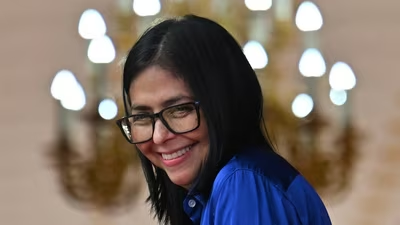
Venezuela’s interim President Delcy Rodriguez.
Her removal from the sanctions list of the U.S. Treasury Office of Foreign Assets Control ends prohibitions barring Americans from doing business with her at the risk of facing civil or criminal penalties.
Rodríguez, 56, praised the decision as “a significant step in the right direction” to normalize relations with the U.S. She has called on the U.S. to end sanctions against other Venezuelan officials and state entities. Rodriguez took over after U.S. commandos removed strongman Nicolás Maduro from power and flew him to New York to face drug-trafficking charges.
“We trust that this progress and determination will ultimately lead to the lifting of the additional active sanctions on our country that will allow for rapid economic development, investment, and an effective bilateral cooperation agenda for the benefit of our peoples,” she posted on X in English.
For now, only Rodríguez has been delisted. Other former Maduro officials remain under U.S. sanctions, and some face criminal drug-trafficking charges in cases built by American prosecutors.
The end of sanctions against Rodríguez comes as Venezuelan diplomats have arrived in Washington to reopen the country’s embassy, closed since 2019, and meet with State Department officials. It also comes a day after Secretary of State Marco Rubio met with Venezuelan opposition leader María Corina Machado, who has called Rodríguez a communist who is “afraid of Trump.”
Rodríguez is trying to prod the Trump administration into positioning itself against Venezuela’s political opposition, which had long enjoyed U.S. support and wants American officials to pressure the interim government into an election. Polls show Machado would easily beat Rodríguez in a vote.
Rubio said on Fox’s “Hannity” show Tuesday that there will have to be a transition phase and free and fair elections in Venezuela.
“It’s not forever, but we have to be patient,” he said. “I feel very good about the progress we’ve made in Venezuela in three months.”
Rodríguez, who served as Maduro’s vice president, was originally sanctioned by the U.S. Treasury in 2018 as part of a broader effort to target senior officials in Maduro’s inner circle.
Since then, Trump has frequently praised the working relationship with the former Maduro loyalist—he calls her “terrific” and “very good to deal with”—and held up his handling of Venezuela as a foreign policy success.
U.S. officials have said that they are implementing a three-part plan for Venezuela that focuses on stabilizing the economy and securing access for American companies to vast energy and mineral resources before working toward a democratic transition.
In recent weeks, executives from dozens of U.S. energy and mining companies as well as large asset managers have traveled to Caracas to meet with Rodríguez and explore investment opportunities.
“This makes it easier for U.S. companies to negotiate with her and with her government,” said Geoff Ramsey, an expert on Venezuela, at the Atlantic Council. He called it “another baby step toward full normalization.”
He said regime figures who are sanctioned may now see the lifting of sanctions on the interim president as a sign they could be next. “The big question is whether we’re getting anything in return that makes progress toward a genuine democratic transition,” Ramsey said.