Scientists at the University of Science and Technology of China (USTC) said their Jiuzhang 4.0 quantum computer solved a Gaussian boson sampling problem more than 10 to the 54th times faster than the world’s most powerful supercomputer, setting a new record in optical quantum computing, according to a study published last week in the journal Nature.
Lu Chaoyang, a professor at USTC, said the team developed a highly efficient optical parametric oscillation light source along with a hybrid space-time multiplexed interferometer.
By integrating 1,024 high-performance squeezed-state optical fields into an 8,176-mode hybrid space-time multiplexing circuit, the researchers were able to control and detect up to 3,050 photons, according to the Chinese Academy of Sciences.
This was a major improvement from the 255 photons achieved by its predecessor, Jiuzhang 3.0, in 2023.
“This means that the most complex data sample generated by ‘Jiuzhang 4.0’ takes only 25 microseconds to produce — shorter than the blink of an eye. In contrast, the world’s most powerful supercomputer would require more than 10 to the 42nd years to calculate the same result,” Lu said, as quoted by Xinhua.
 |
|
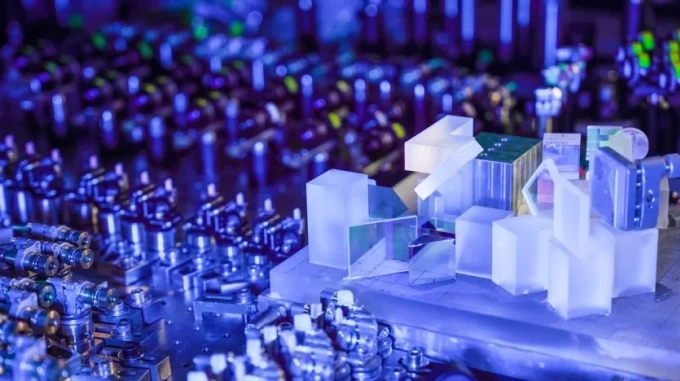
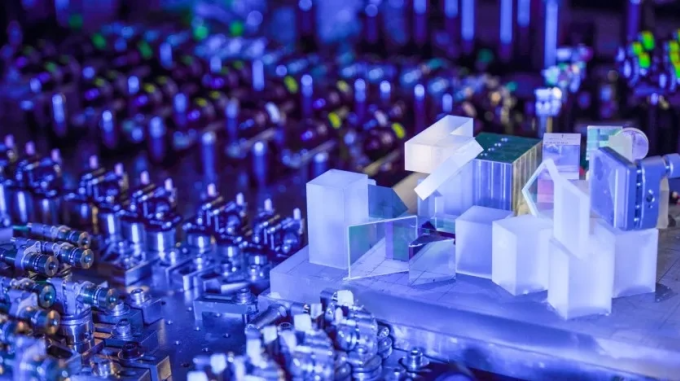
The Jiuzhang 4.0 quantum computer developed by scientists at the University of Science and Technology of China. Photo courtesy of USTC |
A quantum computer works based on the laws of quantum mechanics. Its basic unit, known as a quantum bit or qubit, can exist as both 0 and 1 at the same time, unlike a traditional computer bit, which can only be 0 or 1.
This allows quantum computers to process many possible solutions at once, making them much faster for certain tasks such as solving mathematical problems and simulating quantum systems.
The main quantum computing approaches today include superconducting, ion trap, photonic and neutral atom systems.
The Jiuzhang series belongs to photonic quantum computing, which stores information using photons, or particles of light. Its speed depends on how effectively those photons can be controlled and manipulated, according to China Daily.
USTC first developed the Jiuzhang photonic quantum computer prototype with 76 photons in 2020, making China the second country after the U.S. to achieve quantum computational advantage, when a quantum computer outperforms a traditional one, and the first to do so in an optical system.