
Key Points
-
Baupost Group has historically been known for its value investing approach.
-
The fund generated 20% annualized returns in its first 26 years.
-
In the fourth quarter of 2025, Baupost Group significantly increased its position in a company that has lost the confidence of its investor base.
- 10 stocks we like better than Fiserv ›
Legendary billionaire investor Seth Klarman needs no introduction. In 1982, Klarman teamed up with Harvard professor William Poorvu, Howard Stevenson, Jordan Baruch, and Isaac Auerbach to form Baupost Group, a fund with a nearly $5.3 billion public equities portfolio at the end of 2025.
Klarman and his team are value investors at heart. For instance, Baupost Group purchased the bonds of distressed banks during the heart of the Great Recession. In the fund’s first 26 years, Baupost Group generated 20% annualized returns, although returns have not been nearly as good since 2014, according to Bloomberg. Still, most investors pay close attention to Klarman when he appears on CNBC or comments on the market.
Will AI create the world’s first trillionaire? Our team just released a report on the one little-known company, called an “Indispensable Monopoly” providing the critical technology Nvidia and Intel both need. Continue »
In the fourth quarter of 2025, Baupost Group sold over 40% of its stake in Alphabet (NASDAQ: GOOG)(NASDAQ: GOOGL) and piled into an embattled fintech stock down 75% over the past year.
Image source: Getty Images.
Trimming Alphabet after a big run
While Baupost Group trimmed its stake in Alphabet by 41%, the company remains in the top 10 stocks of the portfolio. After the big year Alphabet had in 2025, trimming perhaps makes sense for a value investor.
Heading into last year, Alphabet faced several headwinds, which made it the value play in the “Magnificent Seven.” For one, Google faced a high-profile lawsuit from the U.S. Department of Justice (DOJ) for engaging in monopolistic practices in its search and digital advertising businesses, which are the company’s largest revenue generators by far.
A federal judge agreed with the DOJ’s assessment that Google had operated as a monopoly. However, the judge stopped short of forcing Google to divest its Chrome web browser. It also essentially said Google could keep paying Apple to make Google the default engine for Safari.
The other big challenge for Alphabet was proving that it could develop strong enough artificial intelligence models to keep up with the new AI chatbots and maintain its dominance of the traditional search market. The company’s AI overviews at the top of most Google search queries and Gemini AI models managed to achieve this, and Alphabet’s stock is up 70% in the past year.
Klarman and Baupost Group are likely locking in some gains.
This historically strong fintech stock stunned the market last year — in a bad way
Arguably, Baupost Group’s most interesting move last quarter was its decision to increase its stake in the financial technology company Fiserv (NASDAQ: FISV) by 146%. Fiserv builds and deploys core processing technology that powers banks’ daily operations, and the company also owns the point-of-sale payment processor Clover.
Until last year, Fiserv was one of those set-it-and-forget-it stocks.
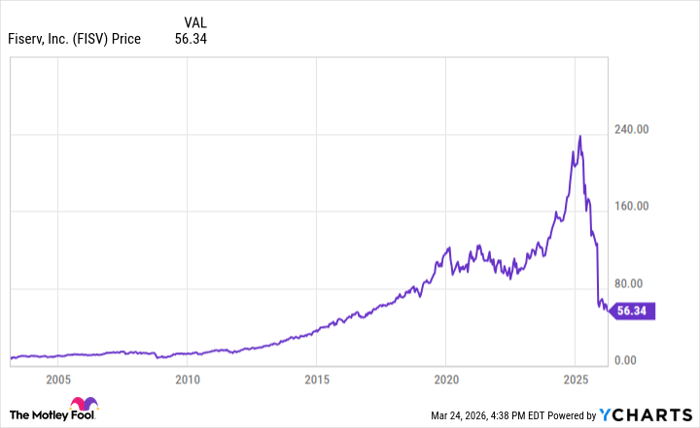
But everything changed when the company reported results well short of expectations in the third quarter of 2025, while significantly lowering its full-year guidance and resetting expectations for the company. Fiserv said it expected full-year earnings of about $8.55 per share, down from a previous forecast of roughly $10.23.
The stock cratered 44% in a single day.
The issue was two-fold: The company had been too aggressive with its guidance on Clover, and the banking business appeared to be struggling, as bank customers sought core processing solutions that were more nimble and would allow the company to innovate with new technology much faster.
Subsequent media reports suggested that Clover customers had revolted over excessive fees. They also suggested that Fiserv had been sued for allegedly migrating small-business customers from its older payments platform to Clover, and then leading investors to believe this was organic growth.
Still, Fiserv now has a relatively new CEO, Mike Lyons, who seems committed to making things right with customers and shareholders. The company also still has a strong position in the bank core processing and point-of-sale payments spaces.
It’s undoubtedly going to take strong performance from Fiserv management to regain the trust of its investor base, which was caught flat-footed by this whole mess. But if they can pull it off, the stock has tremendous upside. Fiserv currently trades at less than 7 times forward earnings. The company has historically traded at 30 times earnings, and often at much higher multiples, so it’s easy to see why Klarman might be interested.
I think investors can either make a small, speculative investment now, or wait for more proof that the company is making progress in improving performance and regaining investor trust.
Should you buy stock in Fiserv right now?
Before you buy stock in Fiserv, consider this:
The Motley Fool Stock Advisor analyst team just identified what they believe are the 10 best stocks for investors to buy now… and Fiserv wasn’t one of them. The 10 stocks that made the cut could produce monster returns in the coming years.
Consider when Netflix made this list on December 17, 2004… if you invested $1,000 at the time of our recommendation, you’d have $490,325!* Or when Nvidia made this list on April 15, 2005… if you invested $1,000 at the time of our recommendation, you’d have $1,074,070!*
Now, it’s worth noting Stock Advisor’s total average return is 900% — a market-crushing outperformance compared to 184% for the S&P 500. Don’t miss the latest top 10 list, available with Stock Advisor, and join an investing community built by individual investors for individual investors.
*Stock Advisor returns as of March 26, 2026.
Bram Berkowitz has no position in any of the stocks mentioned. The Motley Fool has positions in and recommends Alphabet and Apple and is short shares of Apple. The Motley Fool has a disclosure policy.
The views and opinions expressed herein are the views and opinions of the author and do not necessarily reflect those of Nasdaq, Inc.