Earlier this year, several major international financial institutions expanded investments into AI-driven trading infrastructure as volatility surged across stock and forex markets. Financial media coverage throughout 2025 and 2026 increasingly highlighted how machine learning and algorithmic execution are reshaping modern trading environments, especially as AI-related equities continued dominating market momentum.
The shift is becoming increasingly visible at the retail level as well. More traders are now turning toward AI trading bots to automate execution, reduce emotional decision-making, and respond faster to rapidly changing market conditions.
But not all AI trading platforms operate at the same level. Some focus mainly on simple rule-based automation, while others are evolving into adaptive quantitative systems capable of reacting dynamically to volatility, liquidity changes, and macro-driven market behavior.
To help separate marketing claims from real trading infrastructure, this guide ranks the best AI trading bots for stock and forex trading in 2026 based on platform stability, automation quality, market adaptability, beginner accessibility, and long-term usability.
What are AI trading bots for stock and forex trading?
AI trading bots are automated systems that use artificial intelligence, quantitative models, and real-time market analysis to execute trades with minimal human intervention.
Modern AI trading platforms can continuously monitor:
- Market volatility
- Trend strength
- Liquidity conditions
- Technical indicators
- Cross-market correlations
- Real-time trading opportunities
These systems are now widely used across stock trading, forex trading, ETFs, commodities, and other financial markets to improve execution speed and reduce emotional trading mistakes.
Quick comparison table
| Platform | Best For | Overall Rating | Markets Supported | Beginner Friendly |
Free Trial / Bonus |
| BulkQuant | Overall AI Automation | 9.8/10 | Stocks, Forex | Yes | Yes |
| Trade Ideas | Active Stock Traders | 9.4/10 | Stocks | Moderate | Limited Trial |
| MetaTrader 5 | Forex Infrastructure | 9.3/10 | Forex, CFDs | Moderate | Depends on Broker |
| TrendSpider | AI Technical Analysis | 9.2/10 | Stocks, ETFs | Yes | Trial Available |
| Interactive Brokers | Professional Traders | 9.1/10 | Multi-Asset | Moderate | No |
| Capitalise.ai | No-Code Automation | 9.0/10 | Stocks, Forex | Yes | Free Access Options |
| Composer | AI Portfolio Investing | 8.9/10 | Stocks, ETFs | Yes | Limited Free Features |
| Cryptohopper | Strategy Customization | 8.8/10 | Crypto, Forex | Moderate | Trial Available |
| QuantConnect | Quant Developers | 8.7/10 | Multi-Asset | No | Free Tier |
| eToro CopyTrader | Social Trading | 8.6/10 | Stocks, Forex, Crypto | Yes | Demo Account |
| 3Commas | Flexible Automation | 8.5/10 | Crypto, Forex | Moderate | Trial Available |
| Pionex | Built-In Bot Ecosystem | 8.4/10 | Crypto | Yes | Free Bots |
| TradeStation | Hybrid Trading | 8.3/10 | Stocks, Options | Moderate | Limited Offers |
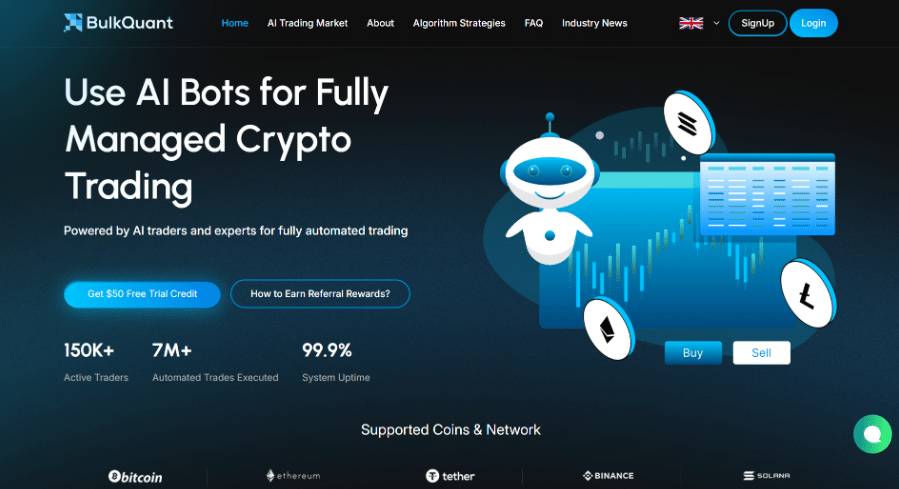
1. BulkQuant: Best overall AI trading bot for stocks and forex

Visit the official website to register and instantly claim your beginner rewards.
Platform rating: 9.8/10
Why BulkQuant is growing so quickly
BulkQuant has gained significant visibility in 2026 because it approaches AI trading differently from many traditional automation platforms.
Instead of focusing heavily on technical setup and manual optimization, the platform emphasizes simplified AI-powered execution designed for mainstream retail users.
That positioning matters because many traders entering AI trading today are not professional developers or quantitative analysts. They want automated execution without spending weeks configuring APIs, VPS systems, or complicated strategy environments. BulkQuant reduces much of that friction.
Where the platform performs best
One of the strongest aspects of BulkQuant is adaptive automation. The system continuously evaluates:
- Market volatility
- Liquidity shifts
- Trend persistence
- Cross-market correlations
- Intraday momentum behavior
This becomes especially valuable during unstable macro conditions where many static trading bots struggle to manage exposure efficiently.
Additional strengths include:
- Fully automated AI trading
- Real-time market monitoring
- Dynamic risk management systems
- Multi-market stock and forex support
- Beginner-friendly onboarding
- Mobile-first infrastructure
- No coding requirements
The platform feels significantly more accessible than many advanced automation environments currently dominating the industry.
Bonus and trial benefits
BulkQuant frequently offers:
- New user registration rewards
- Free AI trading trial credits
- Beginner onboarding incentives
- Promotional automation packages
These benefits make the platform easier to explore for first-time AI trading users.
One limitation to know
Traders seeking extremely deep manual customization or developer-level infrastructure may still prefer more advanced quantitative platforms like QuantConnect or Interactive Brokers integrations.
BulkQuant is clearly optimized more for automation accessibility than institutional-style strategy engineering.
2. Trade Ideas: Best AI trading bot for active stock traders

Platform rating: 9.4/10
Why active traders still use it
Trade Ideas remains one of the most recognized AI stock scanning platforms because it solves a real problem: modern stock markets move too fast for manual scanning alone. This became especially obvious during recent AI-sector rallies where momentum rotated aggressively between Nasdaq growth stocks within single trading sessions.
Where it performs best
Trade Ideas specializes in:
- Momentum acceleration
- Unusual volume activity
- Breakout detection
- Relative strength analysis
- Intraday volatility tracking
For active traders, speed matters.
The platform performs particularly well during:
- High-volatility earnings sessions
- AI-sector momentum rotations
- Fast-moving intraday breakouts
Day traders and momentum traders still represent its strongest user base.
Trial and educational features
Trade Ideas commonly include:
- Simulated trading access
- Limited free trials
- Educational content for active traders
Main weakness
Pricing remains relatively high compared with beginner-focused AI trading platforms. Casual investors may not fully utilize the platform’s advanced scanning infrastructure.
3. MetaTrader 5: Best forex trading infrastructure
Platform rating: 9.3/10
Why MT5 still dominates forex
Despite the rise of newer AI platforms, MetaTrader 5 continues dominating retail forex automation globally. The reason is simple: its ecosystem remains massive. A huge percentage of forex automated strategies still operate through MT5 infrastructure.
Best features for forex traders
MetaTrader 5 supports:
- Expert advisors (EAs)
- Advanced charting
- Multi-asset trading
- Custom strategy deployment
- High-frequency execution environments
For experienced forex traders, flexibility remains one of its biggest strengths.
Bonus and broker offers
Most MT5-related benefits depend on connected brokers, including:
- Free demo accounts
- VPS hosting promotions
- Deposit incentives
- Free EA integrations
What beginners often underestimate
MT5 can become highly technical. Many newer traders underestimate the complexity involved in:
- EA optimization
- VPS management
- Risk parameter configuration
The platform is powerful, but not especially beginner-friendly.
4. TrendSpider: Best AI technical analysis platform
Platform rating: 9.2/10
Why traders like TrendSpider
Most traders underestimate how much time they waste repeating the same chart analysis every day.
TrendSpider solves that problem unusually well.
Instead of focusing heavily on automated execution, the platform specializes in AI-assisted technical analysis.
Core strengths
TrendSpider automates:
- Trendline detection
- Multi-timeframe analysis
- Chart pattern recognition
- Support and resistance mapping
- Strategy backtesting
This significantly reduces manual analysis workload, especially for traders monitoring large watchlists.
Trial benefits
TrendSpider commonly offers:
- Trial access periods
- Educational webinars
- Strategy testing tools
Main drawback
The platform is excellent for market analysis, but traders looking for fully managed automated execution may still need additional infrastructure.
5. Interactive Brokers: Best for professional traders
Platform rating: 9.1/10
Why professionals still prefer IBKR
Interactive Brokers remains one of the strongest institutional-grade trading infrastructures available to retail traders.
Professional traders continue using IBKR because few retail-accessible platforms offer comparable global market access and execution flexibility.
Where it stands out
Interactive Brokers supports:
- Stocks
- Forex
- Futures
- ETFs
- Options
- International exchanges
Advanced users often combine IBKR with:
- AI forecasting systems
- Python trading frameworks
- Machine learning models
- Quantitative analytics engines
This creates an extremely scalable professional trading environment.
Main advantages
The platform is especially strong in:
- Execution quality
- Low trading costs
- Deep liquidity access
- Institutional-grade infrastructure
Potential weakness
Its interface and workflow can feel overwhelming for beginners transitioning from simpler retail platforms.
6. Capitalise.ai: Best no-code AI trading platform
Platform rating: 9.0/10
Why no-code trading is growing
One of the biggest barriers in algorithmic trading has always been programming complexity. Capitalise.ai became popular because it removes much of that barrier. Users can create automated strategies using plain English conditions instead of coding syntax.
Platform strengths
The platform supports:
- Automated stock trading
- Forex automation
- Rule-based AI execution
- Risk condition triggers
- Strategy creation without coding
This makes automation far more accessible for beginners.
Bonus features
Capitalise.ai often includes:
- Free broker integrations
- Demo environments
- Educational onboarding tools
Limitation to consider
Experienced quantitative traders may eventually outgrow the platform’s no-code structure if they require deeper customization.
7. Composer: Best AI portfolio automation platform
Platform rating: 8.9/10
Why Composer feels different
Composer approaches AI trading from a portfolio automation perspective rather than aggressive short-term execution. That difference became increasingly important as more retail investors shifted toward semi-passive quantitative investing during 2026.
Key features
Composer supports:
- Automated portfolio management
- ETF investing systems
- Sector rotation strategies
- AI-assisted asset allocation
- Long-term investing automation
The platform feels particularly accessible for users prioritizing simplicity over active trading complexity.
Trial and free features
Composer commonly offers:
- Free portfolio previews
- Educational investing resources
- Limited free features
Main limitation
Active traders seeking aggressive short-term automation may find Composer too investment-focused.
8. Cryptohopper: Best for strategy customization
Platform rating: 8.8/10
Why traders still use Cryptohopper
Cryptohopper built one of the largest automation communities in retail trading. Its flexibility remains one of its biggest strengths.
Platform advantages
Core features include:
- Strategy marketplaces
- Copy trading support
- Signal integrations
- Cloud automation
- Flexible customization tools
Its ecosystem remains highly active among traders experimenting with different automated strategies.
Trial benefits
Cryptohopper commonly includes:
- Trial subscriptions
- Marketplace access
- Educational tutorials
Main drawback
Highly customized systems still require proper oversight during unstable market conditions. Automation alone does not eliminate risk.
9. QuantConnect: Best for quantitative developers
Platform rating: 8.7/10
Why quant developers respect it
QuantConnect is much closer to institutional quantitative infrastructure than most retail trading platforms.
It is designed for serious developers building AI-driven trading systems.
Core capabilities
QuantConnect supports:
- Machine learning development
- Historical simulations
- Multi-market backtesting
- AI optimization models
- Python and C# environments
The platform offers significantly deeper scalability than beginner-focused AI systems.
Free access and community
QuantConnect includes:
- Free development tiers
- Open-source community access
- Quantitative research environments
Main weakness
The learning curve is steep. Complete beginners may struggle significantly without programming or quantitative finance experience.
10. eToro CopyTrader: Best social AI trading platform
Platform rating: 8.6/10
Why social trading still works
Even in the AI era, many retail traders still prefer observing how experienced investors behave during volatile markets. That is one reason eToro remains highly relevant.
Platform strengths
The platform is especially known for:
- Beginner accessibility
- Automated copy trading
- Social investing tools
- Multi-asset exposure
- Simplified portfolio management
Its interface feels significantly easier than most advanced quantitative platforms.
Bonus features
eToro commonly provides:
- Demo accounts
- Educational investing tools
- Regional promotional offers
Main limitation
Copy trading performance can vary heavily depending on which traders users choose to follow.
11. 3Commas: Best flexible automation platform
Platform rating: 8.5/10
Why flexibility matters
Many traders now operate across multiple markets simultaneously. 3Commas became popular because it offers significantly more execution flexibility than many simplified automation systems.
Key features
The platform supports:
- Smart trading terminals
- Portfolio balancing
- Automated risk tools
- Multi-exchange integrations
- Custom strategy management
This appeals strongly to traders wanting greater control over execution behavior.
Trial benefits
3Commas commonly offers:
- Trial subscriptions
- Educational automation content
- Bot configuration templates
Main weakness
The platform may feel overly complex for complete beginners.
12. Pionex: Best built-in trading bot ecosystem
Platform rating: 8.4/10
Why beginners like Pionex
Pionex focuses heavily on simplicity.
It’s built-in bot ecosystem allows users to deploy automated strategies quickly without complicated setup procedures.
Platform strengths
Popular features include:
- Built-in trading bots
- Grid trading systems
- Arbitrage tools
- Passive automation environments
This low-friction approach helped the platform grow rapidly among newer retail traders.
Bonus features
Pionex offers:
- Free built-in bots
- Beginner-friendly onboarding
- Low operational costs
Limitation to consider
Advanced traders may eventually want more customization flexibility than the platform currently offers.
13. TradeStation: Best hybrid trading platform
Platform rating: 8.3/10
Why TradeStation still matters
TradeStation sits between beginner retail platforms and advanced quantitative infrastructures.
That middle ground remains valuable in today’s trading environment.
Platform features
TradeStation supports:
- Automated trading
- Strategy scripting
- Advanced charting
- Stocks and options trading
- Quantitative integrations
This balanced structure appeals strongly to intermediate traders transitioning toward automation.
Bonus and trial features
TradeStation commonly includes:
- Demo access
- Educational resources
- Broker promotional offers
Main weakness
Compared with newer AI-first platforms, TradeStation’s interface can feel slightly outdated.
Who should use which AI trading bot?
| User Type |
Recommended Platform |
| Beginners | BulkQuant, eToro, Pionex |
| Active Stock Traders | Trade Ideas, TrendSpider |
| Forex Traders | MetaTrader 5 |
| Quant Developers | QuantConnect |
| Professional Traders | Interactive Brokers |
| No-Code Users | Capitalise.ai |
| Portfolio Investors | Composer |
How AI trading bots are reshaping markets in 2026
AI trading bots are no longer niche tools used only by quantitative specialists. They are becoming part of mainstream trading infrastructure as markets grow increasingly fast-moving and data-driven.
Several major trends accelerated adoption recently:
- Rising institutional algorithmic trading activity
- AI-sector volatility
- Macro-driven forex instability
- Retail demand for automation
- Growth of machine learning in finance
As these trends continue, AI-assisted execution will likely become even more integrated into everyday trading workflows.
FAQ
Are AI trading bots profitable?
AI trading bots can improve execution efficiency and reduce emotional trading mistakes, but profitability still depends heavily on market conditions, risk management, and strategy quality.
No platform can guarantee profits.
Are AI trading bots legal?
Yes. AI trading bots are legal in most countries when used through regulated brokers and compliant trading platforms.
What is the best AI trading bot for beginners?
BulkQuant, eToro, and Pionex are currently among the more beginner-friendly AI trading platforms due to their simplified interfaces and lower setup complexity.
What is the best AI trading bot for forex trading?
MetaTrader 5 remains one of the strongest forex trading infrastructures globally, especially for traders using automated expert advisors.
Can AI trading bots work on mobile devices?
Yes. Many modern AI trading platforms now support mobile monitoring, automated execution management, and real-time notifications through mobile apps.
Final verdict
The AI trading industry is entering a much more mature phase. The conversation is no longer simply about whether automated trading works. The real question now is which platforms can adapt effectively to increasingly machine-driven financial markets.
For beginners seeking simplified stock and forex automation, BulkQuant currently offers one of the strongest combinations of usability, adaptive execution, and accessibility. For active stock traders, Trade Ideas and TrendSpider remain highly competitive. For advanced quantitative traders, Interactive Brokers and QuantConnect provide deeper institutional-style scalability. And for forex-focused automation, MetaTrader infrastructure still remains dominant globally.
The broader industry trend is becoming increasingly clear: Trading is steadily moving toward AI-assisted execution, quantitative automation, and data-driven decision-making.
Disclaimer: This is a paid post and should not be treated as news/advice.