Online dating companies are pivoting to Asia as swipe-right fatigue takes hold in North America and Europe.
While the apps have been struggling in western markets, executives said they were growing in the region with rising numbers of women using the apps as stigma over online dating faded.
“It’s become more troublesome to flirt and date in the workplace and harder for people to connect with people when they are spending all their time at work,” said Malgosia Green, Asia chief executive of Match Group, which owns Tinder, Hinge and OKCupid.
“Unlike in the west, the majority of Asian daters are [highly] intentional and marriage orientated.”
The regional pivot is taking place as the biggest online dating companies struggle to keep customers. Tinder’s active user base fell 10 per cent to 51mn in the first half of 2025 compared with the same period in 2024, according to Sensor Tower, a data company. Meanwhile, Bumble had a 5 per cent drop to 20.8mn over the same period.
But Asia is a bright spot, with user numbers expanding fast in several countries, even if revenues and profits are not growing at the same pace.
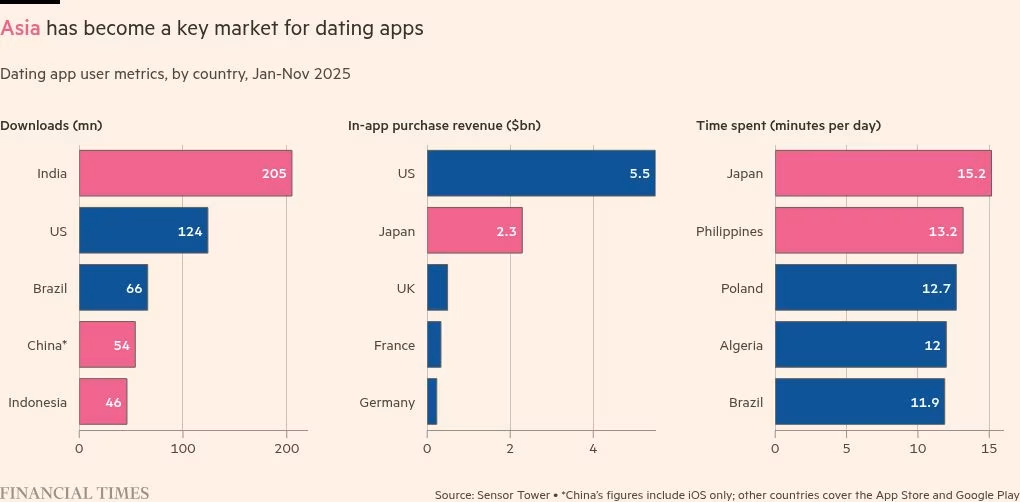
The top five markets globally for number of dating app downloads in 2025 include three Asian countries: India, which has by far the most at 205mn, China (based on Apple downloads) and Indonesia.
However, the top five markets by revenue include just one Asian country — Japan, in second place behind the US, with $2.3bn in the first 11 months of 2025.

The head of French matchmaker Happn, which was acquired by a Chinese social networking company in 2025 and is now targeting markets in Asia, called on the industry to “reinvent itself” to maintain appeal.
Shn Juay, worldwide chief executive of US-founded matchmaker Coffee Meets Bagel (CMB), said much of the increased uptake of the services in recent years was due to changing attitudes of Asian women.
“Women are no longer relying on family and friends to introduce them to their future partners — they don’t want to leave it to chance,” said Juay, who has been working in the industry for more than a decade. “They want to take control through these digital platforms.”
Online dating apps expanding in Asia needed to adapt their services to cultural norms specific to each market, which could be significantly different from countries they were used to operating in, she said.
“Asian daters tend to be very goal oriented,” said Juay. “They are often focused on finding a long-term partner, not just casual hookups.”
In Singapore and Hong Kong, for example, CMB has a user interface that prioritises information about the person, such as their job and education. The Australian version gives much more prominence to pictures.
Asian users were more likely to engage with others if they had taken the time to provide comprehensive answers in their profile, said Juay.
“When singles evaluate each other, they assess how much effort they have put into their dating profile,” she said. “If you leave gaps it is seen as disrespectful.”
The most popular dating app in Japan is Pairs, a homegrown service that was acquired by Match a decade ago. The Japanese government has encouraged people to use dating apps as it works to raise fertility rates, with the Tokyo government launching its own app in 2024.
“They become almost like infrastructure for society,” said Match’s Green.
Given how seriously Japanese users considered their prospective matches on Pairs, profiles included details such as job, income and blood type, said Green. A popular belief in the country is the theory that blood group indicates personality traits, similar to astrology.

The Korean version of Pairs has a feature where the user’s employer verifies that they work where they say they do, which is mandatory for men and optional for women.
India, which has falling rates of arranged marriages, is one of the fastest-growing Asian markets for dating apps. Match recently launched its exclusive The League service, aimed at affluent professionals in Mumbai and Delhi.
While domestically developed apps are downloaded most in India, western apps — including Bumble, Tinder, Hinge, Pure and Grindr — generate the most revenue. Bumble is also the highest revenue-generating app in Indonesia and the Philippines.
In Singapore, CMB recently introduced a new feature that is linked to the government’s Singpass authentication tool, which includes a wealth of personal information such as address and marital status. This has helped reduce a common problem in the city-state of married users pretending they are single.
It is also helping crack down on behaviour that is all too common on dating apps, such as harassment and scammers targeting victims.
Juay said that, when the feature was rolled out in July, CMB suffered a drop-off in accounts, but that was starting to recover. Ultimately, however, it is making it a safer environment for users.
“People tend to be a lot more respectful and kinder when they know that we hold their national identification number and can hand it over to the police,” she said.