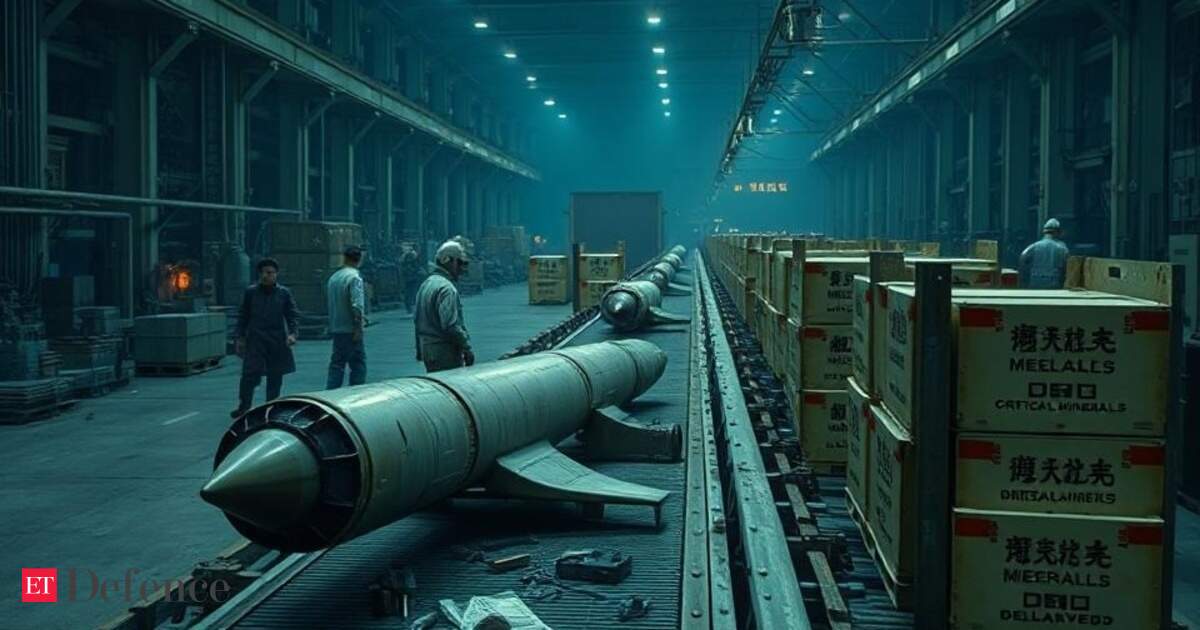
The Pentagon has already started to feel the strain. Missiles, fighter jets, radar systems, drones — all depend on a steady stream of materials like gallium, germanium, and rare earth magnets. And right now, that stream is being choked.
In one example, a US drone component maker had its shipments of key Chinese-made magnets held up for weeks. Chinese suppliers had suddenly begun demanding detailed information about where the parts were going and how they’d be used. Chris Thompson, Vice President of Global Sales at ePropelled, said the company refused.
“Of course we are not going to provide the Chinese government with that information,” Chris Thompson told WSJ.
As a result, the magnets stopped arriving. Production delays followed. ET has not been able to independently verify these claims.
What these critical minerals are and why they matter
These minerals aren’t obscure. They’re the building blocks of nearly every modern military system.Gallium is used in radar and satellite communications. Germanium is key for night vision and infrared imaging. Antimony is used in explosives and armour-piercing ammunition. Rare earth elements like neodymium and samarium are found in high-performance magnets, which power everything from missile guidance systems to drone propulsion and F-35 flight controls.Some, like dysprosium and terbium, are essential for heat-resistant alloys in jet engines. Others, like gadolinium, are critical for sonar and underwater surveillance systems.
These materials aren’t just important, they’re irreplaceable. Substitutes either don’t exist or don’t work nearly as well.
And the problem isn’t just that China mines a lot of them. It’s that China processes and refines most of the global supply. Even when the raw materials come from somewhere else, they often pass through Chinese refineries before reaching the production floor.
America’s arsenal is built on fragile foundations
This isn’t just a one-off problem. The deeper you look, the more it becomes clear: America’s defence supply chain is built on materials it doesn’t control.
Govini, a defence analytics firm, recently found that more than 80,000 parts used across Pentagon weapons systems rely on minerals now facing Chinese restrictions. In many cases, these supply chains include only one or two vendors, and nearly all of them are connected to China.
“We talk about this daily and our companies talk about it daily,” said Dak Hardwick, Aerospace Industries Association, as reported by WSJ.
Leonardo DRS, a US military tech supplier, warned it’s already down to its “safety stock” of germanium, a metal essential for missile infrared sensors.
“In order to sustain timely product deliveries, material flow must improve in the second half,” said Lenardo DRS’s CEO Bill Lynn during a conference call with WSJ.
That’s the reality. Without these minerals, weapons can’t be built. Full stop.
From rare earths to antimony: China’s weapon of choice
The control isn’t just about rare earths. It includes antimony, used in explosives. Gallium and germanium, critical for semiconductors and optics. Samarium, gadolinium, dysprosium, all found in advanced radar and targeting systems.
When China blocked exports of germanium and gallium in late 2024, the market barely blinked at first. But by April 2025, it expanded the bans to cover seven more categories of rare earths. Prices spiked. Delivery times stretched out. In one case, a western buyer was quoted a rate 60 times above the usual market price.
In another, US Antimony Corporation had a shipment of 55 tonnes of Australian-mined antimony blocked at Ningbo port. It sat for three months before being sent back, with seals broken and no clear explanation.
That’s not supply chain risk. That’s coercion.
The West is years behind, and China plans to exploit it
There’s only one operational rare earths mine in the United States: Mountain Pass in California. While it’s been scaling up output, refining remains a problem. Much of the ore it produces still ends up in China for processing.
MP Materials, which runs the mine, received over $400 million in US government funding to close that loop. But the gap between extraction and end-use is still wide.
Ukraine has emerged as a possible new source of rare earths and titanium, with the US pushing to support its mining sector as part of postwar reconstruction. But experts are blunt about the timeline.
“Developing mine sites and sufficient infrastructure in the war-torn nation will take time, potentially decades,” said Aidan Knight, an associate analyst from GlobalData, as per a report by US Critical Minerals website.
In the meantime, the Pentagon has invoked emergency powers under the Defence Production Act to fast-track domestic mining. DARPA is trying to predict global supply trends using modelling software. And companies like Charles River Analytics are being paid millions to map out alternative sourcing strategies.
Still, none of this is fast. And none of it changes the fact that in 2024, China produced 750 out of 760 tonnes of primary gallium worldwide. The US produced zero.
Running out the clock
Time is now the biggest factor. The Pentagon has ordered contractors to phase out all Chinese rare earth magnets by 2027. Most firms have a few months of stockpiles, at best. For smaller defence suppliers, that’s not a transition, it’s a cliff edge.
This isn’t the first time China has flexed its minerals. Back in 2010, it cut off rare earth exports to Japan over a maritime dispute. The move worked. Japan backed down. The message stuck.
This time, the target is wider. And the stakes are higher.
No minerals, no missiles
The logic is simple. You can’t build 21st-century weapons without 21st-century materials. If a missile guidance system needs gallium and there’s no gallium, that missile doesn’t get made. If a fighter jet needs neodymium magnets and none are arriving, the assembly line stops.
As per a report by US Critical Minerals website, Lewis Black, CEO of Almonty Industries, which mines tungsten, put it plainly, “We are trying to break that addiction [to Chinese supply] because… like all addictions, it is unhealthy. We cannot afford to go cold turkey because we are just not strong enough to do it.”
Until the addiction is broken, through new mines, new partnerships, and new infrastructure, Washington’s military ambitions will remain dependent on decisions made in Beijing.
Not just a trade problem. A strategic vulnerability.
