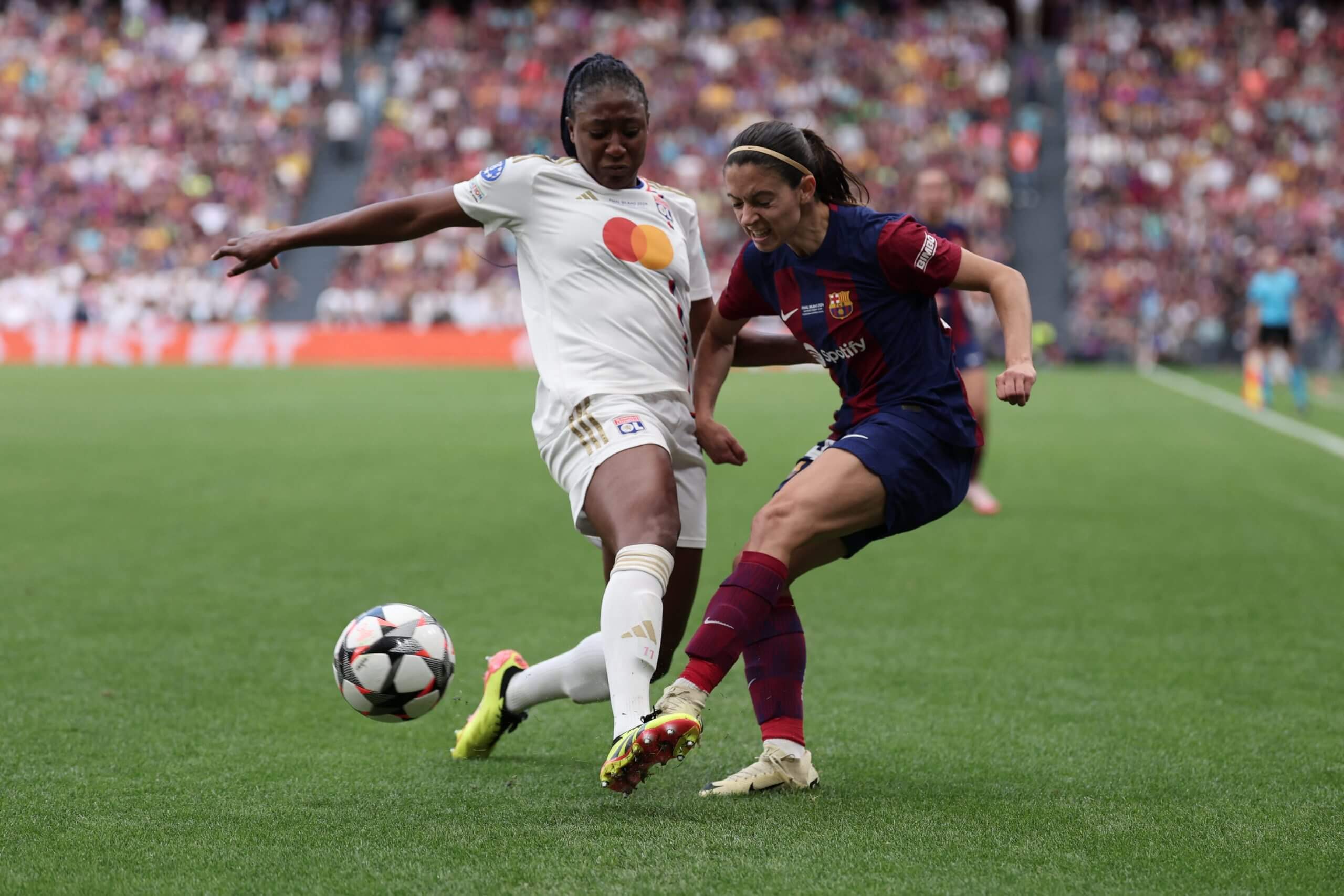
On Saturday night at the Ullevaal Stadium in Oslo, Norway, a new European club champion will assume the throne. Though referring to either OL Lyonnes or FC Barcelona as new is a disservice to both teams.
The French side are storied titans of the UEFA Women’s Champions League, having claimed the title eight times. In their first meeting, OL Lyonnes lifted the continental trophy with a decisive win over Barcelona in 2019, in the Catalan team’s Champions League final debut. Clearly, the heartbreaking whiff of European glory was all Barcelona needed as motivation; seven years on, including this year, they have reached six Champions League finals, winning three of them.
OL Lyonnes and Barcelona have met three times in European finals. The French team won their second meeting in 2022 before Barcelona got the better of them two years later in what is currently their most recent victorious campaign. At the time, Barcelona were coached by Jonatan Giráldez, who is now the manager of OL Lyonnes.
This weekend is an opportunity for Barcelona to even out the series and tighten their grip as a generational dynasty, or for OL Lyonnes, who’ve not lifted a Champions League trophy in four years, to reassert themselves as European legends.
There is plenty at stake on both sides, including the possible (for some) and inevitable (for others) departures of star players whose names have been synonymous with European glory. Alexia Putellas has won more trophies for Barcelona than any other player in club history, male or female, and her contract expires this summer. There is a high likelihood that Putellas, a generational icon and Barcelona’s queen, will leave the club for the first time in her career.
Putellas’ future is less concrete than that of U.S. women’s national team midfielder Lindsey Heaps, who signed with National Women’s Soccer League expansion side Denver Summit on Jan. 12 and will leave OL Lyonnes next month to join them. The 31-year-old midfielder joined the French champions a few months before the team claimed its most recent Champions League in 2022, and will clearly be looking to secure another before she returns to her newly-formed hometown club.
Even though this theatrical tale writes itself, The Athletic’s Tamerra Griffin and Laia Cervelló Herrero discuss the details of this dominant matchup.
Saturday will be the fourth UWCL final meeting between OL Lyonnes and Barcelona. (Thomas COEX / Getty Images)
Is this the greatest UWCL rivalry?
Griffin: Before addressing the question of greatness, I want to sit with the premise of a rivalry. In the purest sense of the term — two teams competing for singular distinction — yes, it is. It certainly appears that way on paper, between the narrow 2-1 tilt toward eight-time champions OL Lyonnes and the more recent European reign that Barcelona holds. But it takes more than two top teams meeting each other across several Champions League finals to make them rivals. That is why, spiritually, this matchup is not that to me.
Part of this is due to a lack of sustained tension between the two sides. Perhaps if the Catalans had upset their French opponents when the two first met in 2019, they could have set the stage for a rivalry to emerge, but OL Lyonnes were always meant to handle business in that match, and they did. Forward Ada Hegerberg’s first-half hat-trick proved it.
That Barça had already won their own title before meeting Lyon again for a final in 2022 does not help matters; it dilutes their collective narrative, which needs to be present and juicy for a rivalry to take root.
Same as 2024, when Barcelona won their second Champions League title, albeit in stunning fashion with a comeback win over Wolfsburg. I think there needs to be more frequent contact to really build a rivalry. It is not quite there — yet.

FC Barcelona have been to six of the last seven UEFA Women’s Champions League finals. (David Ramos / Getty Images)
Cervelló Herrero: I understand what Tamerra means, and I think she’s right, broadly speaking.
For OL Lyonnes, this rivalry is new and based solely on a desire to prove that, in Europe, they are the ones in charge — past, present and future. Since Barcelona won their first Champions League final in 2021, they have been in a golden age, and their style of play has drawn widespread praise. Their golden age coincides with a period in which Lyon has had less of a stranglehold on the Champions League. Perhaps from the French side’s perspective, this rivalry isn’t seen as such, and they continue to regard historic rivals like Wolfsburg as their great European rivals, or their neighbors at Paris Saint-Germain.
Conversely, Barcelona’s emergence in Europe, even though they have now reached seven finals and six in a row, is relatively new. Because they had never before shown themselves to be, or felt themselves to be, competitive on the Old Continent. They have only been a professional team for 11 years. In a decade, their lives have changed, and so have their rivalries.
Since 2020, Barcelona have had no rival in Spain. Liga F has become far too lacking for a European giant. So, their rival must be found in the Champions League. And which team has marked turning points in their learning curve in European finals? OL Lyonnes.
When Barça were thrashed in 2019, it served as a wake-up call — they realized they needed more to win a European final. When the Catalan side arrived in 2022 feeling invincible after winning their first final, Lyon beat them again and showed them they had to keep working. They took the message on board and did just that.
And in 2024, I think both teams starred in one of the most exciting finals in recent times. Both were keen to win the title, but also prove who was the boss of the continent. That desire, for me, is the creation of a new rivalry and, today, looking at the number of Champions League titles both have won, surely the biggest in Europe.

Michele Kang’s investment in OL Lyonnes has helped return the team to the Champions League final. (Molly Darlington / Getty Images)
What role has investment played in these teams’ dominance?
Griffin: As Laia mentioned, there is a stark disparity in Liga F, and it also exists in the French Première Ligue. Barcelona and OL Lyonnes have both received significant support, whether by way of direct financial investment — as is the case with OL Lyonnes owner Michele Kang — or on Barcelona’s developmental side, in ways that none of their domestic counterparts have, even amongst their league rivals Real Madrid and Paris Saint-Germain. The latter have at least reached a couple of Champions League finals, but if anything, teams like Paris FC and Atlético Madrid are encroaching on OL Lyonnes and Barcelona’s so-called domestic rivals more than their rivals are on them.
Cervelló Herrero: I completely agree. Barcelona made a major investment in 2015 and is still reaping the rewards, to the extent that it has become the only section of the club that isn’t running at a loss. They also set up a girls’ academy for young players coming through from the lower age groups, which makes Barcelona’s model similar to that of the men’s side. They develop their own top players to avoid having to spend heavily on transfers.
This contrasts with the reality in Spain, where they play in the Liga F alongside barely professional teams. This makes the Champions League their competitive barometer, but it has also held them back at times when they faced an opponent that made things difficult for them.
In England, the Women’s Super League’s commitment is attracting more and more talent to England, and at some point, Spain’s lack of investment in women’s football, not the club, will end up posing a problem for Barca — as seen in Arsenal’s triumph in the final over the Spanish side last year.

OL Lyonnes’ Melchie Dumornay has provided five goals and one assist in this Champions League campaign. (Pauline Figuet / Getty Images)
Which players will be key in this final?
Griffin: Should Melchie Dumornay, OL Lyonnes’ Haitian superstar attacker, continue her sparkling form in this Champions League final, her chances for a Ballon d’Or will surely increase — if not the award itself, then a finalist position on the list. Dumornay’s five goals and one assist in this Champions League campaign hardly capture her brilliance. It’s her dynamic runs and audacious ambition on the ball that have provided OL Lyonnes a crucial catalyst.
Similar can be said of fullback Salma Bacha. The red and blue of OL Lyonnes crest course through the veins of the 25-year-old, who grew up in the city she has represented her entire career. She has one of the most lethal left-footed deliveries in Europe and is a relentless defender. The team’s fangs are always a bit sharper when Bacha is on the pitch.
We’re always spoiled for choice in highlighting Barcelona’s main characters, but there is a way in which Caroline Graham Hansen rises to the occasion in big matches that warrants some attention on her in this final. Interestingly, she will likely be battling against Bacha down the right flank, a key matchup between the Norwegian winger with a preternatural gift of craftiness and one of the Champions League’s most gritty fullbacks.
Cervelló Herrero: Finals are for the great players – those with the soul of a leader. Players like Barcelona’s Alexia Putellas and Aitana Bonmati.
For Putellas, this could be her last match for the club. She has not yet decided on her future, though everything suggests a farewell and the end of an era. The 32-year-old has the chance to complete her time with another season full of titles. She is in good form after overcoming an injury in 2022 and is ready for the challenge.

Barcelona midfielder Alexia Putellas could bid farewell to her club after this season. (Lluis Gene / Getty Images)
Similarly, Aitana Bonmati excels in finals. She never shies away, even if her team ends up losing. The 28-year-old takes responsibility, and her competitive hunger drives her. The question is whether she will start or come off the bench. She returned on May 3 after five months out due to a leg injury. She came off the bench in the Copa de la Reina final last week. Either way, she could prove decisive for Barcelona. If she does not start, I’d like to see Vicky Lopez in that role. I believe her time has come, and the moment for her to take a definitive step forward is drawing near. Additionally, Ewa Pajor, the team’s top scorer, was the center forward the team needed this season.
For OL Lyonnes, Dumornay is a goalscorer and, according to UEFA, the second-fastest player in the competition – behind only her teammate Tabitha Chawinga. This will be key, as one of Giraldez’s main tactics to cause Barcelona problems will be counterattacks. Meanwhile, Barcelona’s fastest player, Graham Hansen, is a doubt for the match.
Experienced winners Wendie Renard and Hegerberg, are also familiar with that final feeling. Renard is the captain, the leader and a legend of OL Lyonnes. Her contract runs until 2027, and there are not many Champions League finals left for her to aspire to. Meanwhile, the Norwegian forward will be playing a final on home soil and is another football legend who has a knack for beating Barcelona, even if she’s not quite as dominant as she was a few years ago.
Is this match-up a sign of strength or a need for growth in European women’s football?
Cervelló Herrero: I think this shows that the two teams, which, in recent years, have invested more heavily in their women’s sides, are now reaping the rewards. With a little respect and commitment to women’s football, you can and should reach finals.
That said, the landscape has changed over the last five years, and there are other clubs making solid investments. Since 2022, the WSL has really stepped up its game in this regard. I think they have already seen the results of this – Arsenal’s Champions League win last season – and that, in the medium term, English teams will feature more prominently in European finals.
This speaks well of the projects that have been in place so far, but there is undoubtedly still a long way to go. Barça and OL Lyonnes are there to set an example of how such projects are built.
Griffin: It’s a sign of both. Laia is right. Between the historically high bar of OL Lyonnes and the recent surge of Barcelona, the two teams are shining exemplars of what’s possible with proper investment in women’s clubs. These investments have strengthened them into near-indomitability, and should be read by other clubs as a round of warning shots: invest and evolve, or risk getting left behind.