Zohran Mamdani is the Mayor of New York City and a long-time supporter of Arsenal Football Club. Here, he writes about what the club means to him, what it means to see Arsenal win the Premier League trophy and his hopes for Saturday’s Champions League final against Paris Saint-Germain.
“Why argue with an Arsenal fan when you can just wait?” We’ve all heard it time and again. And for a long time, there wasn’t much to say in return. Just grit your teeth and pray. Hope. Reminisce.
That time is done. That wait is over. That prayer has been answered.
We won. We are champions of England. And we are just one game away from being crowned champions of Europe, too. What was once the nostalgia of the past has become the beauty of the present.
Over the past five-and-a-half months, since I swore an oath and became the Mayor of New York City, life has moved very quickly. When you’re trying to overcome a $12billion budget gap, respond to a historic blizzard, deliver universal childcare and govern the largest city in America, you have to prioritize. Exercise has gone out the window. I couldn’t tell you the last time I finished a book. But one thing is non-negotiable.
Every night, no matter how chaotic the day has been, I have ended it the same way as millions of Gunners around the world — from N7 to Norwood, from Kampala to Kensington, from Cairo to Chinatown — by pulling up the Premier League table and smiling at the sight of Arsenal on top.
My relationship with my club began the same way it does for most football fans: before I was old enough to understand what I was getting myself into. When I was nine, my uncle introduced me to a team with a cannon on its shirt, a grizzled captain named Tony Adams and players such as Nwankwo Kanu – who had been born in Africa but now lived somewhere else, just like me. Arsenal felt familiar before I even understood why.
And then there was the manager, a man who I initially thought had been named after the club and then believed that somehow the club must have been named after him. Arsene Wenger might have struggled with his raincoat, but rarely with his orchestra. The football his teams played made music.
@premierleague Arsene Wenger just didn’t get on with those zips 😠 #PremierLeague #Arsenal ♬ AnySoundEffects Funny Song Cavendish – Any Sound Effects
You never forget the players who make you fall in love with the beautiful game. It was Sylvain Wiltord, who was immortalized as one of my most prized fridge magnets. It was Dennis Bergkamp, a man who feared flying unless it was on the pitch. And it was Thierry Henry, a man even cooler than Patrick Vieira’s Vicks VapoRub.
I was 12 when we went invincible, a whole Premier League season unbeaten. I can still remember that campaign — Ruud van Nistelrooy’s missed penalty, Jose Antonio Reyes’ double against Chelsea in the FA Cup, Robert Pires flying down the wing.
And then came Paris in 2006.
I got stuck at school during the Champions League final. When I finally made it home, our goalkeeper Jens Lehmann had already been sent off. I watched as we made it to just 20 minutes away from glory. Twenty years later, the name of Barcelona striker Henrik Larsson still hurts to hear.
I coped by taking matters into my own hands. Even by virtual standards, I was aggressive in the Championship Manager and then Football Manager transfer markets. I finally signed Sebastien Frey, after years of real-life links. Under my stewardship, Jeremie Aliadiere and Jermaine Pennant became the stars we always knew they could be and we brought in Yoann Gourcuff, who soon fulfilled his Zidane-caliber potential.
And like any good socialist, I budgeted responsibly — when I was in charge, we never would have offered £40,000,001 for Luis Suarez. It would have been at least £40,000,002.
But as the years passed, supporting Arsenal increasingly became an exercise in nostalgia. We watched as the era of success was replaced by one of false dawns, of our best players leaving to play for our rivals. Soon, even calling them rivals felt aspirational.
We went from the team that could sign Sol Campbell from Tottenham to the one that watched Robin van Persie sign for Manchester United. And it happened again and again, with Gael Clichy, Bacary Sagna, Samir Nasri, Emmanuel Adebayor, even Cesc Fabregas. Each of them had once heralded a new era for the club, and each of them left before that era ever truly arrived. Talk of titles was replaced by the idea that fourth place was its own title. And still we supported the club.
When Manchester United destroyed us 8-2 — a match I watched through gritted teeth as a sophomore in the Baxter House common area at Bowdoin College — we supported the club. When Sebastien Squillaci was starting in the heart of defense and RVP scored 30 goals for United, we supported the club.
When Jose Mourinho called Wenger a ‘specialist in failure’ then beat him 6-0 in Wenger’s 1,000th match in charge, we supported the club.
We supported the club because you do not leave the club you love.
In any case, our love of Arsenal ran so much deeper than a simple love of success.
For those of us with African roots, Arsenal represented something larger. This was a club that embraced African players before much of Europe bothered to scout the continent seriously. A club that sent players to the Africa Cup of Nations (AFCON). A club where players from Nigeria, Ivory Coast, and Cameroon were central to our story.
It was a love of a club that cherished its roots; that nurtured players such as Jack Wilshere and Max Dowman from Arsenal’s academy, Hale End, all the way through to the first team. It was a love of a team as multicultural as the city it calls home, where immigrants from Pakistan and Poland and Paraguay have all found common cause in hating Spurs. And it was a love rooted in hope — that one day something might change, that one day someone like Mikel Arteta might walk through the door and replace nostalgia with silverware.
Over these past two years, no matter how chaotic life became, Arsenal remained the constant. I snuck in Champions League highlights between campaign ad shoots, streamed snippets of games during debate prep breaks, and consumed more dubstep-laden Leandro Trossard compilation videos than any grown man wearing a suit and tie ever should.
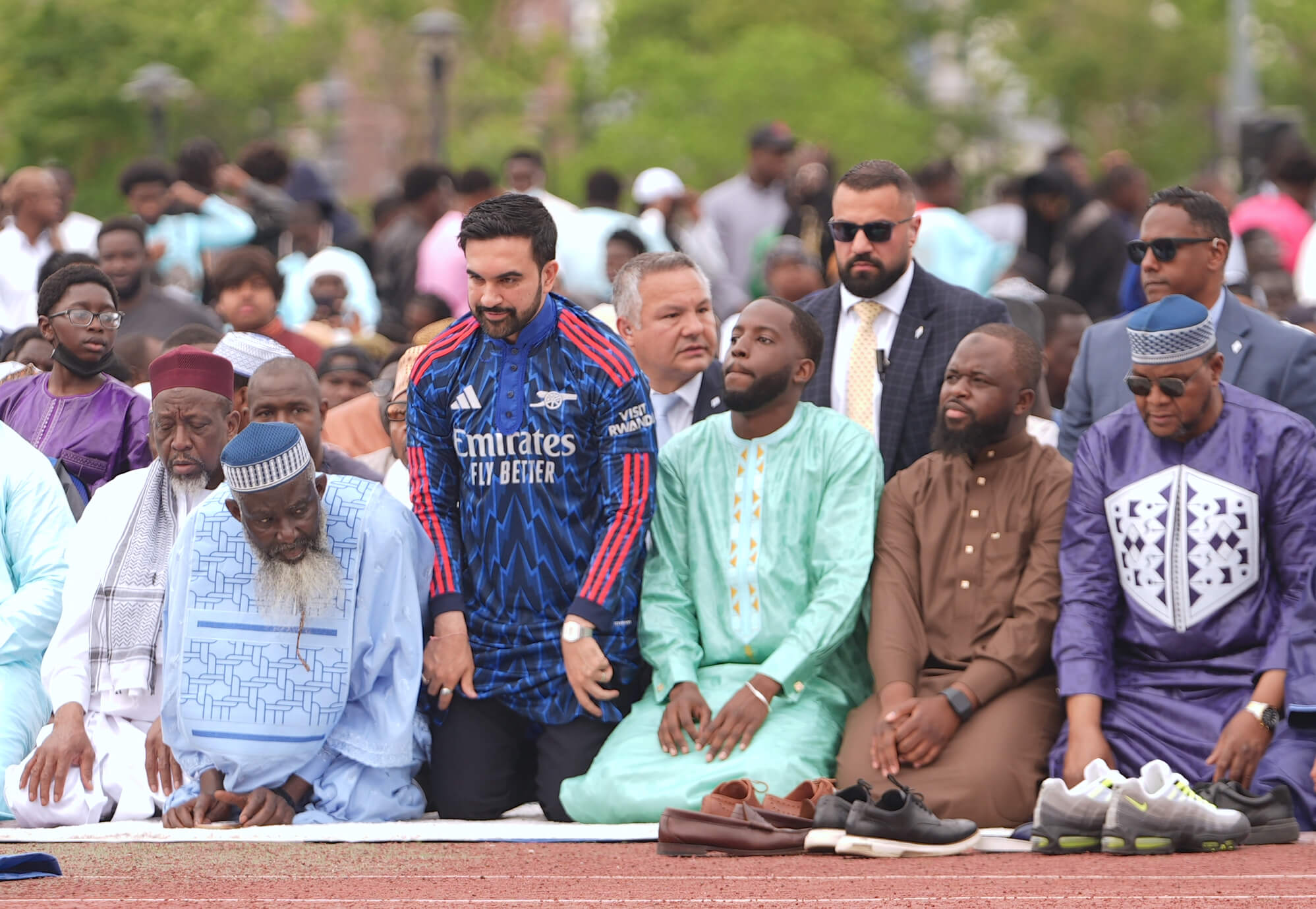
Zohran Mamdani marks Eid al-Adha at Macombs Dam Park in the Bronx, New York City, on May 27 (Selcuk Acar/Anadolu via Getty Images)
And throughout every moment, when a Manchester City resurgence felt inevitable, when the socialist project felt fragile, when both football and politics appeared determined to reward only wealth and cynicism, I have returned to the words of a man with no enemies: Bukayo Saka. “It’s a process.” And we should trust it.
When VAR saved us from Callum Wilson — trust the process.
When Erling Haaland started singing Avicii as Declan Rice insisted it wasn’t done — trust the process.
When Mikel Arteta motivated the team by drawing a heart and a brain on a posterboard — trust the very bizarre process.
And now we arrive at Saturday.
There will be moments against PSG when the process feels very hard to trust indeed. They are brilliant. Their midfield is perfectly balanced. They are frustratingly well-managed. They have some of the best players in the world.
Doesn’t matter — trust the process. Back the man who took us from playing Bodø/Glimt to playing in Budapest. Most of all, enjoy this moment, because they don’t come around often. Twenty years, to be exact.
And no matter what happens, remember, it could be worse — we could support Tottenham. And what do we think of them?