
The Iran war came as an unwelcome shock to the stock market and the global economy. Between Feb. 27 (the day before U.S. military strikes on Iran began) and March 30, the tech-heavy Nasdaq-100 index lost 8% of its value. With the news full of alarming headlines, investors fled to safe-haven assets and moved away from tech stocks.
A longer, more destructive Iran war would have longer-lasting and more damaging impacts on the economy. Higher oil prices would drive up prices all over, which could cause higher-for-longer inflation.
Image source: Getty Images.
The need to put downward pressure on inflation might drive the Federal Reserve to delay further interest rate cuts — or possibly to hike the federal funds rate again. More government borrowing to pay for the war would also drive up yields on longer-term U.S. debt instruments like the influential 10-year Treasury bond. Higher interest rates also tend to be bad for stock prices, especially for growth stocks.
As of this writing, the Iran war has not been declared over. The news is still dominated by updates on ceasefires, negotiations, and blockades of the Strait of Hormuz, through which much of the global supply of oil and natural gas travels.
But in the past few weeks, since the major market indexes hit their low points for the year, it seems that investors are declaring the “all clear” signal. The tech-heavy Nasdaq-100 is up 17.4% since March 30 and has now gained 6.7% year to date.
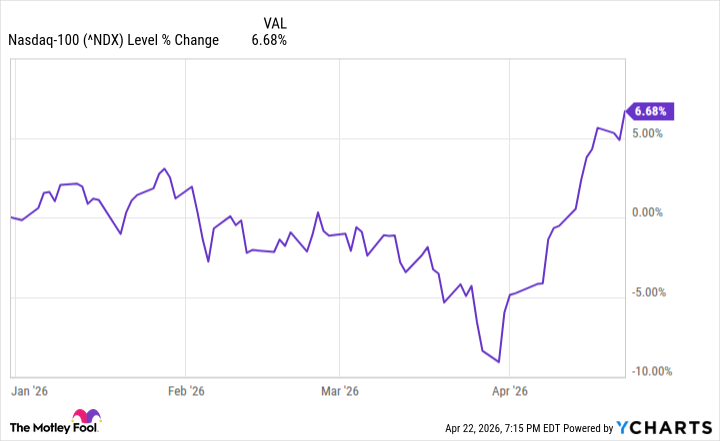
Let’s look at a few reasons why the Nasdaq-100 is on a winning streak despite the Iran war — and why tech investors might want to keep buying.
Investors are betting that tech companies won’t be hurt further by the conflict
Most U.S. tech companies aren’t affected much by Middle East oil shipments or the other disruptions caused by the war. Though Iran has attacked a few data centers in the Middle East, targeting them with drones and missiles, the conflict doesn’t pose a direct physical threat to the infrastructure or operations of most large tech companies.
The Nasdaq-100 rally since March 30 is a sign that investors believe the worst of the war is over, and that it’s safe to buy tech stocks again. This is an optimistic signal that the worst-case scenarios will be avoided, interest rates won’t go up, and tech companies can keep delivering strong earnings growth for the rest of 2026.
Software stocks are rebounding
Part of the rally in tech stocks is coming from the software sector. Remember the SaaSpocalypse? It wasn’t long ago that many investors were worrying that artificial intelligence (AI) was going to put software-as-a-service (SaaS) companies out of business. But that narrative seems to be fading.

iShares Trust – iShares Expanded Tech-Software Sector ETF
Today’s Change
(-5.82%) $-5.16
Current Price
$83.58
Key Data Points
Day’s Range
$83.46 – $85.57
52wk Range
$73.93 – $117.99
Volume
32M
The iShares Expanded Tech-Software Sector ETF (IGV 5.82%), which holds more than 100 software stocks, including major names like Microsoft and Salesforce, is up 8.8% from its prewar close on Feb. 27. Since its April 10 close, the ETF has gained 18.8%.
Software companies might not be out of the woods yet — this fund is still down 16% year to date. But their recent rally is another good sign for tech investors.
There’s a broader appetite for risk
It’s not just the Nasdaq-100 that’s rallying. The S&P 500 index is up 4.3% year to date, and up 12.5% since its 2026 low on March 30. The rest of the world’s stock markets, and many of the exchange-traded funds (ETFs) indexed to them, are rising too. The Vanguard Total International Stock ETF (VXUS 0.64%) holds nearly 8,800 stocks from dozens of countries, and it has gained 10.7% since March 30.
Emerging markets such as China, Taiwan, and India are up even more. The Vanguard FTSE Emerging Markets ETF (VWO 1.60%) is up 12% since March 30 and has gained 9.3% year to date — outperforming the Nasdaq-100 so far in 2026.
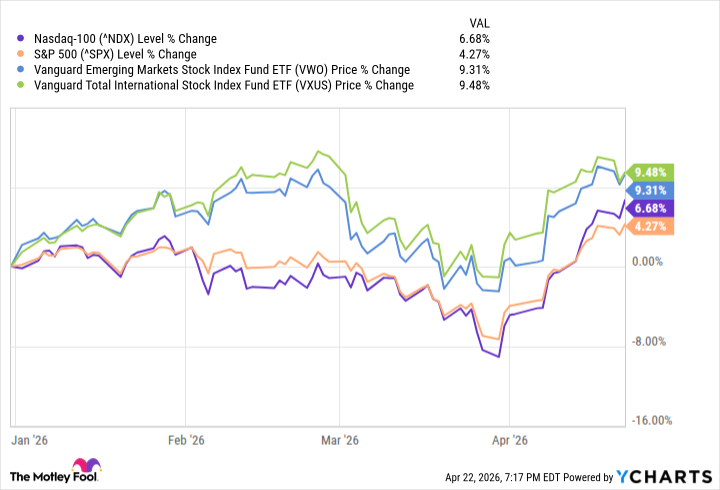
These are signs that investors are in a “risk-on” mood. When the broader appetite for riskier assets is up, the tech-heavy Nasdaq-100 often benefits.
There’s no one simple answer for why the Nasdaq-100 is rallying. But if these favorable trends can continue — a resumption of energy shipments from the Middle East, lower market volatility, and lessened concern about inflation and interest rates — that would be good news for tech stocks.