
In my last post, I asked you, readers, to tell me what you thought about this concept that seems to intrigue media owners — that their news organization should set out to appeal to an audience that craves some sort of middle ground and identifies politically as centrist.
Most recently, this has come up at CBS News under its new, right-leaning management, and previously at CNN. Other media executives seem to agree, though it’s not always as clearly articulated.
Aiming to attract the political middle has always seemed like a weird concept to me, and so far, it hasn’t seemed to benefit those news organizations at all. Quite the contrary.
I asked you to tell me if you see yourself as one of these center-searchers. Your answers were fascinating; most of you said that you’re looking for something different in your news choices — factuality, fairness, authenticity, a sense of mission and yes, truth.
On the same subject, I’ll share a recent speech by the renowned former editor of the Washington Post and the Boston Globe, Marty Baron. Speaking at a journalism-ethics awards gathering a few days ago, he covered a lot of ground; the whole speech is worth your time.
But here’s why this “aim for the center” notion runs counter to his idea of ethical journalism.
Finally, I’ll mention a mindset in vogue among a certain crop of media executives. Although they claim to want politics out of the newsroom — and I do, too —they simultaneously propose a political calculus for their journalists. The new owner of CBS and the current editor-in-chief of the news division, for instance, set an explicit objective of appealing to the center right and the center left. That is a political goal. It is not a journalistic one. And it is a far cry from how Jack Knight instructed his newsroom: “Get the truth and publish it.” That is a journalistic goal.
Media owners who substitute political goal posts for news values find refuge in sophistry. They lay claim to ethics; instead, they subvert them. Their path may be one of commercial convenience. Or of timidity. Or of appeasement to regulators, legislators and the president himself. Or the instinctual path of those who see the press only through the lens of politics. But a news outlet of that formulation is fated to compromise ethics when a rock-solid story moving toward publication is deemed to fall outside the designated political comfort zone.
Accurate, independent, ethical coverage may be well received by the center right, or it may not. It may be well received by the center left, or it may not. No one should set out to alienate anyone. But at times, as Jack Knight said, the best journalism may end up facing “public wrath and displeasure.” That is the price, at times, of honest work. So be it.
Personal note: Marty (who was played by Liev Schreiber in the Oscar-winning movie, “Spotlight”) hired me as media columnist at the Washington Post, where I began in 2016, and encouraged me to track the overarching story of Donald Trump’s disparagement of, and attacks on, the independent press. Baron left in 2021; I departed the following year, far less certain that his successors would have my back as he always did.
On another subject, I want to praise and question two recent stories in the New York Times.
First, praise to Jodi Kantor and Adam Liptak for their stunning scoop revealing the “shadow docket” in John Roberts’s Supreme Court. Here’s a gift link to the main story, which describes the politicized fast track that many consequential court decisions have been on over the past decade. The story is based on confidential memos the justices wrote to each other, obtained by the Times.
Kantor’s name may be familiar as one of the two bylines (with Megan Twohey) on so many of the investigative stories that held powerful men — including Harvey Weinstein — accountable for sexual misconduct; to a large extent, this coverage launched the #metoo movement. When I read some months ago that Kantor would be focusing her reporting now on the Supreme Court, I thought something remarkable might follow. Her reporting partner, Adam Liptak, has been covering the court for many years as his beat, and is an expert on its workings and its people.
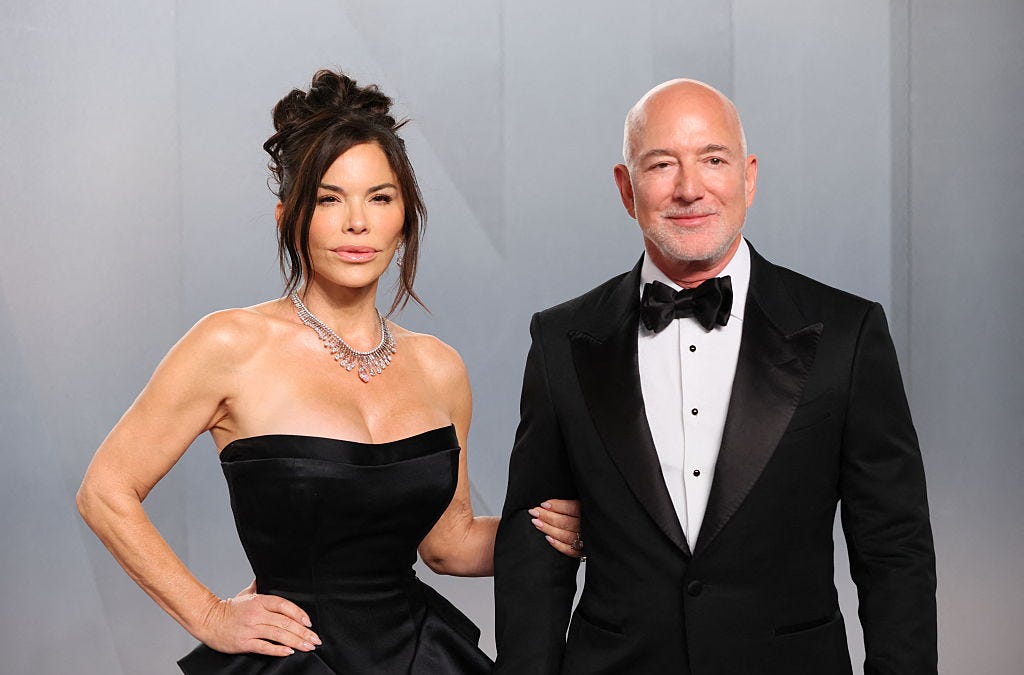
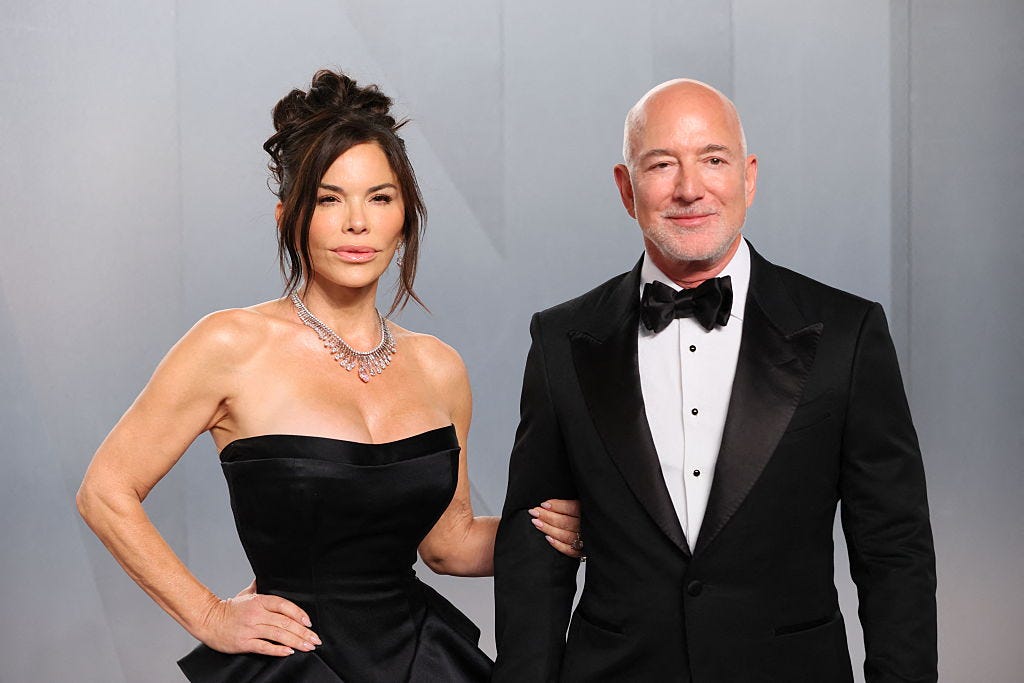
In contrast, I’m baffled by the Times’s decision to devote its entire Sunday business cover to a fluffy feature story on Lauren Sánchez Bezos, who professes how much fun it is to be rich. Headline: “Someone Has to Be Happy. Why Not Lauren Sánchez Bezos?” Longtime journalist Katie Couric was among the most prominent critics, and you can read all about the reaction here. To get the flavor of the story, written by Hillary Clinton chronicler Amy Chozick, here’s a sample: “Unabashed rich-person exuberance is back with a Blue Origin bang, a Mar-a-Lago makeover of the White House, and a Zuckerberg rap cover. The Bezos marriage seems, at times, as much a cultural inflection point as a love story — the moment American money stopped apologizing and decided it might as well enjoy itself.”
I asked Assistant Managing Editor Patrick Healy why this deserved to be a business story at all, and one that on a recent Sunday dominated the business section front as if it were a matter of great import. Here’s his response
I would argue that writing about powerful and wealthy people in America IS a business story. Many magazines and trade newspapers do such pieces regularly as a window into how society, industry and culture intersect, and Sunday Business often does deep profiles of these people as well to take readers inside how they operate and think. In recent weeks, the business department of The New York Times has also written dozens of stories on the crisis in oil markets, the economic fallout from the war with Iran, inflation, the administration’s feud with the Fed chairman, the impact of the war on Asia, Europe and global industry, the financial markets in the U.S., Asia and Europe, the price of gasoline in the U.S., the shortage of jet fuel, the impact of the war on retail, disinformation, AI, Anthropic’s new Mythos model, crypto, private credit, earnings, EVs, shipping and the list goes on. We are providing a wide range of stories to our audience. Many readers found this piece compelling; other readers didn’t like some of the details and framing. The Times provided new reporting, information and insight about a part of our society, and let readers make up their own minds about it. That’s what journalism does.
Readers, what say you? Is this a good use of resources? Is it worthy of the Times business section front on its best-read day? I would have found it far less objectionable in Styles as a celebrity profile; it’s an entertaining-enough read, but frothy enough to float away on the next spring breeze, and its celebratory tone seems more than a little tone-deaf at a time of extreme turmoil and income inequality in America. I’m also appalled by Jeff Bezos’s blatant cozying up to Donald Trump in order to become ever richer, and by his diminishment of the Washington Post, which he owns. That makes me a lot less likely to admire his lavish lifestyle. Gift link here.
Separately, I had a good chat with Parker Molloy for Long Lead’s Depth Perception newsletter, where we talked about billionaire press barons, about my former gig as Times public editor, and other media topics. Parker also writes an incisive newsletter, the Present Age, where she’s offering new subscribers 40 percent off to recognize her own 40th birthday. Here’s a link to our conversation.
Readers, as always, thank you for your support and interest. Both are deeply appreciated. Those who’ve upgraded to paid subscriptions at $50 a year are keeping this newsletter and its comments section open to all.
My background: I am a Lackawanna, NY native who started my career as a summer intern at the Buffalo News, my hometown daily. After years as a reporter and editor, I was named the paper’s first woman editor in chief in 1999, and ran the 200-person newsroom for almost 13 years. Starting in 2012, I served as the first woman “public editor” of the New York Times — an internal media critic and reader representative — and later was the media columnist for the Washington Post. These days, I write here on Substack, as well as for the Guardian US. I’ve also written two books, taught journalism ethics, and won a few awards, including three for defending First Amendment principles.
The purpose of ‘American Crisis’: My aim is to use this newsletter (it started as a podcast in 2023) to push for the kind of journalism we need for our democracy to function — journalism that is accurate, fair, mission-driven and public-spirited. That means that I point out the media’s flaws and failures when necessary.
What I ask of you: Shortly after Trump’s election in November of 2024, I removed the paywall so that everyone could read and comment. I thought it was important in this dire moment and might be helpful. If you are able to subscribe at $50 a year or $8 a month, or upgrade your unpaid subscription, that will help to support this venture — and keep it going for all. Thank you!