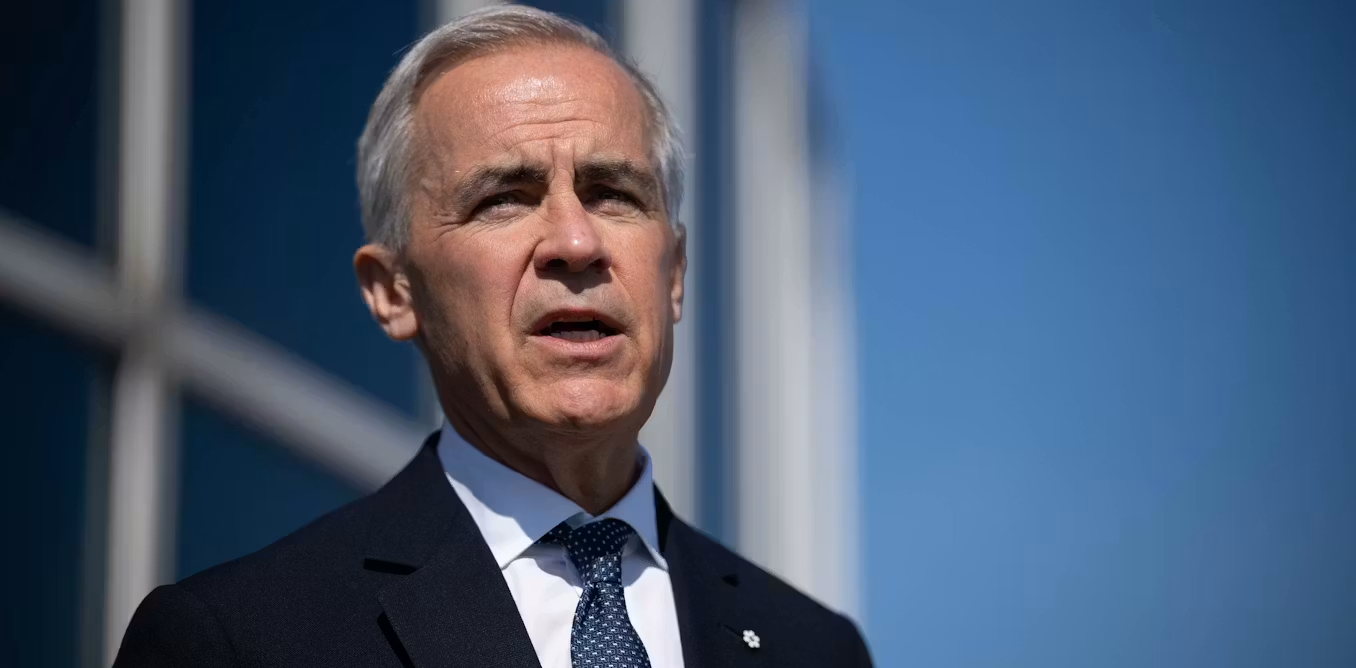
Prime Minister Carney recently said that “like Mexico, Canada remains open to deeper integration, including options for Fortress North America in (certain) sectors.” He added that “offers are on the table,” though he did not specify what they were.
Even with a review of the Canada-U.S.-Mexico Agreement (CUSMA) on the horizon, Carney is surely aware that it’s politically risky to advocate for closer ties with the United States when the country under President Donald Trump is considered a threat to Canadian sovereignty.
There is historical precedent for Canadian politicians to face backlash after calling for deeper integration with the U.S.
Anti-U.S. sentiment
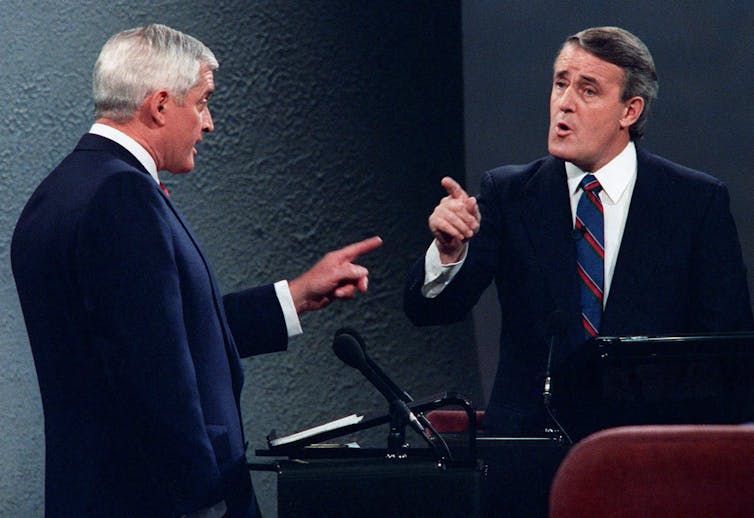
In the 1988 federal election, critics argued that the Canada-U.S. free-trade deal negotiated under Brian Mulroney’s Progressive Conservative government could make Canada the 51st state. The government lost 34 seats, while parties opposing the deal gained 56.
THE CANADIAN PRESS/Fred Chartrand
In 2005, Paul Martin Jr.’s minority Liberal government reversed its intention to join the U.S. Ballistic Missile Defence program in the midst of widespread opposition from voters and the Liberal caucus.
In 2010, Stephen Harper’s Conservative government worried about reaction to a proposed Canada-U.S. “shared vision” of a Canada-U.S. security perimeter. It developed a communications strategy to defend itself against criticism that it would “spark worries about eroding sovereignty and privacy rights.”
Favourable environment
So why would Carney take such a risk?
Political conditions are favourable. His primary opponent, Conservative Leader Pierre Poilievre, criticizes the prime minister for not moving fast enough to tighten ties with the U.S. The NDP, so influential in past debates, has only five MPs.
This creates space for Carney. He is seen more as a crisis manager than a politician who forcefully opposes Trump’s attempt to break Canadians.
He has surfed a wave of economic patriotism to soaring heights of popularity. His approval ratings remain high a year after his election, while Poilievre’s have plummeted.
Read more:
Mark Carney in Australia: How did he become the darling of the global anti-Trump movement?
Reassuring Canadians
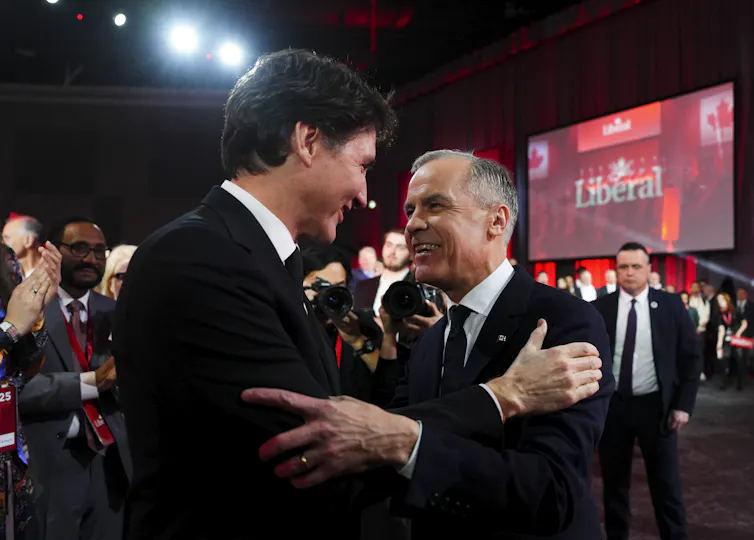
Carney’s brand is far different from his predecessor’s, Justin Trudeau. But he is using Trudeau’s successful brand strategy of reassuring Canadians of the benefits of deeper integration despite historic concern and division about cross-border economic ties.
Trudeau claimed that integration’s benefits reflected Canadian values and strengthened Canadian sovereignty.
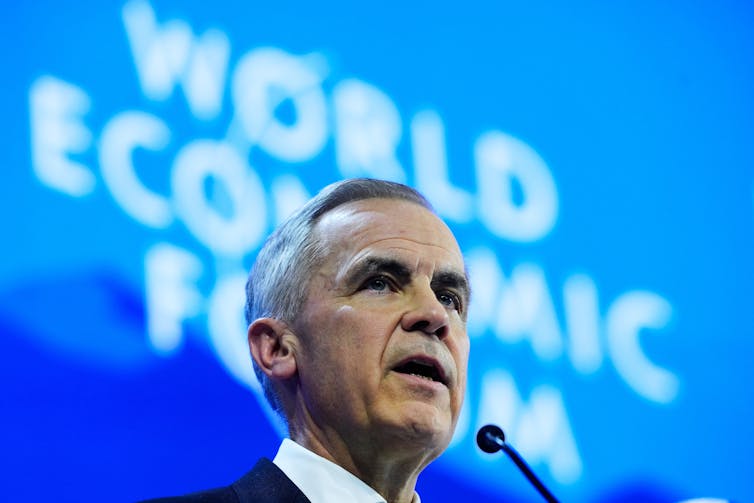
Carney’s widely praised speech to the World Economic Forum in January hinted at this strategy. It was interpreted as standing up to and moving on from Trump’s increasingly isolationist and punitive policies. But he also said:
“You cannot live within the lie of mutual benefit through integration when integration becomes the source of your subordination.”
In other words, integration is desirable if mutually beneficial.
(AP Photo/Markus Schreiber)
Attracting U.S. investment
Carney wants Canada to become an “energy superpower,” and the U.S. remains the primary market for Canada’s energy products.
Read more:
Mark Carney wants to make Canada an energy superpower — but what will be sacrificed for that goal?

THE CANADIAN PRESS/Sammy Kogan
To that end, Energy and Natural Resources Minister Tim Hodgson recently argued in the U.S. that Fortress North America would allow Canada to help Americans achieve energy dominance.
As the U.S. competes against China, American investments in Canadian critical minerals and mining projects would also tighten ties.
Days before mentioning Fortress North America, Carney asked: “Should we be further integrating our energy markets with the United States at a time they view that as, quote, ‘leverage’?”
But he soon answered his own question by invoking Fortress North America and declaring, with few details, that Canada has offers on the table.
Hinting at these deals could help attract U.S. investment during Carney’s fall Canada Investment Summit. However, direct foreign investment often produces increased foreign control of existing Canadian companies. Carney therefore must frame Canadian interests as being served within Fortress North America.
Canada ‘not for sale’ — but open for business
Carney’s “elbows up” rhetoric while focusing on a new trade deal with the U.S. reflects Canadian public opinion. An Ipsos survey conducted earlier this year found that Canadians want “to pursue diversification without fully decoupling from the U.S.” if it benefits Canada.
Similarly, Ontario Premier Doug Ford successfully navigated public opposition to Trump alongside a desire for integration. In January 2025, Ford proposed “Fortress Am-Can” that would deepen cross-border ties.
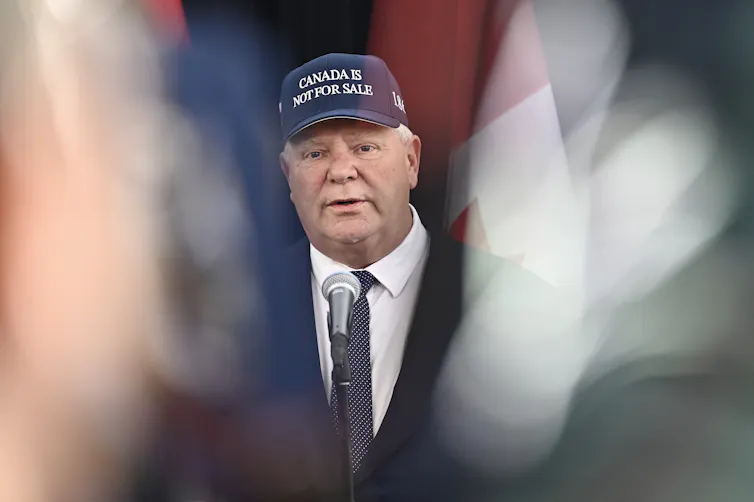
But he was nevertheless dubbed “Captain Canada” for vocally standing up to Trump and wearing a “Canada is Not For Sale” hat. Ford went on to win a large majority in the February 2025 provincial election.
THE CANADIAN PRESS/Justin Tang
Risks of a ‘Fortress North America’ strategy
This is the essence of domestic brand politics. Political competition is increasingly based on a party’s ability to frame its platform in terms of national values. The popularity of Carney and Ford show how this can be a winning strategy.
Carney’s approach mirrors his Liberal predecessors, Jean Chretien and Justin Trudeau. They touted progressive social values and distinctive sovereignty.
THE CANADIAN PRESS/Sean Kilpatrick
But their actions were actually neoliberal and deepened integration with the U.S. Carney could face the same criticism that confronted Chretien and Trudeau since there were similar rhetoric vs. reality gaps between their visions of Canada and their actions.
Carney has been criticized for weakening the fight against climate change, despite his prior beliefs, to promote resource exploitation. Members of his caucus have expressed concern.
Read more:
Is Mark Carney turning his back on climate action?
Cutting federal program spending and considering “asset recycling” have prompted critics to argue that Carney is advancing “neoliberalism in a nicer suit.”
Elbows down?
Anti-Trump sentiment and the deliberately ambiguous nature of the term Fortress North America could derail Carney’s approach. Opposition could mobilize over any deal, especially if critics argue that it has an “elbows down” agenda.
Read more:
Mark Carney’s apology to Donald Trump: Far from ‘elbows up,’ it seems Canada has no elbows at all
Carney chose to make his first public mention of “Fortress North America” at an event billed as “the world’s premier convening of progressive leaders, thinkers and changemakers.” This seems designed to curb criticism from the nationalist left in Canada.
Canadian academic Blayne Haggart has argued “there appears to be a rising disconnect between Mark Carney’s professed goal of increasing Canadian independence, and his action regarding the U.S.” Yet Carney’s rebranding of sovereignty helps explain why he remains popular despite that apparent contradiction.
Canadians seem comfortable with it for now, but since they remain in an elbows up mood for the foreseeable future, this could change quickly.